
 USD

Print on Demand Supplier Vetting: The 7+12 Framework (7 Steps and 12 Red Flags Every Brand Founder Should Run)

Most "best print on demand suppliers in 2026" lists rank vendors by integrations, pricing, and shipping speed. None of those metrics tell you what actually breaks when you scale.
What breaks is consistency. Unit 50 ships looking great. Unit 500 arrives 3 GSM lighter, with a slightly different neck label, decorated at a hair-different angle. Your customers notice. Your reviews flatten. Your reorder rate drops. By the time you have diagnosed it, you have lost the inflection moment.
Vetting a print on demand (POD) supplier on the wrong dimensions is how most founders end up shopping for a new supplier within their first 12 months. This framework, which we call the 7+12 Framework for its 7 evaluation steps and 12 red flags, is built around the questions that actually expose production model risk, not just feature differences.
The print on demand supplier vetting framework in 30 seconds
The 7+12 Framework:
- Identify the production model. Factory, aggregator, or broker?
- Test for batch drift. Does unit 500 match unit 50?
- Audit the QC stack. How many checkpoints, where, and what gets caught?
- Map the lead time honestly. Production days plus decoration delays plus shipping days.
- Stress-test the decoration ceiling. Print area, color count, and finish range.
- Read the SLA fine print. What happens when they are late, lose, or break your order?
- Validate integration depth. API depth, error handling, and bulk-order routing.
If a print on demand supplier cannot answer all 7 with specifics in under 15 minutes, you have your answer already.
Why most print on demand vetting articles miss the real question
Most print on demand vetting articles read like product comparison spreadsheets. They list 8 suppliers, score each on a 1-to-5 scale across 6 features, and let you pick the highest total.
That format misses the entire question. The question is not which print on demand supplier has the most features. The question is which production model can deliver what you need at the unit volume you are going to operate at.
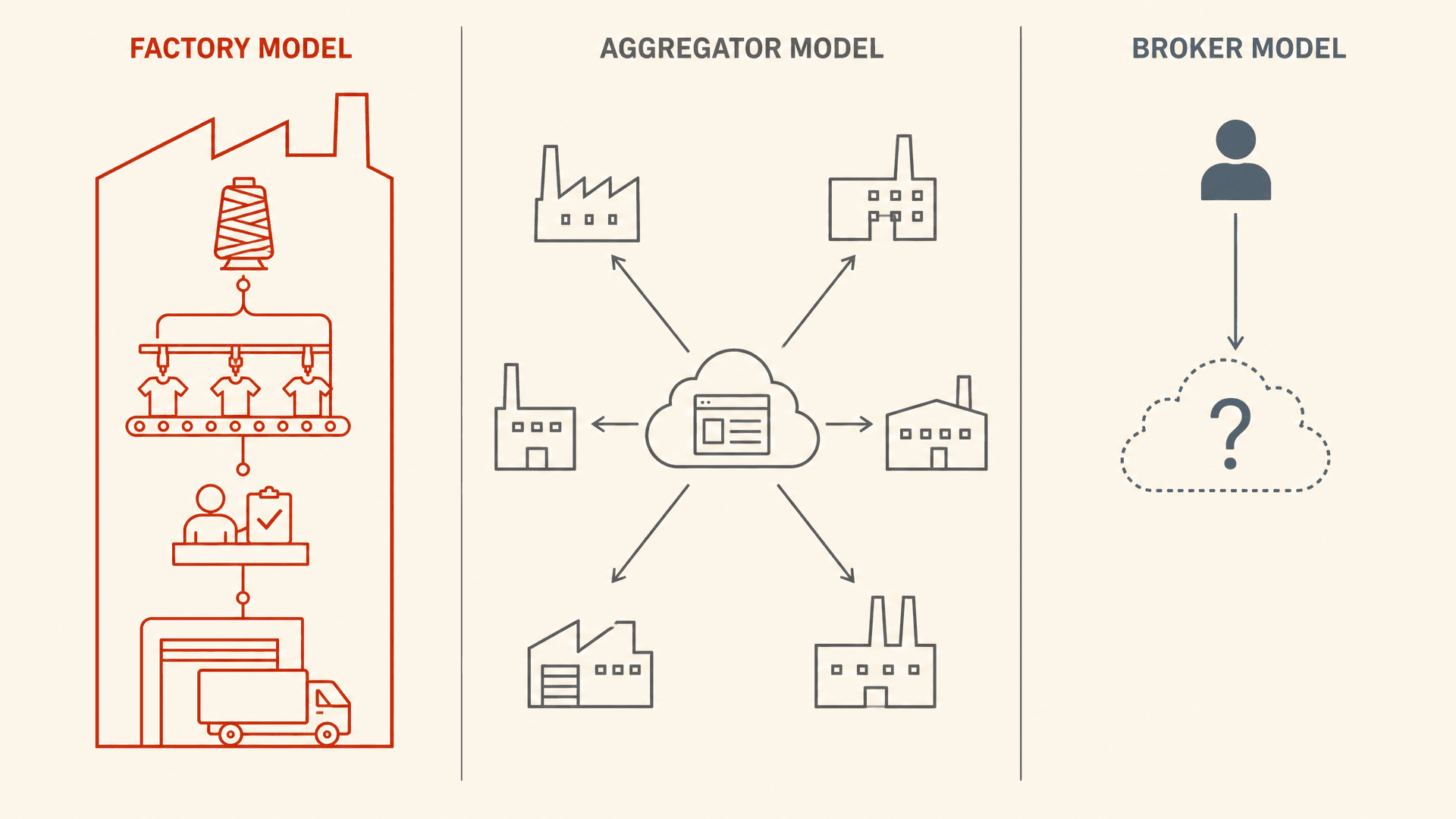
There are three production models in print on demand today:
- The print on demand factory model. One facility owns its production lines yarn-to-shipment. One team, one QC standard, one decoration floor. Quality consistency is structural, not promised.
- The print on demand aggregator model. A software layer routes your orders to one of dozens of third-party print partners depending on geography, capacity, and SKU. Quality is the average of whichever partner got your order that day.
- The print on demand broker model. No production at all. Orders are forwarded to a factory the broker does not own. The broker controls the customer relationship, not the product.
These three models behave radically differently at scale. A vetting framework that treats them as comparable items on the same list will silently steer you toward the wrong one for your stage. The 7+12 Framework below is designed to surface model differences first, feature differences second.
Three print on demand production models side by side
The seven dimensions that separate the three models:
Factory Model
- Production facility: Single owned facility
- QC consistency: Structural · same team every order
- Batch drift risk: Structurally low
- Customization depth: Deep · single floor full visibility
- Lead time (typical production): 2 to 3 days
- Catalog breadth: Narrower · constrained by single facility SKU stock
- Best suited for: Brand-tier operators scaling past 100 units per month
Aggregator Model
- Production facility: Pool of third-party print partners
- QC consistency: Varies by which partner got the order
- Batch drift risk: Structurally high
- Customization depth: Medium · limited to common partner capabilities
- Lead time (typical production): 2 to 5 days
- Catalog breadth: Broader · aggregated partner catalogs
- Best suited for: Founders testing designs at low volume
Broker Model
- Production facility: No production · pure forwarding
- QC consistency: Uncontrolled · depends on downstream factory
- Batch drift risk: Uncontrolled
- Customization depth: Shallow · whatever downstream offers
- Lead time (typical production): Usually slower · added forwarding layer
- Catalog breadth: Variable
- Best suited for: Generally not recommended
This grouping is the meta-framework. The 7 steps below let you confirm which model a specific supplier actually operates, regardless of how they describe themselves on their homepage.
Step 1: Force them to name the production model in one sentence
Ask directly: "Do you own the factory that prints my orders, or do you route them to print partners?"
A print on demand factory answers in one sentence with a location. An aggregator answers with a three-paragraph explanation of their "global production network." A broker dodges entirely.
Follow-up questions that confirm the answer:
- What is the physical address of the facility producing my orders?
- How many SKUs do you stock blanks for in-house?
- Who employs the people running your DTG printers?
You are not looking for a marketing answer. You are looking for an operational one.
Step 2: Test for batch drift before you commit a launch to them
Place small orders across multiple weeks before you commit any launch volume. Compare:
- Stitch quality and consistency on shoulder seams and hems
- Color matching on identical SKUs ordered three weeks apart
- Print sharpness and placement accuracy
- Fabric hand-feel: is it the same fabric, or did the substrate quietly shift?
The print on demand aggregator model cannot, by structure, guarantee batch consistency. Different partners get assigned different orders. Some have older DTG ink batches. Some have looser cutting tolerances. The variance is real, even when each individual unit "passes."
If the supplier requires a $200-to-$300 sample fee before they will let you test, that is a signal in itself. Real print on demand factories do not separate "samples" from "production." Every unit is held to the same standard.
Step 3: Audit their QC stack, not just their final inspection
Most print on demand suppliers describe QC as "we inspect every order before shipping." That sentence covers exactly one checkpoint: pre-pack final inspection.
A real garment factory runs QC at every stage of production:
- Yarn intake quality
- Greige fabric inspection
- Post-dye color verification
- Pre-cut sampling
- 100 percent post-cut inspection
- Mid-sew sampling
- Pre-shipment construction check
- Finished goods intake
- Decoration in-process check
- Final pre-shipment with photo record
That is 10 stages. Most aggregator-routed orders pass through 1. Ask the print on demand supplier for a written QC checklist. If they cannot produce one, they do not run QC. They spot-check.
Step 4: Map the lead time honestly, not the marketing version
Print on demand lead time is the sum of three real numbers:
- Production days (how long until decoration starts)
- Decoration days (DTG is faster than embroidery, which is faster than multi-process hybrid)
- Shipping days (origin to destination)
"5 to 7 business days" usually means 5 to 7 days in one of those buckets, not all three. Ask for each separately. A supplier that conflates them is hiding the real lead time.
Also ask about peak-season behavior. November and December stretch every print on demand lead time by 30 to 60 percent. A supplier without a clear holiday-season SLA will burn your Q4 revenue.
Step 5: Stress-test the decoration ceiling against your peak design needs
Vetting on average designs misses the ceiling. Vet on your most ambitious design:
- Print area maximum. DTG is typically 12 by 16 inches. Jumbo DTG can hit 24 by 24. If your brand strategy involves edge-to-edge or oversized graphics, 12 by 16 caps you.
- Color count for embroidery. Six-color machines are common. Fifteen-color machines are not. If your logo has 8 or more colors, ask before you commit.
- Finish range. Most heat transfer vinyl operations offer matte and gloss only. Reflective, holographic, glitter, and metallic finishes are differentiation. They are either available or they are not.
- Hybrid decoration. Can they combine DTG and embroidery on the same garment? Most aggregators cannot, because the order has to be routed to a single print partner.
If your brand thesis is "look like a retail brand," your decoration ceiling has to match retail decoration. Test the ceiling, not the average.
Step 6: Read the SLA fine print before you sign
A real print on demand SLA contains three numbers:
- The production day commitment (e.g., 3 business days)
- The per-day penalty when they miss (e.g., 1 percent of order value per day late)
- The maximum penalty cap (e.g., 20 percent of order value)
Plus a hard escalation: at some threshold (e.g., 20 or more business days late), the order is free-reshipped or fully refunded with additional compensation.
If the SLA is "we will do our best" with no penalty clause, there is no SLA. There is marketing copy. The difference matters when you have a Black Friday drop scheduled and the supplier ships 11 days late.
Step 7: Validate integration depth, not integration count
"Connects to Shopify" is not a useful claim. Every print on demand supplier connects to Shopify. The questions that matter:
- Is the connection an API or a plugin? APIs are robust. Plugins break on Shopify version updates.
- How does the system handle SKU mismatches? Silent fail, error notification, or manual queue?
- Can it bulk-import a 500-SKU catalog cleanly? Most plugins choke at 100 plus.
- Does it support webhook order routing for custom flows?
- What is the failure mode when their API is down? Lost orders, queued orders, or visible error states?
A print on demand supplier with 25 integrations and shallow depth on each is worse than a supplier with 5 integrations and deep, reliable plumbing on each.
Before you book a sales call, ask the print on demand supplier these three questions over email. If you do not get clear, specific answers in under 24 hours, walk away. You have already failed the 7+12 Framework.
- Where is the physical facility that will produce my orders?
- Show me your SLA. What is the per-day penalty if you ship late?
- How many QC stages exist between blank intake and shipment?
A real print on demand factory answers these in three sentences. A broker writes a paragraph that does not contain the answers.
The 12 print on demand red flags
If any of these appear in the print on demand supplier's website, sales conversation, or SLA, treat them as exit signals. Not every red flag is fatal individually. But two or more in the same supplier means the production model is fundamentally not aligned with brand-tier work.
- They cannot name a production location. "Global network" and "USA plus international partners" are aggregator code. A real print on demand factory will give you a city.
- Lead time is stated as "typically X days" with no SLA backing. Marketing copy without a contract is not a commitment.
- Sample fees over $50 with no production credit. $300 sample fees are common in aggregator print on demand. They exist because the partner routing the sample is not the partner who will route the production order. So the sample does not actually represent what you will receive.
- QC is described as "we inspect every order." That is one checkpoint. Real print on demand factories run 8 to 10.
- Hoodie weight is 240 GSM or labeled "midweight" without a number. 240 GSM is corporate event weight. Retail hoodies are 320 to 450 GSM. If a supplier defaults to 240, their substrate library is built for budget, not brand.
- Maximum DTG print area capped at 12 by 16 inches. This is the aggregator industry ceiling. It locks your designs to chest-pocket placement. If your brand thesis includes oversized prints, this red flag is structural.
- No edge-to-edge or full-bleed print capability. Retail apparel often prints to the seam. If a print on demand supplier cannot, your designs will read as "POD" to anyone with a retail eye.
- The SLA has no late-shipment penalty. This tells you exactly what happens when they are late: nothing. To them.
- Customer reviews mention "second batch looked different" or fabric inconsistency. Batch drift signals from the field are more reliable than the supplier's own marketing.
- Marketing photos are all flat mockups with no production floor footage. A real print on demand factory shows the floor. An aggregator shows mockups because there is no single floor to show.
- "Rush production" is an upcharge on every order, not just expedites. This means standard lead time is so slow they have monetized speed.
- Decoration is DTG-only with no heat transfer vinyl, embroidery, or hybrid capability. DTG-only suppliers are universally available. Anything you launch can be replicated overnight by any of dozens of competitors using the same DTG fleet.
How PODpartner scores on the 7+12 Framework
Most "vetting framework" articles end before they apply the framework to the author's own supplier. We are going to apply it transparently, including where we underperform.
Step 1 (Production model). Single in-house yarn-to-shirt vertically integrated print on demand factory in China. Not an aggregator. Not a broker. The address is real, the floor is photographable, and the people running the DTG fleet are PODpartner employees.
Step 2 (Batch drift). A single facility removes the structural cause of batch drift. Unit 50 and unit 500 come off the same lines, with the same QC team, using the same dye lot tracking.
Step 3 (QC stack). 10 stages, from yarn intake through final pre-shipment with photo record. Documented checklist exists.
Step 4 (Lead time honest map).
- Production: typically 1.7 to 2.8 business days, shown on each product page, with a 3-business-day SLA for orders under $800.
- Shipping (US): 7 to 12 days standard, 3 to 5 days express.
- End-to-end: 10 to 15 days.
This is a relative weakness against US-local aggregators with 5-to-7-day end-to-end. We do not yet operate a US warehouse. We will not pretend otherwise. The tradeoff is that the production half is faster than aggregator print on demand (which typically runs 2 to 5 production days) and the consistency is structurally better. But the shipping half is real distance.
Step 5 (Decoration ceiling).
- Standard DTG: up to 16 by 20 inches.
- Jumbo DTG: 24 by 24 inches.
- Heat transfer vinyl: 6 finishes (matte, gloss, reflective, holographic, glitter, metallic).
- Embroidery: 15-color machines.
- Hybrid: DTG plus embroidery on the same garment supported.
Step 6 (SLA).
- 3 business day production guarantee.
- 1 percent of order value per day late, capped at 20 percent.
- 20 or more business days late: free reship or full refund plus an additional 10 percent compensation.
Step 7 (Integration depth). Shopify, Etsy, WooCommerce, Wix, Squarespace. Five integrations, all native, with webhook routing and bulk SKU import.
Where we honestly underperform. Our catalog is roughly 150 SKUs, which is narrower than aggregator catalogs. We do not offer custom cut-and-sew construction. We do not yet operate a US warehouse. End-to-end lead time is the slowest leg of the framework for US customers. These are real tradeoffs, not marketing weaknesses we are hiding.
When the 7+12 Framework does not apply
This framework is built for brand operators. Founders treating apparel as a real retail business, where quality consistency at scale determines whether reorders happen.
If you are running:
- A single-design test where any supplier's "good enough" is fine
- A souvenir or personalized-gift business where the design is the value, not the garment
- Below 100 units per year across your entire catalog
- A market where same-week US delivery is non-negotiable
You may not need the 7+12 Framework. An aggregator with a deep catalog, shallow QC, and 5-day US shipping will probably serve you better than a real factory with overseas shipping.
The framework starts mattering when your brand reputation depends on the 500th customer receiving the same product the 50th customer received. That is the inflection point.
Print on demand supplier vetting FAQ
1. What is the difference between a print on demand factory and a print on demand aggregator?
A print on demand factory owns its production facility, employs its production team, and runs its own QC. A print on demand aggregator is a software layer that routes orders to third-party print partners. Aggregators offer broader catalogs and faster regional shipping. Factories offer structural quality consistency and deeper customization. Vetting on this distinction first is more important than vetting on features.
2. Is Printful a print on demand factory or an aggregator?
Printful operates production facilities in multiple US, EU, and global locations and routes orders to whichever facility is closest to the destination. By production model, this places Printful between the pure aggregator model (no owned production) and the single-facility factory model. The implication for brand consistency: a unit produced in a North Carolina facility may differ slightly from one produced in a California or European facility, even when the SKU is identical. This is a structural feature of multi-facility routing, not a quality failure.
3. What is the difference between Printful and Printify?
Printful owns and operates its production facilities. Printify operates as a pure aggregator: it does not own production at all, and instead routes orders to a network of third-party print providers. For brand consistency: Printful gives you facility-level variance (which Printful facility produced the unit). Printify gives you print-provider-level variance (which third-party partner produced the unit), which is structurally higher. Neither matches the consistency of a single-facility print on demand factory model.
4. How long should print on demand supplier vetting take?
For a brand operator, 2 to 3 weeks is reasonable. That includes initial vetting calls, sample orders, batch comparison across at least two weeks of orders, and SLA review. Vetting in under a week usually means you skipped the batch-drift test, which is the most important test.
5. Are sample fees ever justified?
For one-of-a-kind cut-and-sew or complex multi-process garments, yes. Those are real engineering costs. For standard blanks with DTG or heat transfer vinyl decoration, $300 sample fees are inherited from the aggregator model, where the partner routing samples may not be the partner producing your bulk order. If a supplier charges high sample fees but will not credit them toward production, that is the aggregator economics showing through.
6. What is the average print on demand industry lead time?
Production time across the print on demand industry varies by production model. In-house factories typically run 2 to 3 business days; aggregators typically run 2 to 5 business days because orders must be routed to an appropriate print partner, which adds a layer of waiting time. Shipping time depends entirely on origin and destination: US-local aggregators can deliver in 3 to 5 days; overseas factories typically deliver in 7 to 15 days. Anything claiming "1 to 2 day end-to-end" is either US-local aggregator routing with narrower decoration capability and lower QC depth, or marketing language disguising one of the three lead time components.
7. What GSM is considered "retail quality" for hoodies?
Retail-quality hoodies typically run 320 to 450 GSM. 240 GSM is corporate-event weight, suitable for budget promotional items but visibly thinner and lighter than what mainstream retail brands ship. If a print on demand supplier defaults to 240 GSM hoodies without offering heavier options, their substrate library is built for budget, not brand. The Fabric Ceiling (one of the 5 Ceilings of aggregator print on demand) is the structural reason most aggregators stock lighter weights: heavier substrates compress the unit economics that make aggregator pricing work.
8. What is a reasonable print on demand lead time?
Production: in-house factories run 2 to 3 business days; aggregators typically run 2 to 5 business days. Shipping depends on origin and destination. End-to-end of 7 to 15 days is typical. Anything claiming "1 to 2 day end-to-end" is either US-local aggregator routing (narrower decoration capability, lower QC) or marketing.
9. How important is integration count versus integration depth?
Depth matters more once you are past 50 SKUs. A native Shopify connection that handles bulk catalog updates and routes errors visibly is worth more than 15 plugin-level connections that each have edge-case failures. Ask about webhook reliability and bulk import behavior before signing up.
10. Should I avoid print on demand suppliers without US warehouses?
Not necessarily. But be honest about what you are trading. US warehouses give you 3 to 5 day domestic shipping. Overseas factories give you structural quality consistency with a single facility and single QC standard, but longer shipping. Match the choice to your customer's tolerance for shipping time versus quality variance.
11. What is the most overlooked print on demand red flag?
The SLA penalty clause. Founders read marketing copy and skip the contract. A print on demand supplier without a written per-day late-shipment penalty has not committed to anything operationally. The penalty clause is the difference between a promise and a guarantee.
12. Does PODpartner pass its own 7+12 Framework?
Yes on Steps 1, 2, 3, 5, 6, and 7. Step 4 is a partial pass: production is fast at 2 to 3 days, shipping is the weak leg at 10 to 15 days end-to-end. The framework is genuinely intended to expose model risk, not to set up a sales pitch with a foregone conclusion.
Use the 7+12 Framework today · Copy-paste checklist
Save this checklist. Run it for every print on demand supplier you evaluate.
Before any sales call · The 30-Second Sniff Test
- ☐ Q1 · Where is the physical facility that will produce my orders?
- ☐ Q2 · Show me your SLA. What is the per-day late-shipment penalty?
- ☐ Q3 · How many QC stages exist between blank intake and shipment?
If you do not get clear answers within 24 hours by email, walk away.
During evaluation · 2 to 3 weeks
- ☐ Step 1 · Production model named in one sentence with a location
- ☐ Step 2 · Multi-week sample orders placed and compared for batch drift
- ☐ Step 3 · Written QC checklist obtained from supplier
- ☐ Step 4 · Production days, decoration days, and shipping days mapped separately
- ☐ Step 5 · Maximum design ambition tested against decoration ceiling
- ☐ Step 6 · SLA contains 3 numbers: commitment, per-day penalty, maximum cap
- ☐ Step 7 · Integration depth verified (API vs plugin, error handling, bulk SKU import)
Before signing · Final red flag scan
Count red flags from the 12-flag list. Threshold:
- 0 red flags · Strong candidate. Verify references.
- 1 red flag · Acceptable if non-structural. Confirm in writing.
- 2 or more red flags · The production model is not aligned. Keep looking.
Before committing launch volume · Three references
- ☐ Reference 1 · Another brand at your unit scale, contacted directly
- ☐ Reference 2 · Confirmation of SLA enforcement (have they ever paid a late penalty?)
- ☐ Reference 3 · Visual confirmation of production facility (video tour, recent photos, or in-person visit)
If a supplier resists any of the three references, that is a 13th red flag.
The bottom line
Most print on demand suppliers will pass 3 or 4 steps of the 7+12 Framework. Very few pass all 7. The ones that do are usually small factories that do not market themselves loudly enough to be on the first listicle you found.
If you are vetting now: run the 30-Second Sniff Test first, then work through Steps 1 through 7 in order. If a supplier fails Steps 1, 2, or 3, the rest of the framework does not matter. The production model is wrong for brand-tier work.
If you have completed the framework and want to compare a real print on demand factory's answers side-by-side:
- Browse the PODpartner product catalog to see how a vertically integrated factory operates
- Compare PODpartner against Printful directly with our side-by-side comparison
The framework is the test. Whoever passes is your supplier.