
 USD
USD
Direct-to-Consumer VS Marketplace in Print-on-Demand

Print-on-Demand has revolutionized e-commerce, offering a powerful way for creators and merchants to sell customized products without holding inventory. In this model, products are printed only after an order is placed, and businesses can reach customers through two main approaches: building a Direct-to-Consumer brand or selling through an online Marketplace. This article explores the key decision for creators and merchants in the POD model: building a standalone DTC brand website or joining an established Marketplace. Understanding this difference is crucial for setting the right foundation for your business.
Part 1. Direct-to-Consumer & Marketplace
Understanding the core difference between these two paths begins with defining what each model actually means in the context of Print-on-Demand.
Detailed introduction to the Direct-to-Consumer(DTC) in POD Business
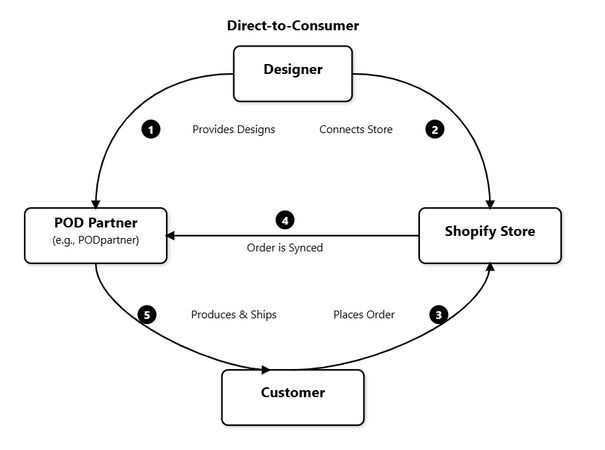
The Direct-to-Consumer model involves building your own branded online store, typically through platforms like Shopify, Etsy, WooCommerce, or BigCommerce, and connecting it with a POD supplier such as Printful or PODpartner. You design and customize your store to shape the entire shopping experience, upload your designs through the fulfillment app, and link them to your POD products. From there, you drive traffic through marketing channels like social media, ads, SEO, or email campaigns to reach customers directly.
What makes this model especially powerful is that you can build your own brand. From product designs to packaging. Take PODpartner for example: it provides customized made-to-order labels, hangtags and packaging that make the unboxing experience uniquely yours. In this case, you act as both the brand owner and retailer, maintaining full control over pricing, customer relationships, and overall brand image.
Detailed introduction to the Marketplace in POD Business
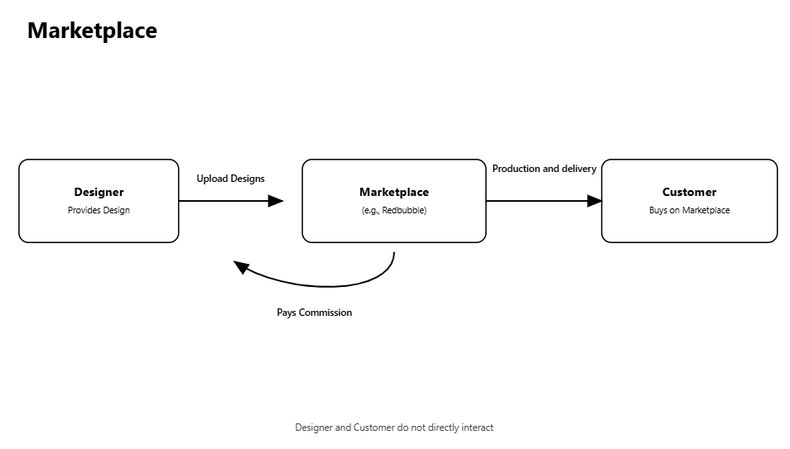
A Marketplace is a large, established platform where many independent sellers or designers list their products for sale to an existing audience, essentially a digital version of a department store.
Examples include Redbubble, TeePublic, Zazzle, and Amazon Merch on Demand. These platforms provide ready-made infrastructure which covering everything from website hosting, payment processing, and order tracking to customer support and production logistics. You don't need to build your own website or handle fulfillment; instead, you simply upload your artwork, choose product types, like t-shirts, mugs, phone cases, etc, and publish your listings.
Once a buyer places an order, the Marketplace's integrated Print-on-Demand system automatically prints, packs, and ships the product on your behalf. Your role mainly revolves around design creation, keyword optimization, and product presentation to increase visibility within the platform's search system.
However, the convenience of Marketplaces comes with trade-offs: you're operating under the Marketplace's brand identity, not your own. Your product design will highlight your design characteristics, but you can't have your own independent brand.
Part 2. Application of Direct-to-Consumer & Marketplace
For The Long-Term Brand Builder
The Direct-to-Consumer model is the ideal choice for those looking to scale their business, build an independent brand.
DTC is far more than just a sales channel. It's a dedicated brand-building strategy, by owning the entire customer journey: from initial exposure and first purchase to ongoing service and support. You can create a distinct and truly memorable brand experience. This unparalleled level of control allows you to ensure message consistency, product quality, and service excellence, which ultimately fosters deep customer loyalty, drives repeat purchases, and results in a valuable brand asset that belongs entirely to you.
Are you seeking maximum profits and long-term, sustainable growth? Choose the Direct-to-Consumer model.
The strategic decision to adopt DTC involves a deliberate trade-off. It demands a higher upfront investment and more time to overcome the learning curve for developing your own online business, and managing marketing. However, this investment directly translates into higher profits in the long run, as you keep the majority of the revenue that would otherwise go to Marketplaces. More critically, you gain valuable brand equity and a proprietary database of customer information. Fundamentally, selecting the DTC model is an investment in the future and a strategic move toward building an enterprise with genuine, defensible value.
For The Low-Risk, High-Traffic Starter
The overall value of the POD Marketplace lies in its accessibility, scale, and shared ecosystem that benefits both creators and consumers. For designers, it opens the door to an existing global audience without the need to build a brand or manage logistics. For consumers, it offers an endless variety of creative products in one place, where each piece reflecting the individuality of its creator.
For designers, a Marketplace serves as a low-risk testing ground, ideal for experimenting with new ideas and validating which designs truly connect with an audience. You can upload multiple artworks, test different niches, and analyze real-time performance without investing in your own website or marketing campaigns. This makes it a practical environment to gather market trend insights, as platform analytics and high-volume sales data reveal what styles, themes, or product types are gaining traction—helping you refine your creative direction. However, this convenience comes with a trade-off: you don't own your brand identity or customer data, as all transactions and interactions happen under the platform's ecosystem. And you need to constantly optimize keywords and product listings to maintain visibility, which can add hidden costs in terms of time and effort.
The low barriers to entry of Marketplaces makes them especially appealing to beginners. There's virtually no upfront investment. You simply create an account, upload your designs, and let the platform handle production, fulfillment, and customer service. If you're seeking the lowest barriers to entry and a quick path to launch, the Marketplace model is the right fit. It trades minimal startup costs for lower profit margins, since you earn commissions or royalties per sale. Still, it stands as the ultimate proof-of-concept model to test, learn, and grow before committing to a full-scale brand of your own.
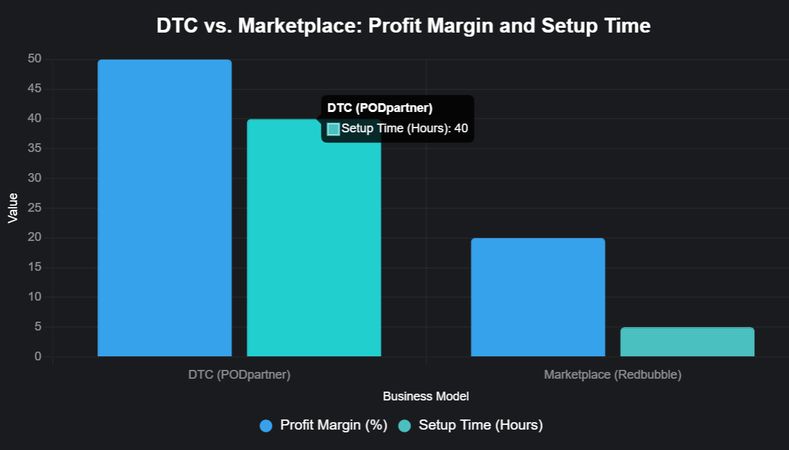
The values are average values
Part 3. Representative Platforms in POD Business
Their shared place: Both the Direct-to-Consumer and Marketplace models, while distinct e-commerce routes, are fundamentally unified by the POD framework. At their core, success in both depends on high-quality, trend-driven design; the artwork itself is the primary product. Crucially, both operate on a true inventory-free system, eliminating financial risk by producing items only after a purchase is made. In each case, a POD supplier handles the entire process: printing, packaging, and shipping—allowing creators to focus entirely on design and marketing. Since the core asset is digital, both models offer infinite scalability across various products.
To clearly illustrate these concepts, let's compare the practical application of a DTC model using PODpartner against a Marketplace model represented by Redbubble.
The Direct-to-Consumer Approach (PODpartner):
The DTC model, facilitated by a POD supplier like PODpartner, is akin to opening your own branded boutique.
If you want to build your own unique clothing brand, you need to find a reliable POD supplier who can consistently provide high-quality, uniquely styled garments, and whose design flexibility supports creating your own brand characteristics. For example, PODpartner supports 18 design areas and combines DTG printing with embroidery technology. All these features help you leverage your unique designs to build a distinctive brand of your own.
While a marketplace, like Redbubble, its most apparel designs are limited to the front, with other printable areas (like the back or sleeves) depending on the specific product template. In this case, if you're building a special appeal brand, DTC model will be your ideal choice.
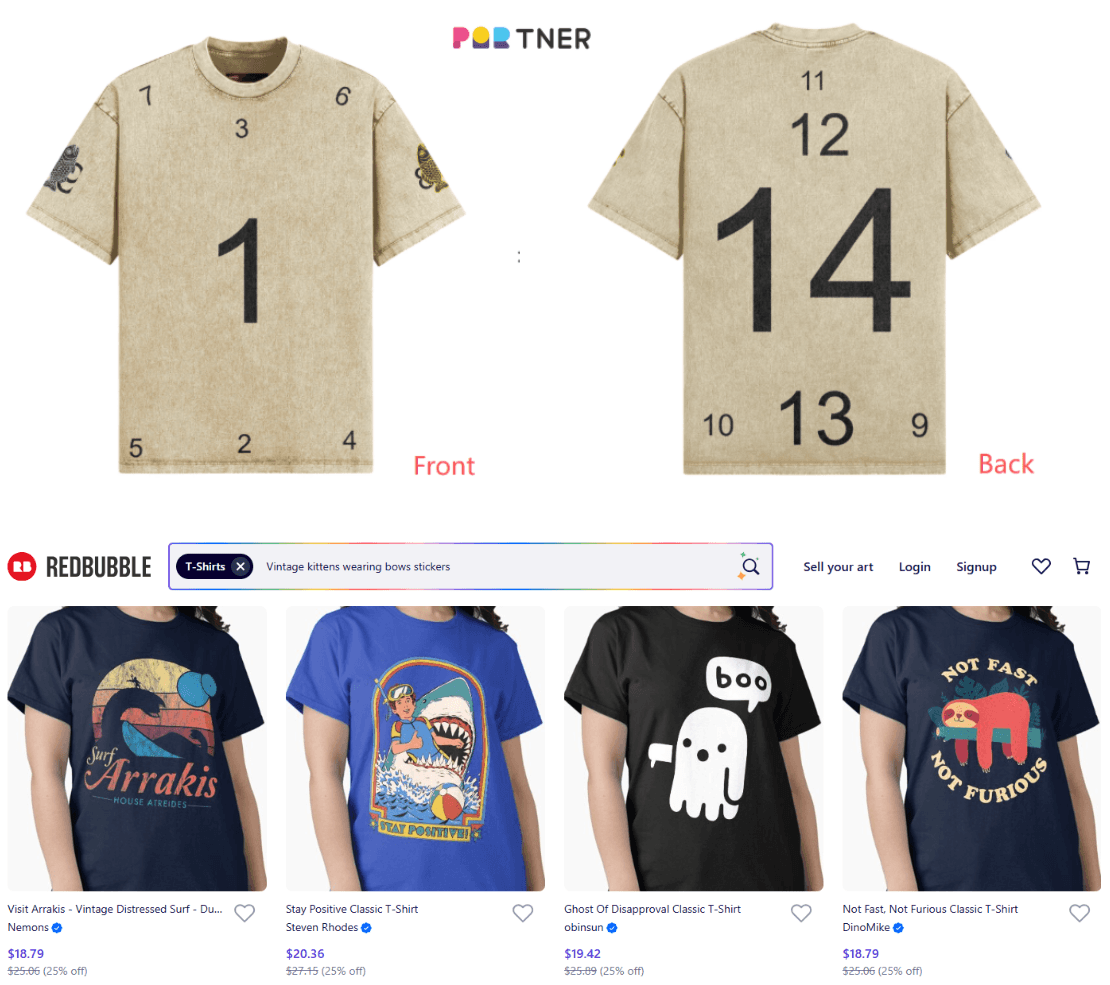
You're not just selling products, you're your own brand manager, designing your store to reflect your brand's style and strengthen brand impact, choosing packaging styles and writing product descriptions, every detail reflects your brand's identity. It requires more upfront effort: before cooperating with the POD supplier, you need to buy samples to confirm their quality, then you should upload your design on POD platform and sync products to your online store.
Besides, if you're building your own brand, you'd better design your branded label, hangtags and packaging. PODpartner offers customize made-to-order label, hangtags and packaging, which can enhance your brand identity, elevate the unboxing experience for customers, and foster greater brand loyalty. More importantly, this made-to-order branding services, can contribute to cost savings through streamlined branding efforts.
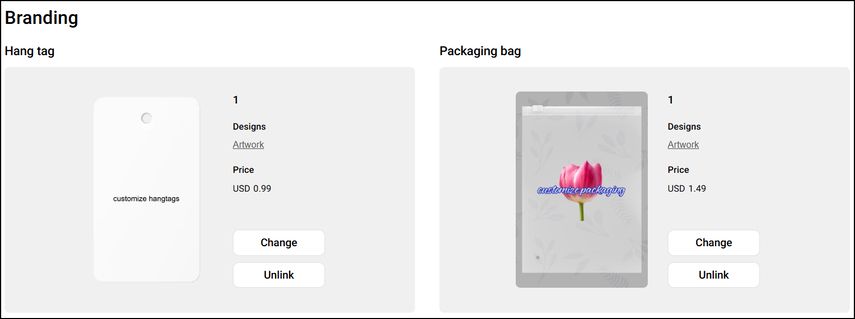
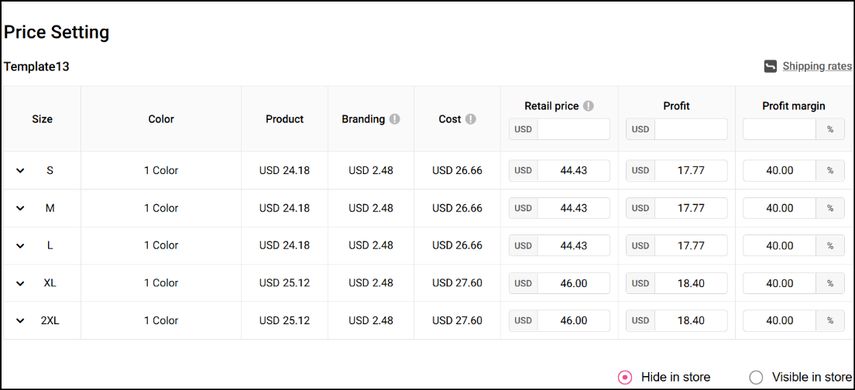
Moreover, since you run your own brand, you can set up your product profit margin. Different POD products have varying profit margins. According to industry reports, the average profit margin for DTC brands ranges from 40% to 60%(according to feedback from most Reddit users, apparel products can reach profit margins of around 30%, while home decor items can go up to about 44%.) Of course, great design isn't limited by product type and brand premium is also key to increasing profit margins.
After syncing the products to your store, when customers make an order, PODpartner will take care of production and dropshipping. With access to user data, you can take full control of your store's marketing activities — from setting prices and profit margins to creating discounts and promotions, collecting customer insights, and running email or retargeting campaigns. However, you need to make more efforts: you should promote your store. You need to invest time and money in digital marketing — running Google or Facebook Ads, managing social media, collaborating with influencers or KOLs, and handling customer service. These efforts can be demanding at first, but they're what truly set a brand apart from a simple store.
Price setting from PODpartner dashboard
The Marketplace Approach (Redbubble):
Think of Redbubble as a lively global marketplace where artists can open their own virtual stall. With 7 million monthly organic search visits (data from SEMrush, 2025), it's an easy way to showcase designs to a massive, diverse audience. Uploading takes minutes, there are no upfront costs, and Redbubble handles everything from production to shipping and payments—perfect for testing designs, following trends, or experimenting without risk.
Its huge catalog lets creators apply one design across dozens of products, while the dashboard and built-in promos simplify management and visibility. The marketplace itself brings steady traffic and visitors, so all you need to focus on is optimizing your product SEO keywords and creating distinctive, eye-catching designs. Artists can also target niche fandoms and communities that thrive on the platform.
The trade-off? Lower profit margins (around 10–30%), no control over branding or packaging, and limited access to customer data. Visibility depends heavily on Redbubble's algorithms, and competition is fierce.
If your design is unique, you can also be top artists
According to industry reports, the average profit margin for DTC brands ranges from 40% to 60%, while Marketplace platforms typically take a 10%–30% commission. That means: if your T-shirt sells for $30, a DTC model might bring in around $12 in profit, whereas on Redbubble, you might only earn about $3 in royalties. If you have the budget and time to invest in building a brand, DTC is the better long-term choice. But if you're running a side hustle or just starting out, selling on a marketplace can be a more practical and low-risk entry point.
Different platforms and products have varying commission structures, the figures shown here represent average values.
Whether you choose DTC or Marketplace, selecting a reliable POD supplier (such as PODpartner) is crucial for ensuring product quality and customer satisfaction.
| Feature | PODpartner (DTC Model Example) | Redbubble (Marketplace Model Example) |
|---|---|---|
| Ideal For | Brand building, high profits, and achieving sustainable growth. | Niches testing, validating designs, low-risk side hustle, passive income. |
| Business Analogy | Opening your own branded boutique store. | Setting up a street vendor stall in a busy bazaar. |
| Barriers to Entry | Higher: Requires store setup and promotion. | Very Low: Only upload designs. |
| Traffic Source | Must be self-generated (SEO, social media, paid ads). | Built-in platform audience. |
| Profit Margin | 40%-60% Seller retains full profit after base costs. |
10%–30% Royalties/Commission/Take rate. |
| Branding Control | Full Control: Custom labels, hangtags, packaging, and product quality. | Minimal/None: Products ship in platform packaging. |
| Customer Data | Fully owned by the seller for remarketing and loyalty programs. | Not owned by the seller; limited access. |
Part 4. Which One is Better
There's no direct comparison between direct-to-consumer and Marketplace models; they represent distinct e-commerce models with different goals. The correct question should be, "Which model should I use to sell my designs now and for the future?"
While Marketplace models (like Redbubble and TeePublic) offer traffic advantages and a low barrier to entry, making them suitable for beginners to quickly get started or as a side hustle, direct-to-consumer(like PODpartner) offers significant advantages in building a brand, retaining customers, and growing a business in the long run.
If you are looking to build a long-term, valuable brand and control your financial destiny rather than relying solely on Marketplace sales, establishing a Direct-to-Consumer store is the ideal choice. If you're don't want to spend too much time on maintenance business, Marketplace is the ideal option.
You can also start with a Marketplace and then transition to a DTC store once you've validated your niche and designs, or, choose to use Marketplaces to test designs while building their brand through DTC, balancing short-term gains with long-term growth.
Further reading

No Order Minimums

No Membership Fees

No Unsold Stock

No Quality Concerns
Only Creativity, Satisfaction, and Profits!