
 USD
USD
Vertically Integrated Print On Demand: Why This Category Exists

Print-on-demand was built to solve one problem: let anyone sell apparel without holding inventory. It solved that problem well. It never solved the next one — what happens when the anyone becomes a brand.
That's the gap a new category is built to close: Vertically Integrated Print-on-Demand. Not a feature. Not a marketing label bolted onto the same supply chain everyone else runs. A different manufacturing architecture, built from the yarn up. PODpartner builds in this category — and this post explains what that actually requires.
In the following sections, this article will unfold three important mindsets: (a) what "vertically integrated" actually means in a practical manner, (b) how it differs structurally from the aggregator model most of the industry runs on, and (c) why brand-tier apparel — the kind sold at $30–120 retail, the kind a customer has to believe in before they'll wear it in public — depends on it.
1. What "Vertically Integrated Apparel Supply Chain" Actually Means
Vertical integration is a manufacturing term before it's a marketing one. It means a single company owns and operates the sequential stages of production, rather than subcontracting each stage to a different, disconnected party.
In apparel, that chain runs from raw fiber to finished, decorated garment: yarn sourcing, fabric formation, cutting, sewing, decoration (print, embroidery, or both), quality control, and fulfillment. PODpartner operates the majority of these stages in-house — yarn through fabric, cut, sew, decoration, and QC — under one standard and one chain of accountability.
The alternative — and the model most of print-on-demand runs on — is an aggregator. An aggregator doesn't manufacture. It routes. A brand's order gets sent to whichever blank-garment supplier and whichever decoration shop happen to be in the network for that SKU, in that region, on that day. Different fabric mills. Different decorators. Different QC standards, if any exist at all. The aggregator's job is matching, not making.
Neither model is inherently wrong. They're built for different things. Aggregation is built for catalog breadth and geographic reach. Vertical integration is built for consistency, craft, and control — the three things a brand-builder actually needs when a customer is deciding whether their $65 hoodie feels like a $65 hoodie.
That's the category this post is naming: Vertically Integrated Print-on-Demand — an on-demand manufacturing infrastructure designed from scratch. The distinction is architectural, not a deeper tech stack layered on top of the same old factory floor.
2. Vertically Integrated vs. Aggregator POD — The Structural Difference
Here's the comparison stripped down to what actually changes between the two models.
| Aggregator POD | Vertically Integrated POD | |
|---|---|---|
| Ownership | Routes orders across a network of third-party blank suppliers and decorators | Owns the production stages directly |
| Fabric source | Varies by which supplier fulfills the order | Controlled and consistent across runs |
| Decoration | Typically outsourced to separate print/embroidery partners; often one technique per order | Multi-technique in one pass — DTG, Heat Transfer Vinyl, and embroidery auto-sequenced in a single production run |
| QC standard | Set (or not set) by whichever third party touched the order | Set once, applied at every stage, by the manufacturer |
| Batch consistency | Can vary order to order, since the fulfilling party can change | Designed to hold across runs — same fabric, same decoration parameters, same result at unit 1 and unit 100 |
| Data ownership | Fragmented across the network the order passed through | Full-stack — one system, one record, from order to shipment |
| Accountability for delay | Diffused across whichever party in the chain caused it | Direct — automatic compensation (1% per day delayed, capped at 20%) |
The technical difference that matters most for a brand-builder is the decoration line. Most POD platforms force a choose-one: print or embroidery, because the order is routed to whichever partner handles that single technique. A vertically integrated line doesn't have that constraint, because it isn't routing — it's producing. Multi-technique in a single pass (DTG, Heat Transfer Vinyl, and embroidery, auto-sequenced) is available as a $2.99 switch, not a separate order, a separate vendor, or a separate wait.
The other difference is less visible but shows up in the customer's hands: batch drift. When fabric sourcing and decoration shift with whichever third party fulfilled a given order, unit 47 in a drop can differ from unit 3 — slightly different shade, slightly different hand-feel, slightly different print registration. A vertically integrated line holds the same fabric and the same process across a run of 100+ units, because it's the same facility doing the same thing every time, not a different subcontractor per order.
3. The Seven Stages — Yarn to Shipment
This is what "vertically integrated" looks like as an actual production line, not a diagram. Seven stages, one continuous chain of custody.
① Yarn — The raw fiber stage. Fiber selection determines weight, hand-feel, and wash durability.
② Fabric — Dyed and finished; GSM is set here. PODpartner's standard runs at 440 GSM heavyweight, against an industry range of roughly 280–320 GSM. That's the difference between a shirt that drapes like a premium hoodie and one that drapes like a promotional giveaway.
③ Cut — ④ Sew
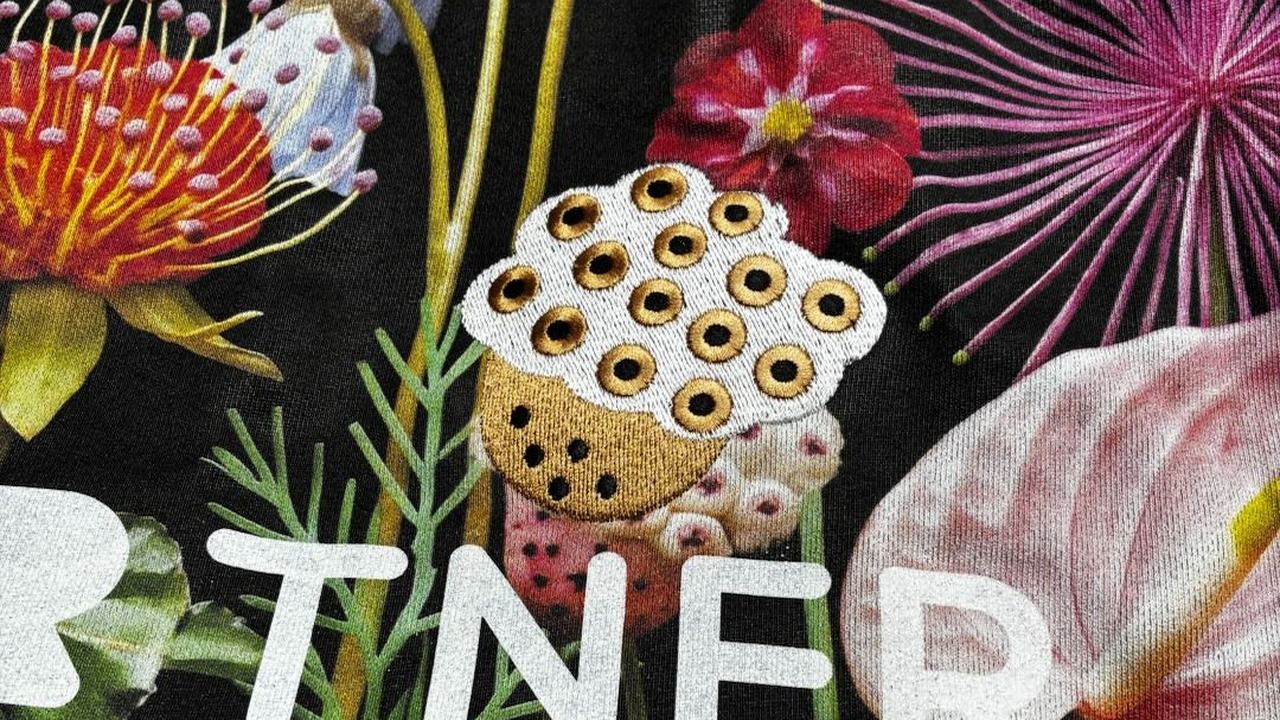
⑤ Decoration — Print, embroidery, or both, applied in a single production pass. This is where multi-technique lives, along with jumbo print (up to 24×24 inches), and the just-launched 3D (puff) embroidery, which raises the thread above the fabric surface for a dimensional finish standard flat embroidery can't produce.
⑥ QC — ⑦ Shipping
Seven stages. One chain of custody. No handoff between stage four and stage five that introduces a different fabric mill's tolerances or a different decorator's calibration.
4. What Changes When the Chain Doesn't Break
In an aggregator model, quality is the average of whichever suppliers happened to fulfill an order.
That average can be good. It can also be inconsistent — not because any single supplier is bad, but
because the system isn't designed to hold a standard across suppliers it doesn't own. A brand-builder
running a drop of 150 units has no way to guarantee unit 1 and unit 150 came off the same fabric
roll, through the same decorator, checked against the same standard. In many aggregator setups,
they didn't.
In a vertically integrated model, quality is a specification, not an average. 440 GSM is either the
fabric weight or it isn't — there's no "usually," because there's no second supplier who might
substitute a lighter roll when their preferred stock runs low. No shrink and no fade aren't slogans;
they're outcomes of controlling the fabric-to-decoration handoff internally instead of trusting it
across a company boundary.
This is also where instant pricing in the design tool becomes more than a UX convenience.
Aggregator pricing often has to account for which partner in the network will fulfill a given order
— a variable the platform itself doesn't fully control. Full-stack ownership of the pipeline means the
manufacturer knows its own costs at every stage, which is what makes instant, stable pricing
possible instead of a quote that shifts based on network routing.
None of this is a claim that aggregator POD is a broken model. It's a claim that it's a different
model, optimized for breadth over consistency. Brand-builders competing on craft need the other
optimization.
5. Why Brand-Tier Apparel Needs This, Specifically
A brand at $30–120 retail is not selling a garment. It's selling a claim — that this is a real brand, not
a reseller. Three things carry that claim, and all three depend on vertical integration.
Value transfer. A customer paying $65 for a hoodie is transferring trust, not just money. That trust
has to land on something real: weight in the hand, a print that doesn't crack after wash three, an
embroidery edge that doesn't fray. Every one of those is a manufacturing outcome, not a marketing
outcome. If the supply chain can't hold the spec, the brand can't hold the price.
Manufacturing craft. Multi-technique decoration and 3D puff embroidery aren't features for their
own sake — they're what let a brand-builder put a design on the garment the way it was actually
designed, instead of simplifying it to whatever single technique the routing network happens to
support that week. Jumbo print (up to 24×24 inches) exists for the same reason: a design shouldn't
have to shrink to fit the supplier's constraint.
Product quality, held at scale. The hardest part of running a brand isn't making one great shirt. It's
making the hundredth one identical to the first, on a drop the brand can't afford to have inconsistent.
No batch drift over 100+ units isn't a nice-to-have for a test drop or a key seasonal release — it's the
entire requirement.
This is also where the category applies beyond craft-forward drops. A merchant who just wants
merch printed — a fitness studio ordering team gear, a band ordering tour shirts — still benefits
from the same fabric consistency and QC standard as a full apparel line. Vertical integration isn't a
premium tier bolted onto a cheaper base process. It's the same manufacturing standard, applied to
every order that runs through it.
6. Ten-Stage Quality Control
Quality control in a vertically integrated line isn't a single inspection at the end. It's checkpoints
distributed across the production chain, because a defect caught at fabric intake is cheaper to fix
than one caught after decoration — and a defect never caught at all is the one that reaches a
customer.
Roughly, the ten checkpoints run across the pipeline as follows:
- Yarn intake — color-fiber ratio, evenness, and fiber length checked before fabric formation
- Greige fabric — weaving/knit defects and GSM verified.
- Post-dye — color matched to reference; dye defects checked.
- Pre-cut spot check — fabric surface sampled before the cutting table.
- Post-cut — 100% of cut panels inspected.
- In-sewing spot check — stitching, sizing, workmanship, symmetry.
- Garment-factory pre-shipment — full inspection before the blank leaves the line.
- Finished-garment intake — full inspection on warehousing.
- In-decoration — style and color confirmed; print registration, ink color, embroidery thread, and
HTV verified. - Final pre-shipment — whole-garment full inspection, with a photo record kept.
The point of a ten-stage structure isn't the number — it's that no single stage is trusted to catch
everything, and no stage happens outside the manufacturer's own walls.
7. Where This Stands Today — and What's Still Ahead
What's operating now: the seven-stage vertically integrated pipeline described above, multi-
technique decoration in a single pass, 3D puff embroidery, 440 GSM heavyweight fabric as
standard, jumbo print up to 24×24, instant pricing inside the design tool, full-stack data ownership,
and automatic delay compensation on production timelines.
What's not open yet: two capabilities that are natural extensions of a vertically integrated model,
but aren't available to merchants today.
• Fabric-spec customization. Choosing your own fabric composition or weight outside the
current standard isn't available yet. The 440 GSM standard is fixed, not configurable, at this
stage.
• Zero-MOQ fabric-level customization. True zero-minimum-order-quantity production at
the fabric-spec level — as opposed to zero-MOQ at the standard-catalog level, which
already exists in the on-demand model — is not yet live.
Vertical integration is what makes both of these possible to build toward — you can't offer fabric-
spec customization on a network you don't own the fabric stage of. It's also why they're not rushed.
Opening a capability before the underlying manufacturing can hold the standard is the same failure
mode as the aggregator model this category exists to move past.
8. Where to Go From Here
Vertically Integrated Print-on-Demand isn't a claim about being bigger or newer. It's a claim about
owning the chain of custody from yarn to shipment, and being able to say exactly where a garment's
quality comes from — because every stage that built it is accountable to the same standard.
If you're evaluating suppliers for a craft-intensive drop, a key seasonal release, or a test run you
can't afford to have come back inconsistent, this is the distinction to run your due diligence against:
does the manufacturer own the chain, or route around it.
9. FAQ
What does "vertically integrated" mean in print-on-demand?
It means one company operates the majority of the production chain in-house — yarn, fabric, cut, sew, decoration, and QC —instead of routing an order through separate, disconnected suppliers the way an aggregator model does.
How is this different from a regular POD platform?
A regular POD platform matches an order to whichever supplier can fulfill it. It doesn't manufacture. A vertically integrated line produces the garment itself, end to end, so fabric weight, decoration technique, and QC standard stay consistent across every order rather than varying by which supplier picked it up.
Does vertical integration mean faster shipping?
Not by itself — this post is about manufacturing architecture and quality control, not delivery timelines. What vertical integration changes is consistency and capability: the same fabric spec and QC standard on unit 1 and unit 100, and decoration options (like multi-technique in a single pass) that a routed, multi-vendor model can't offer as a single order.
Can I mix print and embroidery on one garment?
Yes. Multi-technique decoration (DTG, HTV, and embroidery, auto-sequenced in a single pass) is available as a $2.99 add-on rather than a separate order or vendor.
How many print area are available?
21+ print areas, with jumbo print sizing up to 24×24 inches.
Is fabric customization available?
Not yet — fabric-spec customization and fabric-level zero-MOQ are both roadmap items, not live capabilities. Standard-catalog zero-MOQ (ordering a single unit from the existing fabric options) is already available.
Who is vertical integration for — only premium/craft brands?
No. The same fabric consistency and QC standard apply to every order, whether it's a craft-intensive apparel drop or a straightforward merch run for a team or event. Read the full model breakdown — or see what this looks like on a finished garment: explore PODpartner's heavyweight line and decoration capabilities.