
 USD
USD
Bella+Canvas Alternatives for Print on Demand: When Aggregator POD Caps Your Brand

The moment you stop being satisfied with Bella+Canvas isn't a price moment. It's an identity moment.
You've sold a few hundred units. The reviews are positive. But the photos coming back from customers don't quite match what's on your moodboard. The fabric reads "fine," not "premium." The fit is correct, but it's the same correct as twelve other brands in your category. And when someone asks what makes your hoodie different, you find yourself talking about the artwork, not the product.
That's the Bella+Canvas ceiling. It isn't a quality problem. Bella makes excellent blanks. It's a positioning problem. The aggregator POD model that distributes Bella+Canvas (Printful, Printify, and similar platforms) is built around the lowest common denominator of brand needs, not around the founder building real product depth.
This article isn't a list of "blanks like Bella but cheaper." That misses what serious brand founders are actually searching for. It's a framework for understanding why founders outgrow aggregator POD, what the real alternatives look like, and when staying on Bella+Canvas via an aggregator is still the right call.
Why Founders Search "Bella+Canvas Alternatives"
Most "alternative" listicles assume the search is about price. It almost never is, at least not for founders past their first few hundred units sold.
When brand founders run this query, three real frustrations consistently surface, and price is rarely top of the list.
The aggregator stack adds delay you didn't sign up for
Your customer orders. The aggregator routes the order to a fulfillment partner. The fulfillment partner queues your job behind hundreds of others. Two days pass before anyone touches your garment. Then printing, then drying, then QC, then shipping handoff. By the time it leaves the door, four to seven days have gone by.
Customers don't see "the aggregator routing layer." They see "your brand was slow."
The decoration options feel boxed in
Most aggregator platforms run one decoration line: DTG. You want to add an embroidered chest hit and a silicone HTV detail at the hem? You're looking at three different vendors and three different shipments. The decoration options that would actually let you build a recognizable product don't exist on a single order.
The single-piece "no MOQ" claim doesn't hold up
Watch the "no MOQ" claim carefully. Many aggregators offer no MOQ on stock blanks but require 50+ units for any customization beyond decoration: custom labels, special sizes, or extra print areas. The real MOQ test is whether you can order one fully customized piece. In aggregator POD, the answer is usually no.
The structural reason these limits exist: aggregator POD is built on top of multiple separate businesses (a blank manufacturer like Bella, a warehouse distributor, a contracted print shop). Each handoff adds a constraint. The brand founder ends up paying for the limitations of three separate businesses stacked on each other.
The Two Categories of Alternatives
Most articles answering "Bella+Canvas alternatives" only show you Category A. The more interesting answer for a brand founder is Category B, and most founders don't realize it exists as a distinct category.
Category A: Other premium blank brands
The peer-set of Bella+Canvas. Examples include AS Colour, Independent Trading Co., Stanley/Stella (EU), Cotton Heritage, and Comfort Colors for garment-dyed work.
These solve real problems. AS Colour's relaxed fit reads more brand-tier than Bella's standard cut. Stanley/Stella has stronger sustainability documentation. Comfort Colors owns the pigment-dyed look in a way Bella doesn't.
What Category A solves: aesthetic differentiation between blank brands.
What Category A doesn't solve: you're still sourcing through an aggregator stack. Whichever blank you pick, the order still routes through warehouse distributors and contracted print shops. The delays, the decoration limits, the MOQ-on-customization problem: all unchanged. You've changed the blank brand, not the production model.
Category B: Vertically integrated POD with in-house manufacturing
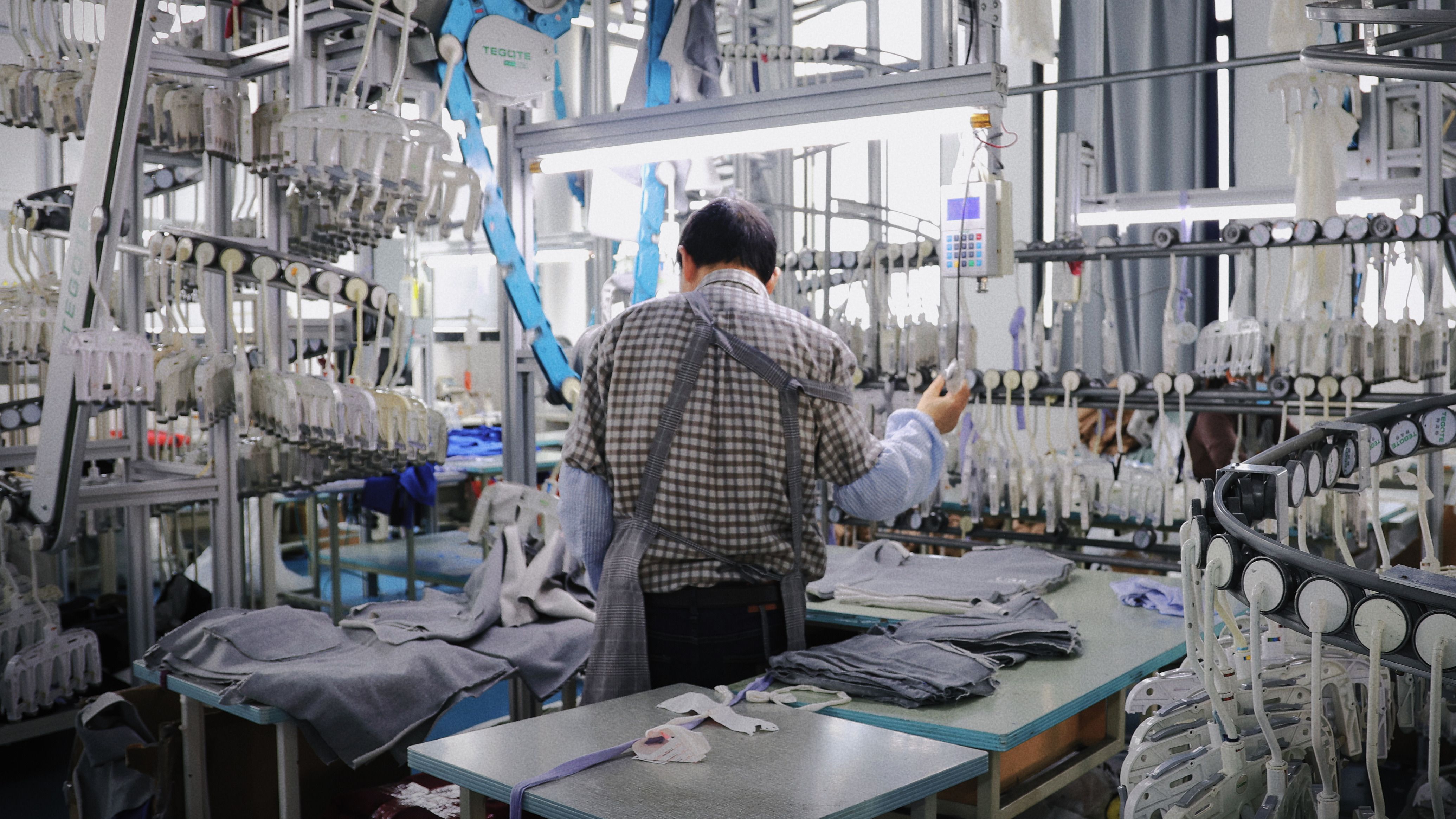
A different category entirely. Instead of an aggregator routing your order across multiple separate businesses, a single in-house factory handles the full chain: stocking the blank, printing, embroidering, applying HTV, quality control, and shipping. One facility, one quality standard, one decision-maker accountable for the whole order.
This is the model PODpartner runs. It isn't a comparison to Bella+Canvas at the same level. It's a different production architecture entirely. Where Category A asks "which blank should I print on?", Category B asks "who's actually going to make my garment, end to end, and how fast?"
What Category B solves: faster fulfillment (no inter-vendor routing), broader decoration combinations on a single order (one factory does it all), and single-piece minimums for fully customized work (no warehouse means no batch-size logic).
What Category B costs: a slightly narrower stock catalog than aggregators that pool inventory from many blank brands. The trade-off is depth and speed over breadth.
If you've ever waited a week for an aggregator to ship one shirt, or been told "we can't combine those decoration techniques on a single order," you're ready for Category B. If you haven't yet, Category A is probably enough.
A Framework for Choosing: 5 Questions Brand-Tier Founders Should Ask
When founders evaluate suppliers, they tend to default to the wrong scoring criteria: price per unit, integration with Shopify, catalog size. Those matter, but they don't separate brand-tier suppliers from volume-tier ones.
These five questions do.
1. How fast can the supplier actually ship a single order?
Not "lead time on bulk orders." Single piece, one customer, fulfillment time. Aggregator platforms typically take 2 to 5 business days from order to shipment because the order routes through a warehouse and a contracted print shop. In-house manufacturing factories can ship within 2 days for most orders, because there's no routing layer. For brands competing on customer experience, shipment speed compounds into reviews, repeat purchase rates, and reduced "where's my order" support tickets.
2. Can decoration techniques combine on a single order?
A brand-tier garment often combines techniques: embroidered chest hit, DTG photo print on the back, silicone HTV detail at the hem. Aggregators built on a single decoration line can't combine these without splitting your order across vendors. In-house factories that own DTG presses, embroidery machines, and HTV equipment under one roof do all three in one production run.
3. What's the actual MOQ for a fully customized order?
The "no MOQ" marketing claim usually means "no MOQ on stock blanks." Real customization (custom labels, multiple decoration techniques, larger print areas) often triggers a 50+ unit minimum. The real MOQ test: can you order one piece, fully customized, with combined decoration techniques? Aggregator answer: no. In-house manufacturing answer: yes.
4. How big can the print area actually be?
Standard DTG print areas on aggregator platforms cap around 12" by 16". For brands designing oversized graphics, all-over prints, or back-and-sleeve continuous designs, this becomes a hard constraint. Some in-house factories run jumbo DTG equipment with print areas up to 24" by 24", and support up to 18 print areas per garment for fully decorated designs. If your design vision lives in scale or coverage, this question matters more than fabric weight.
5. Will I outgrow this supplier in 12 months?
The hardest question. Most brand founders pick a supplier optimized for where they are today, not where they'll be in a year. Bella+Canvas via Printful is excellent for Year 0. By Year 2, the same setup is bleeding margin and capping your product roadmap. Pick a supplier whose ceiling sits above your 18-month plan, not your 3-month plan.
The Bottom Line
If your question is "what's the best blank to print on?", Bella+Canvas wins or ties most fights. They've been optimizing that exact question for two decades.
If your question is "who can actually ship my product fast, with the decoration depth my brand needs, at the volumes I'm currently working with?", you aren't in the same conversation. The two production models have different ceilings, and the difference is structural, not incremental.
Aggregator POD optimizes for breadth. In-house manufacturing optimizes for depth and speed.
Which question you're asking determines which alternative your brand actually needs. Most founders don't realize they've been asking the wrong one until they see what the right one unlocks.
When You Should NOT Switch from Bella+Canvas
Honesty matters in a category-comparison article. Switching from aggregator-distributed Bella+Canvas to an in-house manufacturing factory is not always the right move.
Stay on Bella+Canvas (via Printful, Printify, or another aggregator) if:
- You're in Year 0, still validating product-market fit. Don't optimize the supply chain before you've validated demand.
- Your monthly volume is under 50 units. The economics of in-house manufacturing don't matter much at this scale; the simplicity of aggregators does.
- You depend on a very specific blank SKU that aggregators stock and in-house factories may not. Aggregators pool inventory from dozens of blank brands; that breadth has real value when you're matched to a specific catalog item.
- You're testing many SKUs simultaneously without strong opinions about decoration depth. Aggregators absorb experimentation cost in a way in-house factories don't.
Consider switching if:
- Your customers are commenting on slow shipping, and aggregator lead times of 4 to 7 days are hurting your reviews.
- You've designed product details that require multiple decoration techniques on the same garment, and you're tired of splitting orders across vendors.
- You've crossed roughly $5,000 to $10,000 monthly revenue and are noticing margin compression from aggregator markup stacks.
- Your design vision needs print areas larger than standard DTG can handle, or more print regions than aggregator platforms support.
- Competitors using the same Bella+Canvas blank through the same aggregator platform are starting to look indistinguishable from your brand on the shelf.
Neither of these is a moral position. They're business positions. The right choice depends on which problem your brand is currently optimizing for.
Frequently Asked Questions
What are the top Bella+Canvas alternatives?
The answer depends on what you're actually replacing.
For premium blanks (similar quality to Bella but different aesthetics or fits): AS Colour, Stanley/Stella (EU), Cotton Heritage, Comfort Colors for garment-dyed work, and Independent Trading Co. These are real upgrades within the same blank-based, aggregator-distributed model.
For a different production model (faster shipping, single-piece custom orders with combined decoration techniques, in-house quality control): PODpartner and similar in-house manufacturing factories. These don't compete with Bella+Canvas at the blank level; they replace the entire aggregator-distributed production model.
The right alternative depends on whether you want to change the blank or change the production system.
What's the minimum order to switch to a manufacturer like PODpartner?
PODpartner's MOQ is one piece, including print, embroidery, and HTV decoration in any combination. This is structurally different from "no MOQ on stock blanks" claims, which typically still require 50+ units for any meaningful customization beyond a single decoration technique.
How fast does PODpartner ship versus aggregator POD?
PODpartner ships within 2 days from the factory for most orders, faster than the typical aggregator fulfillment of 2 to 5 business days. The reason is structural: aggregators route orders across separate warehouses and contracted print shops; in-house manufacturing skips the routing layer entirely.
Is PODpartner's product catalog as broad as Bella+Canvas via an aggregator?
Not yet. Aggregators pool stock from many blank brands, so on raw catalog breadth they currently have an advantage. PODpartner's catalog focuses on apparel categories where in-house manufacturing delivers the strongest brand-tier results (T-shirts, hoodies, sweatshirts, long sleeves, tank tops, shorts, and pants in both men's and women's lines). For brands whose product roadmap fits within these categories, the depth and speed gain outweighs the breadth trade-off.
Can I combine printing and embroidery on the same garment?
Yes, on a single order with no minimum quantity. PODpartner runs DTG, embroidery, and HTV equipment in-house, so combined decoration is a normal production run rather than a multi-vendor coordination problem. Aggregator platforms typically support one decoration technique per order or require splitting across vendors.
What's the maximum print area?
Standard DTG print areas go up to 16 by 21 inches per region. PODpartner also offers Jumbo DTG up to 24 by 24 inches for oversized graphics, and supports up to 18 print regions on a single garment for fully decorated designs.
Are there any platform fees or membership costs?
No. PODpartner has no membership fees, no minimum order requirements, no setup costs. Brands only pay for what they sell.
What happens if my volume scales 10x in a year?
This is where in-house manufacturing starts compounding ahead of aggregator models. Aggregator margin stacks don't shrink at scale; they multiply across every unit. An in-house factory absorbs volume directly into production scheduling, with unit economics improving as orders grow. The 10x case is exactly where staying on aggregator POD becomes painful.
Conclusion
The "Bella+Canvas alternatives" question is really two different questions wearing the same words.
If the question is "which blank should I use instead?", the answer lives in Category A: AS Colour, Stanley/Stella, Cotton Heritage. They're real upgrades within the same category.
If the question is "should I be using an aggregator at all?", the answer lives in Category B: in-house manufacturing factories that handle production from blank to decoration to QC to shipping in one place, faster than aggregator routing allows.
The right alternative for your brand depends on which question you're really asking. Founders who confuse the two end up cycling through Category A suppliers for years before realizing the constraint they kept hitting wasn't the blank, it was the aggregator model behind it.
If you're past that realization, browse PODpartner's product catalog to see what brand-tier in-house manufacturing looks like in practice. The catalog covers T-shirts, hoodies, sweatshirts and the rest of the core apparel categories most brands build their roadmaps around.
Quick Answer (for the time-pressed)
If you want a different blank brand: AS Colour, Stanley/Stella (EU), Cotton Heritage, Comfort Colors, Independent Trading Co. These are all premium blanks like Bella+Canvas, with different fits and aesthetics.
If you want a different production model, faster shipping, single-piece fully customized orders, multiple decoration techniques on one garment: PODpartner. This is in-house manufacturing rather than the aggregator model that distributes Bella+Canvas through Printful or Printify.
These two paths answer different questions. The rest of this article explains which path fits your brand stage.
Further reading

No Order Minimums

No Membership Fees

No Unsold Stock

No Quality Concerns
Only Creativity, Satisfaction, and Profits!