
 USD
USD
Want That Fear of God Essentials Raised-Logo Look? 3 Production Paths That Don't Require a $5,000 Mold

The Touch You Cannot Print
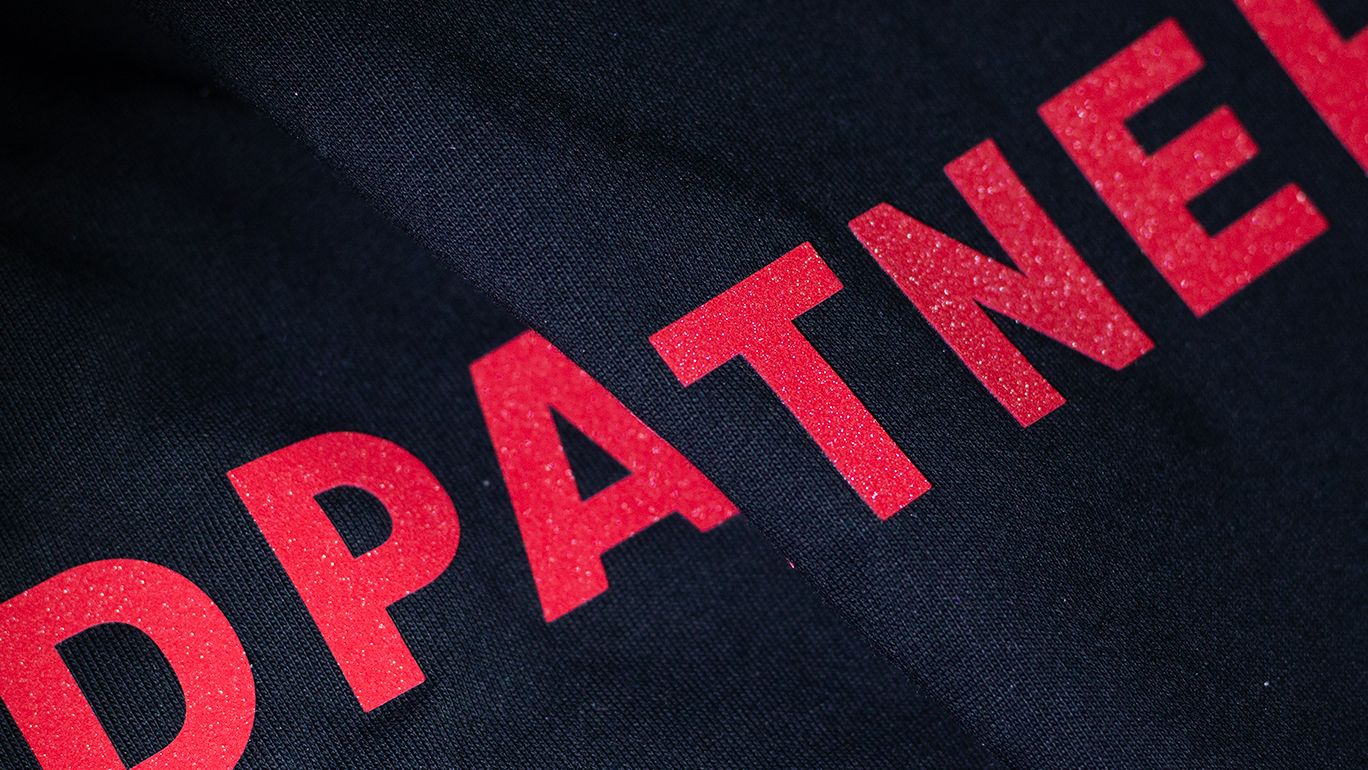
If you have ever touched a Fear of God Essentials hoodie, you know the chest logo does not feel printed. It is soft. Slightly springy. Raised. The edges are crisp. It feels like the logo grew out of the garment instead of being applied on top.
That is not a print. That is 3D Silicone Applique, a production technique that requires a custom CNC metal mold for every design, liquid silicone injected and vacuum-cured at high temperature, then heat-pressed onto the fabric with a transfer film. Molds run roughly $2,000 to $5,000 each, with minimum order quantities typically 100 to 500 pieces.
If you are searching "essentials silicone print" or "raised logo apparel," chances are what you actually want is the feel, not the technique name. Those two things are very different.
This article is about exactly that gap. Without spending $5,000 on a mold, which production paths can your brand realistically take to achieve a comparable retail-quality touch?
Quick Answer: 3 Production Paths
For brand founders who want the Essentials raised-logo tactile feel, here are 3 production paths ordered by capsule drop size:
- Path 1: Premium Silicone HTV (Velvet or Premium Matte finish). MOQ 1 piece. Best for new brands testing concepts or capsule drops under 50 pieces. Delivers "Soft Silicone Touch."
- Path 2: HTV + Embroidery Hybrid (PODpartner's named configuration: "The Elevated Icon"). MOQ 1 piece. Best for 200 to 500 piece hoodie or tee lines. Visually closest to retail brand quality.
- Path 3: Real 3D Silicone Mold. MOQ 100 to 500 pieces. $2,000 to $5,000 mold cost per design. For brands with proven product-market fit.
Most early-stage brand founders need Path 1 or Path 2. Mold costs will drain your cash flow before you have even validated the product.
The Essentials Look, Decoded
The technique behind that raised Essentials logo is officially called 3D Silicone Applique, sometimes Molded Silicone Heat Transfer.
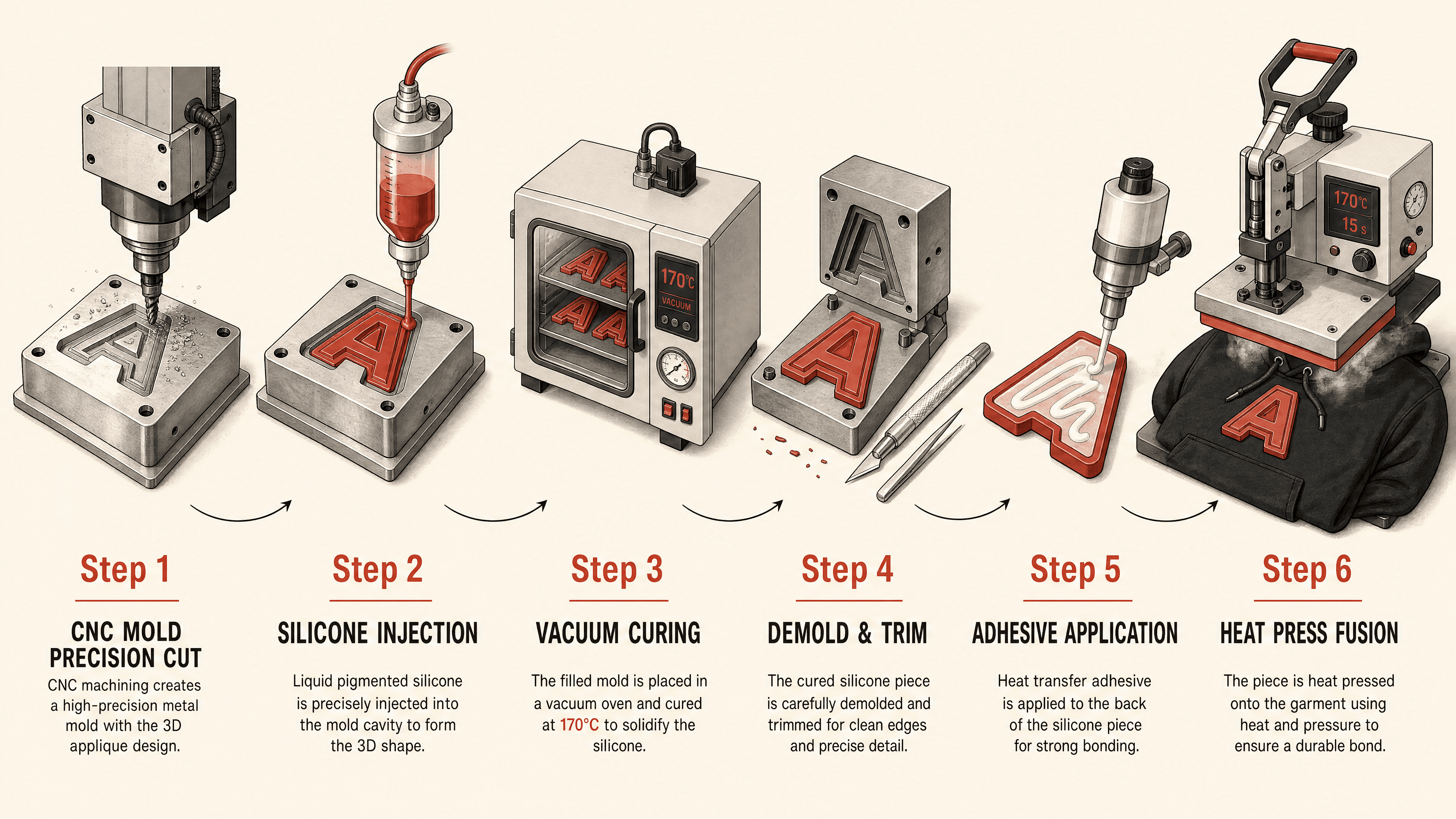
The full production path runs 6 steps:
- CNC-machined metal mold, typically at 0.05mm tolerance. This is what gives the logo its crisp edges.
- Pigmented liquid silicone injected into the mold cavity. Multi-color logos require layered injection or hand inlay.
- Vacuum curing at high temperature, usually 150 to 180 degrees Celsius for 5 to 15 minutes. This converts the liquid silicone into an elastic solid.
- Demolding, edge trimming, and quality control.
- Heat transfer adhesive applied to the back of the cured silicone piece.
- Industrial heat press bonds the piece to fabric at approximately 320 degrees Fahrenheit and 60 PSI for 15 to 25 seconds.
The result: a logo standing 1 to 2mm above the fabric, soft yet elastic, with crisp edges and a soft rubber tactile signature. Under SGS-standard wash testing, the bond typically survives 50+ wash cycles without cracking.
The Real Cost Breakdown
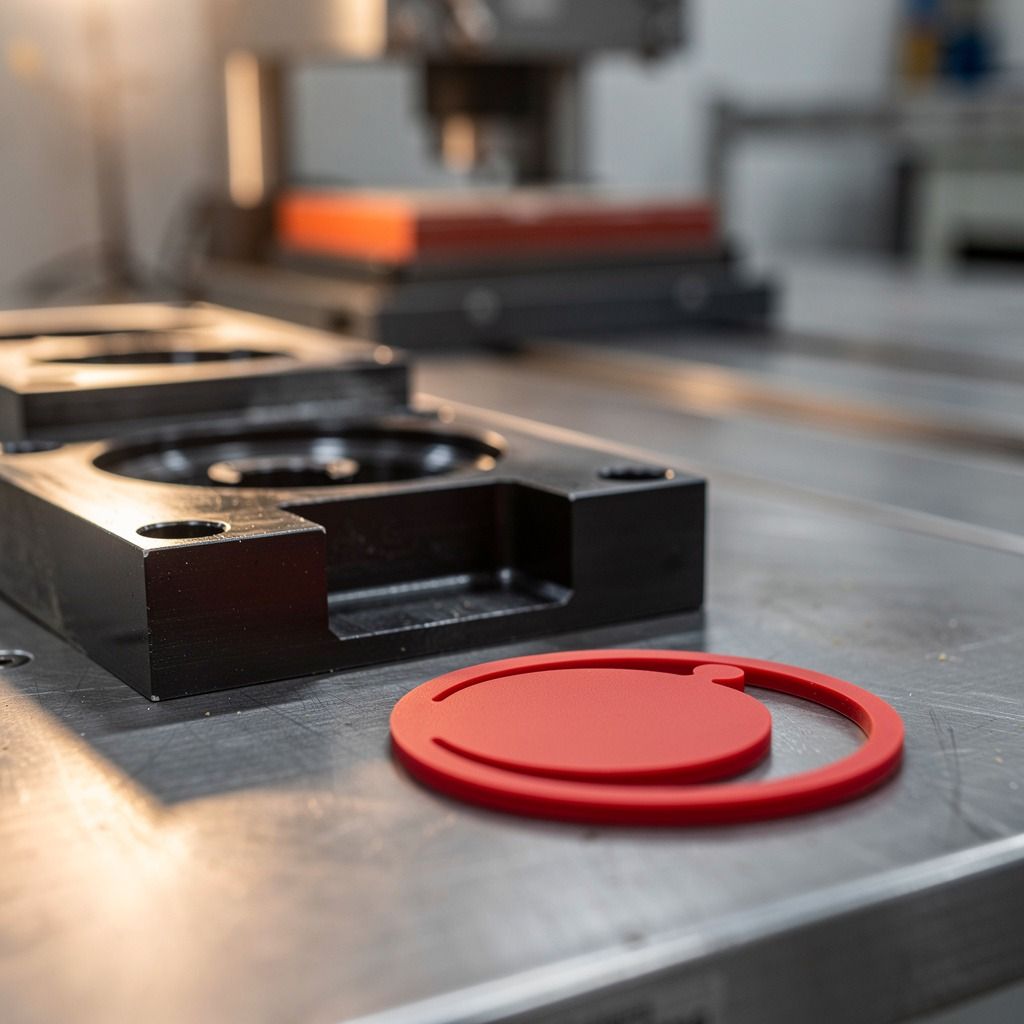
Industry-typical ranges for the 3D Silicone Mold path:
- One-time mold investment: $2,000 to $5,000, depending on size and detail complexity
- MOQ: typically 100 to 500 pieces to amortize mold cost
- Lead time: 3 to 5 weeks (1 to 2 weeks mold tooling + 1 to 2 weeks production + 1 week QC and shipping)
If you can confidently run 1,000+ pieces per design, the math works. If you are testing capsule drops of 50 to 200 pieces total, the mold cost destroys your per-unit economics entirely.
Do you actually need 3D Silicone?
Close your eyes and feel that Essentials chest logo. What do you notice?
- Soft, but with spring. Not the rigidity of plastic.
- Raised, roughly 1 to 2mm above the fabric surface.
- Crisp edges, no lifting, no peeling.
- A faint rubber quality, but softer than a silicone phone case.
Now imagine this: PODpartner's Premium HTV describes its Premium Matte finish as "Soft Silicone Touch" and its Velvet finish as "Ultra-soft, luxurious hand-feel." Material thickness can be built up to 0.6mm. How far off is that from the Essentials feel you just imagined?
The honest answer: about 0.5 to 1mm of raised height, and slightly less edge sharpness.
At retail price points under $120 for a hoodie or tee, consumers cannot tell the difference between Premium Silicone HTV and a real 3D Silicone Mold.
Path 1 · Premium Silicone HTV (Direct Surrogate)
This is the path most brand founders should take, especially while still validating product-market fit.
The Core is the Material, Not the Technique
Most POD platforms hand you cheap PVC vinyl. The kind that feels like a stiff plastic shield, embrittles over time, and cracks after a few wash cycles.
PODpartner Premium HTV does not use this. The full material declaration: Premium PU (polyurethane), TPU (thermoplastic polyurethane), and Premium Silicone. All three materials are softer, lighter, and more elastic than PVC. They stretch with the cotton instead of sitting rigidly on top of it.
Premium Matte: The Direct Essentials Surrogate
PODpartner's own description of Premium Matte is "Soft Silicone Touch" and "100% Opaque Coverage." This is the opposite of a PVC sticker. Non-reflective, smooth, sitting flush against the fabric while still raised enough to register tactile depth. This is the surface that Essentials black-on-fabric logos are aiming for, and it is the most direct surrogate among PODpartner's 6 finishes.
For monochrome logo work that needs a softer hand-feel, Velvet is the alternative finish to consider. Velvet uses a short-pile texture (PODpartner's description: "Ultra-soft, luxurious hand-feel, shorter pile than Flock"), pairing especially well with heavyweight brushed fleece (380gsm and up). Both finishes deliver the raised, retail-quality touch, but Premium Matte is the cleanest visual match for the Essentials look.
Manufacturing Credibility
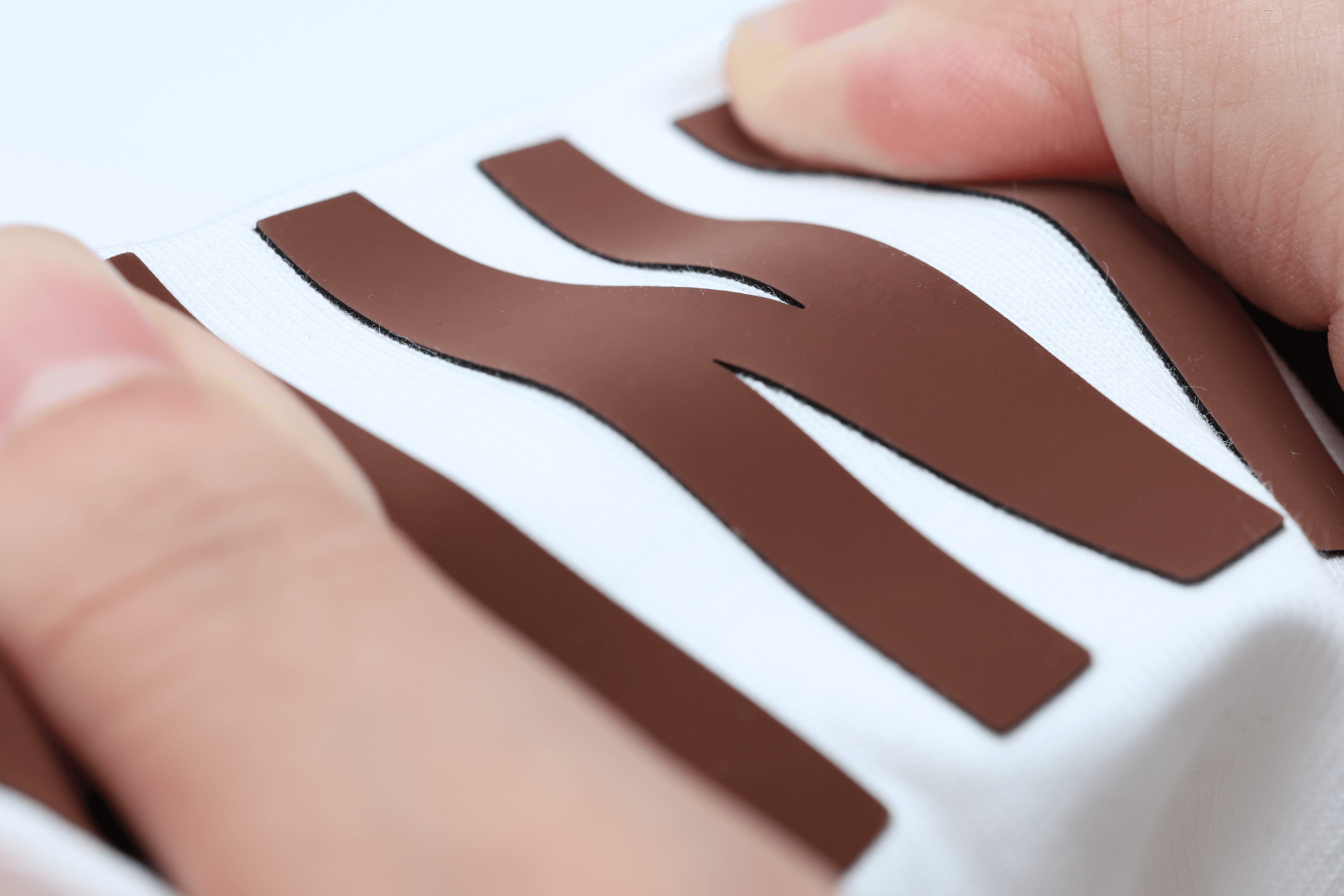
Production specs:
- Industrial pneumatic press at 320 degrees Fahrenheit and 60 PSI
- 0.2mm cutting precision (edge sharpness)
- Tested through 20+ wash cycles
- Stretch tested (will not crack under tension)
- Eco-Safe Bond (skin-safe)
These specs put Premium Silicone HTV essentially level with real 3D Silicone Mold work on industrial credibility.
Production Reality
MOQ 1 piece. Mold cost: $0. Lead time is one business day longer than standard DTG, settling at 3 to 4 business days in production. The HTV process requires additional precision cutting and heat-press operations.
Raised height: PODpartner Premium HTV supports material build-up of up to 0.6mm. Compared to a real 3D Silicone Mold, what is the gap? Roughly 0.6mm versus 1.5mm of raised height, approximately 80% touch-elasticity match, with visible material differences within 1 meter viewing distance and essentially no perceivable difference at 2 meters.
At retail price points under $120, consumers cannot perceive the difference.
Path 2 · HTV + Embroidery Hybrid ("The Elevated Icon")
This is PODpartner's strongest configuration. The product page has already named it "The Elevated Icon," and it deserves its own breakdown.
The Logic Is Not a Single Technique, It Is Tactile Contrast
The retail-quality feel Essentials achieves does not actually come from "3D Silicone" as a single technique. It comes from two different material qualities existing simultaneously on the same garment. Soft against firm, raised against flat, woven texture against printed texture. That is the real tactile signature of a brand. No single craft can deliver this.
"The Elevated Icon" Configuration
- Embroidery for the logo: Delivers that stitched, established-brand signal. A 15-color embroidery setup handles the complexity most brand logos require, and the DST file workflow at PODpartner is well-established.
- HTV for the larger graphics or wordmarks: Delivers bold statement-graphic visual impact. Premium Matte or Velvet gives the unified retail tactile signature.
PODpartner's product page describes this combination as: "The ultimate texture contrast. Luxury Branding (Embroidery) + Bold Statement Graphics (HTV) + High-End Retail Aesthetic."
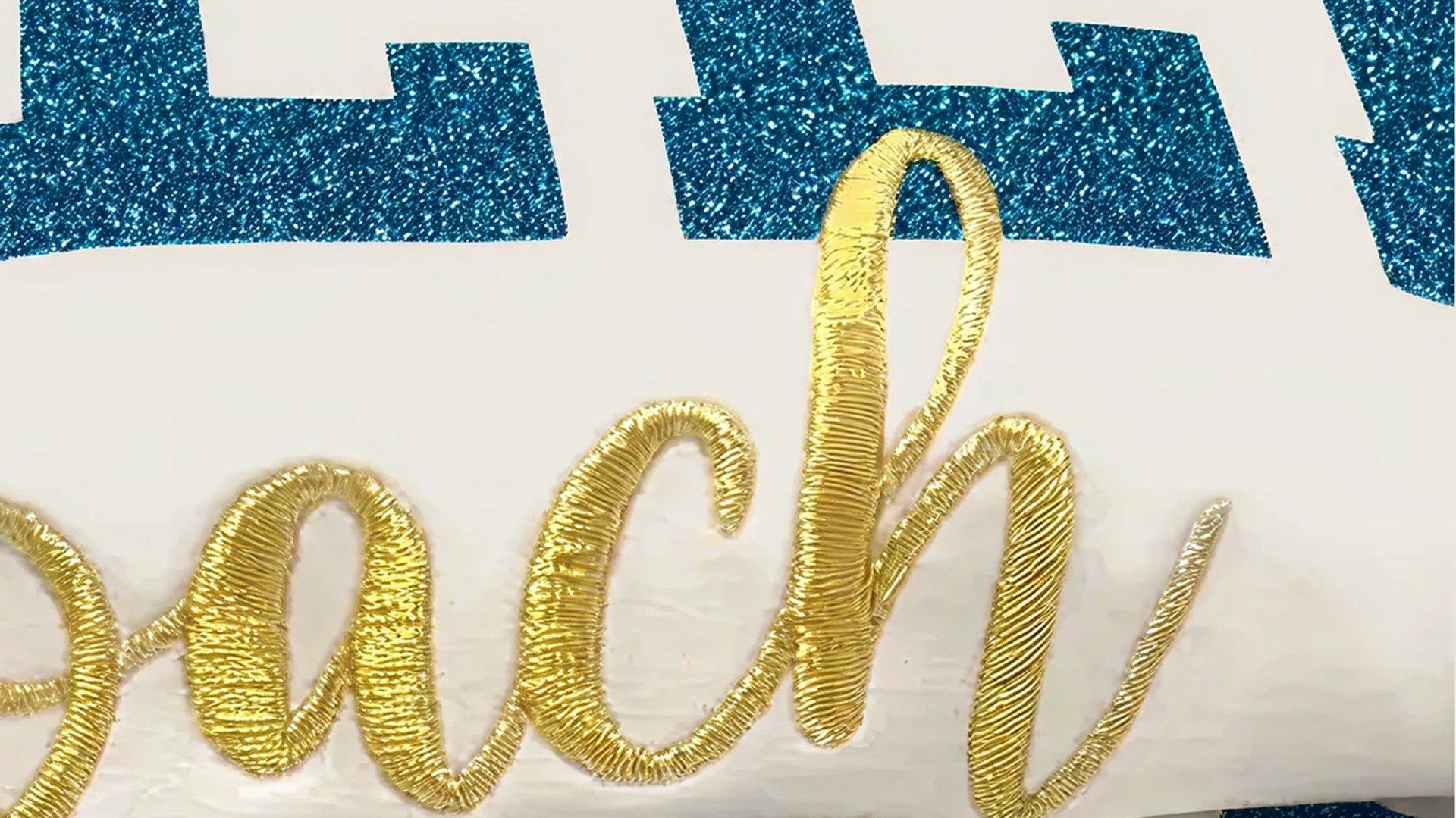
Visual Logic
- Logo zone: embroidery for stitched depth (thread-built dimensionality)
- Statement zone: HTV for surface depth (raised material dimensionality)
Two kinds of depth coexisting. This is something a single 3D Silicone Applique cannot deliver. Multi-layered tactile experience is the actual unlock.
Who Should Take This Path?
- Mid-size brands running 200 to 500 pieces per design
- Founders at any stage who want the "POD provider that does not look like POD" effect (LP customer testimonial)
- Iterating brands that validated Path 1 and want to upgrade brand-quality perception
MOQ 1 piece. Running both techniques together does not add extra lead time. Total production stays at 3 to 4 business days.
Path 3 · Real 3D Silicone Mold (Premium Tier)
A complete look at the real 3D Silicone Applique path, because readers need to know when to actually consider it.
Who Should Take This Path?
- Already validated product-market fit
- Single designs reliably moving 1,000+ pieces per quarter
- Cash flow that can absorb $2,000 to $5,000 mold cost per new design
- Comfortable with 3 to 5 week lead times
- Retail price point above $90, with margins that absorb mold amortization
If those conditions are met, 3D Silicone Mold per-unit cost can amortize down to $3 to $8 (depends on mold size), roughly $2 to $5 more per piece than Premium Silicone HTV. The trade-off: higher visual dimensionality and a closer consumer perception of "luxury-tier brand signature."
Where to Source
This is not a POD service. It is specialized decoration factory territory. Main industry players:
- Specialized decoration factories in Guangzhou (such as DOY Label)
- Stahls' LIQUID 3D (2025 standardized product offering)
- Decoration departments inside select Vietnamese and Bangladeshi cut-and-sew factories
PODpartner does not offer this path in the short term. If your brand has reached this stage, you are typically already operating a traditional supply chain. POD is not your tool at this point.
The Decision Framework
Different brand stages call for different production paths. Match your stage to the path below:
| Your Stage | Recommended Path | Why |
|---|---|---|
| New brand, still testing product, capsule drop under 50 pieces | Path 1, Premium Matte HTV | MOQ 1 piece + zero mold cost + 80% match on Essentials tactile feel + manufacturing credibility appropriate for retail tier $50 to $80 |
| Mid-size brand, hoodie or tee lines of 200 to 500 pieces, wanting retail-quality leap | Path 2, HTV + Embroidery "The Elevated Icon" | Dual-craft tactile contrast + visually closest to luxury label + maintains POD flexibility |
| Mature brand, single design at 1,000+ pieces, hit logo becoming brand DNA | Path 3, Real 3D Silicone Mold | Mold cost amortizes + tactile brand-asset investment justified + not in PODpartner ecosystem + sourced from specialized decoration factories |
| Pure graphics tee, no logo tactility needed, large image dominant | Standard DTG or Jumbo DTG | No surrogate needed + full-color printing handles graphics most directly |
Why This Bridge Matters
The core of this article is not to teach you the Essentials technique. The core is to tell brand founders: when you search "essentials silicone print," what you want is not the technique name. You want the overall sense of retail-quality tactility and brand-like signature.
And most POD platforms cannot give that to you. Because their HTV is cheap PVC vinyl. (PODpartner's own product page frames the opposing position directly: "Cheap vinyl sits on the fabric like a stiff plastic shield.")
The difference between PVC and Premium Silicone HTV is not a marketing-words "a little better." It is a material-science fundamental difference. One embrittles, the other stretches with cotton.
PODpartner is, by its own product page description, the "World 1st HTV-Enabled Apparel POD Platform." The first to embed this kind of retail-grade decoration into a POD flow.
What that means in practice: you get the closest commercially available approximation of the Essentials tactile experience, while keeping:
- MOQ 1 piece
- Automated integration with Shopify, Etsy, WooCommerce, Wix, Squarespace
- 3 to 4 business day production turnaround
The "I want to build a real brand but I refuse to be chained to inventory" tension. The real resolution is not opening a mold. The real resolution is finding a platform that automated the craft logic into a POD workflow.
Frequently Asked Questions
Q1: Do I actually need a 3D Silicone Mold?
Probably not. If your single design is not moving 1,000+ pieces yet and your brand is still in validation phase, the $2,000 to $5,000 mold cost will damage you more than the technique-difference will help. Run Path 1 to validate the product first.
Q2: How is Premium Silicone HTV different from regular HTV?
Material. Regular HTV is cheap PVC. It gets stiff, embrittles, and peels. PODpartner Premium HTV uses three premium materials: PU, TPU, and Premium Silicone. They stretch with cotton and survive 20+ wash cycle testing.
Q3: Will Velvet or Premium Matte crack in the wash like cheap vinyl?
No. The industrial pneumatic press operating at 320 degrees Fahrenheit and 60 PSI creates a permanent molecular bond, not a surface adhesion. The product page features customer testimonials describing 20+ washes with the garment still looking new.
Q4: What is PODpartner Premium HTV's MOQ?
1 piece. This is the core of the POD model. No minimum order quantity.
Q5: Can Premium HTV be applied to a 380gsm heavyweight hoodie?
Yes, and the results are particularly strong. The product page explicitly states that HTV pairs best with 100% Cotton heavyweight blanks, and 380gsm brushed fleece is the listed "Best for" pairing for Velvet finish.
Q6: Why is HTV plus Embroidery called "The Elevated Icon"?
Because a single craft can only deliver one tactile quality. Two crafts together (stitched embroidery plus raised vinyl HTV) deliver tactile contrast, the actual signature of retail-quality brand decoration. This "two material qualities existing together" design logic is a common practice across premium streetwear brands.
Q7: How long does an HTV hybrid order take to produce?
The HTV process requires one extra business day beyond standard DTG, settling at 3 to 4 business days total production. Combining HTV with Embroidery in a hybrid order does not extend that further. US standard shipping is 7 to 12 days. Express is 3 to 5 days.
Q8: Can I see and feel a sample before committing?
Yes, just place a single-unit order. Under PODpartner's model, every order is a sample, with no traditional sampling fees. Pick the Premium Matte or Velvet finish you want to test, order one, and the production 3 to 4 business days plus US express shipping 3 to 5 days (or standard 7 to 12 days) delivers a sample you can feel firsthand.
The Craft Is Already There
The Essentials raised-logo feel is not really a story about silicone molds. It is a story about retail-quality tactility.
PODpartner Premium HTV delivers two finishes (Velvet and Premium Matte) built from Premium PU, TPU, and Premium Silicone. Giving you a tactile experience approaching what a $5,000 mold delivers, at MOQ of 1 piece. Pair with 15-color embroidery, and "The Elevated Icon" configuration creates a multi-layer tactile experience that a single 3D Silicone Mold cannot match.
If you want to build something that does not look like POD (in the product page customer's own words: "a POD provider that does not look like POD"), the craft is already there. What is left is your design and your decision.
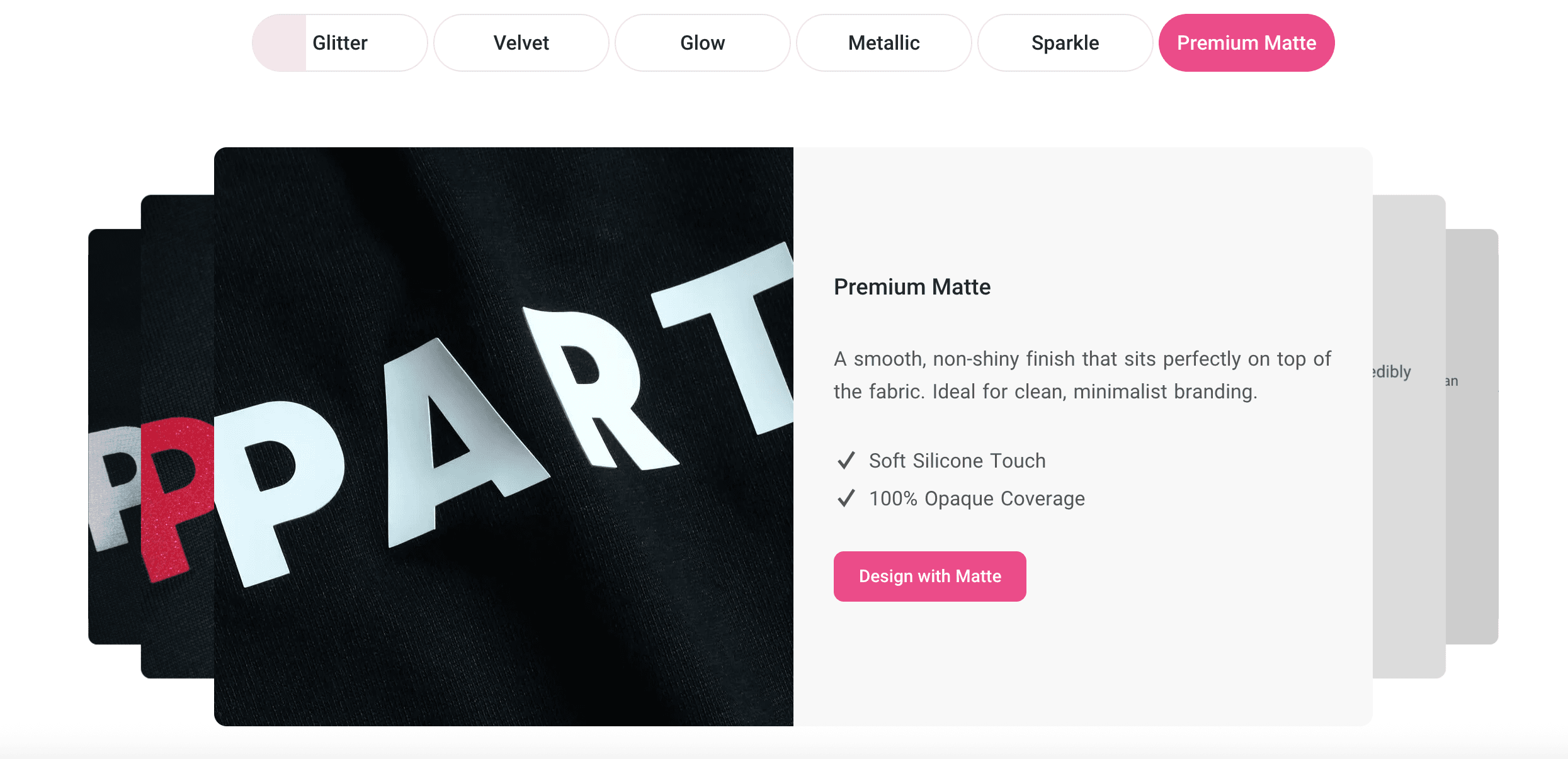
Explore the 6 Premium HTV Finishes
See the Velvet and Premium Matte finishes that give you raised, silicone-touch texture up to 0.6mm thick. No $5,000 mold cost, no 500-piece minimums. Industrial-pressed at 320 degrees Fahrenheit and 60 PSI, made with PU, TPU and Premium Silicone, tested for 20+ wash cycles. Produced in 3 to 4 business days.
See all 6 finishes at the Premium HTV page.
Or Pair with 15-Color Embroidery for "The Elevated Icon"
A single craft is just a craft. Two crafts together is what makes a retail-quality brand.
Explore Custom Embroidery to design your hybrid configuration.
Further reading

No Order Minimums

No Membership Fees

No Unsold Stock

No Quality Concerns
Only Creativity, Satisfaction, and Profits!