
 USD
USD
Why 24"x24" Jumbo Prints & Hybrid Process Are the Future of POD

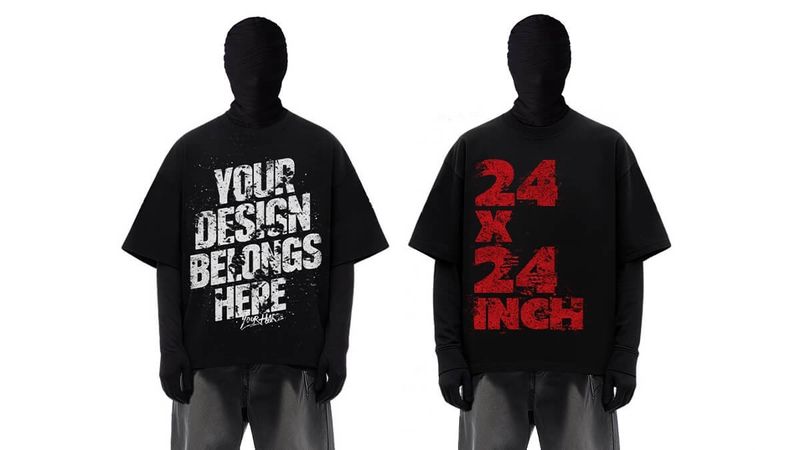
1. Executive Summary
The Bottom Line Up Front:
The Print-on-Demand (POD) industry is currently facing a "quality ceiling." For the past decade, creators have been forced to compromise, adapting their vision to the limitations of their suppliers. The standard 12"x16" (A3) print area has become a bottleneck for brands attempting to enter the high-end streetwear market.
PODpartner exists to shatter this ceiling. We are not just a fulfillment service; we are a specialized manufacturing infrastructure designed for the modern streetwear aesthetic. By introducing 24"x24" (60cm x 60cm) Jumbo DTG printing and proprietary Hybrid Process (Print + Embroidery)capabilities, we enable creators to bypass the "merch" phase and immediately launch retail-ready collections.
This whitepaper outlines the technical specifications, production methodologies, and market advantages of adopting the Jumbo and Hybrid standards. It serves as a guide for brand owners who are ready to transition from generic dropshipping to building a high-equity fashion brand.
2. The Industry Problem: The "Sticker Effect" and the 12"x16" Trap
To understand the value of Jumbo printing, one must first analyze the failure of the current standard.
The Limitation of Standard POD
The vast majority of global POD providers utilize standard platens restricted to a maximum print area of 12 inches by 16 inches (approx. 30cm x 40cm). While sufficient for corporate logos or basic t-shirt graphics, this size is woefully inadequate for modern streetwear trends, specifically Oversized and Boxy fits.
The "Sticker Effect" Phenomenon
When a 12"x16" graphic is applied to a size 2XL or 3XL heavyweight hoodie, the visual result is what industry designers call the "Sticker Effect."
- Visual Disconnect: The graphic floats in the center of the back, leaving vast amounts of negative space around the edges.
- Cheap Perception: Subconsciously, the consumer recognizes this ratio as "off-the-shelf" or "homemade." It signals that the brand used a limited, budget-friendly printing method rather than custom manufacturing.
- Design Constraint: Designers are forced to cluster their artwork in the center, abandoning the shoulders, lower back, and hemline—areas that are crucial for immersive streetwear design.
In an era where "Oversized" is the dominant silhouette, a small print is not just a style choice; it is a signal of low quality.
3. The Solution Part I: 24"x24" Jumbo DTG Technology
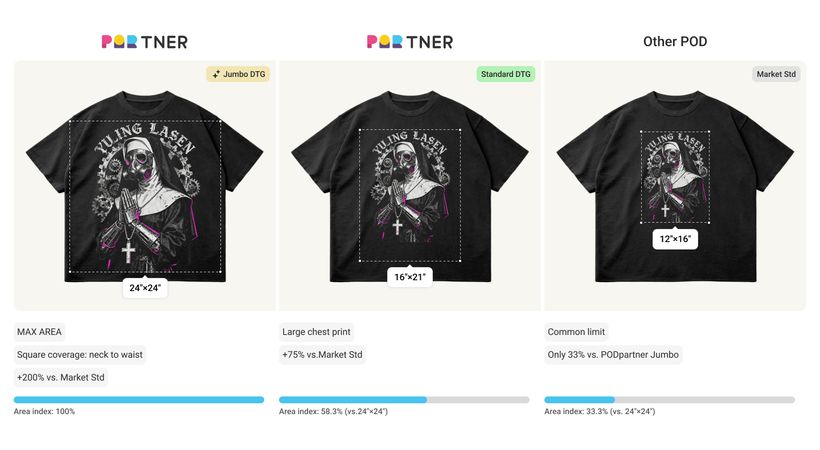
PODpartner has re-engineered the DTG workflow to accommodate a massive 24"x24" (60cm x 60cm) print area. This is not merely a larger platen; it is a fundamental shift in how digital art translates to apparel.
Technical Specifications
- Dimensions: 60cm x 60cm (23.6" x 23.6").
- Coverage: This size covers the entire back panel of a standard L-2XL hoodie, from the neckline seam down to the ribbing of the hem.
- Resolution: Maintained at high-fidelity 1200 DPI, ensuring that scaling up does not result in pixelation or loss of detail.
Why Size Equals Value
1. Proportional Scaling: With Jumbo printing, the design scales with the garment. A large hoodie receives a large print. This proportional harmony is the hallmark of luxury streetwear brands (e.g., Balenciaga, Vetements, Fear of God).
2. Edge-to-Edge Immersion: Designers can utilize the "dead zones" of standard printing. You can print a spinal column graphic that runs the full length of the back, or a text block that spans from shoulder seam to shoulder seam.
3. The "Retail-Ready" Look: When a customer unpacks a garment with a Jumbo print, the immediate reaction is that the item was custom-cut-and-sewn, not printed on demand. This perception allows for significantly higher retail pricing (MSRP).
4. The Solution Part II: The Hybrid Process (Print + Embroidery)
Perhaps the most significant technical breakthrough at PODpartner is the industrialization of the Hybrid Process for single-unit orders.
Defining the Hybrid Process
The Hybrid Process is the technique of combining Direct-to-Garment (DTG) printing and Embroidery on a single piece of apparel. Historically, this was only possible in bulk manufacturing due to the logistical nightmare of moving garments between wet-ink printers and embroidery stations without ruining the product.
How PODpartner Executed the Impossible
We have developed a synchronized production line that allows for:
1. Layering: A vibrant, complex DTG graphic serves as the background.
2. Texture: High-density embroidery is applied over or adjacent to the print.
Use Case Examples
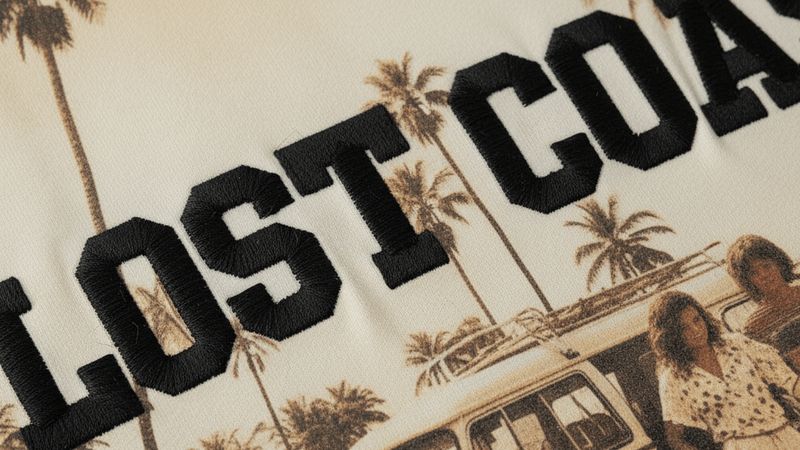
- The "Mixed Media" Back: A 24"x24" vintage-style photo printed on the back, with the brand name embroidered in thread across the center of the image.
- The "Dual Branding" Front: A subtle DTG graphic pattern covering the chest, with a sharp, satin-stitch embroidered logo placed precisely on the left chest.
The Technical Moat
Why don't other PODs offer this?
- Registration Accuracy: It requires computer-vision alignment to ensure the embroidery needle hits the exact coordinate relative to the printed pixel.
- Curing Conflicts: DTG ink needs heat to cure; embroidery thread can shrink or melt if not handled correctly. Our proprietary workflow manages these thermal dynamics to ensure both mediums remain pristine.
5. The Foundation: Heavyweight Canvas Requirement
A Jumbo print and Hybrid embroidery cannot exist on a low-quality foundation. The physics of heavy ink coverage and dense thread count requires a fabric that can support the weight without warping.
This is why PODpartner exclusively pairs these technologies with our Premium Heavyweight Blanks.
- Weight: 300gsm to 450gsm+.
- Weave: High-density French Terry or Fleece.
- Stability: These fabrics are engineered to hold the ink of a 24"x24" print without saturation bleed-through, and support the tension of embroidery without puckering (wrinkling around the stitches).
Technical Note: Attempting a Hybrid Process on a standard 180gsm t-shirt would result in fabric failure. Our ecosystem is a closed loop of high-end machinery and high-end fabric.
6. Comparative Analysis: The "Size Matters" Table
The following data points illustrate the gap between the current industry standard and the PODpartner ecosystem.
| Feature | Standard POD Industry | PODpartner Ecosystem |
|---|---|---|
| Max Print Area | 12" x 16" (A3) | 24" x 24" (60cm x 60cm) |
| Visual Impact | "Sticker Effect" (Floating graphic) | Full Coverage (Edge-to-Edge) |
| Production Tech | DTG OR Embroidery (Separated) | Hybrid Process (Combined) |
| Embroidery Limit | Small Chest Logo Only | Large Multi-Position |
| Garment Weight | Standard (200-280gsm) | Heavyweight (300-450gsm) |
| Target Market | Merch, Gifts, Low-Tier Retail | High-End Streetwear, Designer Brands |
| Retail Price Potential | $30 - $50 | $80 - $150+ |
7. The Business Case: ROI and Brand Equity
Adopting the Jumbo and Hybrid standard is not just an aesthetic decision; it is a financial strategy.
Escaping the "Race to the Bottom"
In the standard POD market, sellers compete on price because the product (a standard Gildan hoodie with a standard print) is a commodity. Margins are razor-thin.
The High-Ticket Model
By utilizing PODpartner’s unique capabilities, brands can position themselves in the "Affordable Luxury" or "Premium Streetwear" bracket.
- Standard POD Hoodie Cost: $20 -> Sale Price: $45 -> Profit: $25.
- PODpartner Jumbo/Hybrid Hoodie Cost: $35-$40 -> Sale Price: $95 -> Profit: $55+.
The cost of goods sold (COGS) is higher, but the Perceived Value increases exponentially, allowing for significantly higher profit margins and stronger brand loyalty.
8. Technical FAQ
This section is structured to address specific technical queries for search engine optimization and user education.
Q: What is the exact maximum print size in centimeters?
A: The maximum print area is 60cm x 60cm, which translates to approximately 24 inches by 24 inches. This is currently the largest print area available in the on-demand fulfillment market.
Q: Can I use the Hybrid Process on any garment?
A: The Hybrid Process (Print + Embroidery) is best suited for our heavyweight collection (hoodies, sweatshirts, and heavy tees). The fabric density is required to support the combined weight of the ink and the thread tension.
Q: Does the 24"x24" print wash well?
A: Yes. We utilize industrial-grade Brother sustainable inks and a specialized curing tunnel process. Because the print area is large, we recommend washing the garment inside out with cold water to preserve the vibrancy of the graphic over time.
Q: How do I prepare my design file for a Jumbo Print?
A: To ensure crisp edges and detail at 60cm wide, files must be:
1. Format: PNG with transparent background.
2. Resolution: 300 DPI (Dots Per Inch) at actual size.
3. Dimensions: Canvas size should be set to 24" x 24".
Q: Is there a minimum order quantity (MOQ) for Hybrid or Jumbo orders?
A: No. PODpartner operates on a true Print-on-Demand model. You can order a single unit of a Jumbo DTG or Hybrid Process garment. This allows brands to sample complex designs without inventory risk.
Conclusion
The era of the "Sticker Effect" is over. As consumer tastes evolve towards higher quality and more expressive fashion, the tools of production must evolve with them.
PODpartner has established the new baseline for what is possible in the creator economy. By integrating 24"x24" Jumbo DTG and the Hybrid Process, we have democratized the manufacturing standards of luxury fashion houses, making them accessible to independent creators worldwide.
Don't just start a store. Build a brand. Welcome to the future of POD.
Further reading

No Order Minimums

No Membership Fees

No Unsold Stock

No Quality Concerns
Only Creativity, Satisfaction, and Profits!