
 USD
USD
PODpartner vs Gelato (2026): Print Quality, Apparel Range & Shipping

In the expanding universe of Print-on-Demand, Gelato has carved out a unique and impressive niche. Their value proposition is seductive: "Local Production." By connecting to over 100 print partners in 32 countries, they promise to print your product as close to the customer as possible.
For a business selling posters, calendars, or greeting cards, this model is revolutionary. It reduces carbon footprints and slashes shipping times.
But if you are building a Fashion Brand or a Streetwear Label, you must ask a critical question: Is a supply chain optimized for paper suitable for premium apparel?
This article provides a structural analysis of Gelato (The Decentralized Network) versus PODpartner (The Centralized Manufacturer). We will explore the inevitable trade-offs between "Local Speed" and "Brand Consistency," and help you decide which infrastructure aligns with your business goals.
The Core Definition: Logistics vs. Manufacturing
To understand the difference in output, we must understand the DNA of the two companies.
Gelato is a Software & Logistics Company.
Gelato's core innovation is connectivity. They do not own the factories; they own the API that routes orders. Their algorithm is designed to optimize for Distance. If a customer in Berlin orders a shirt, the system routes the order to a German partner to save shipping time. Their heritage is in paper products (cards, wall art), where standardization is easy.
PODpartner is a Vertical Fashion Manufacturer.
We are a factory, not a software router. We operate on a Centralized Manufacturing model. We knit the fabric, cut the patterns, and print the garments under one roof. Our system is designed to optimize for Product Quality. Whether the customer is in Berlin or Boston, the product comes from the same line. Our heritage is in streetwear and high-end apparel.
The Fundamental Trade-off:
- Gelato prioritizes Geography (Where it is made).
- PODpartner prioritizes Consistency (How it is made).
At-a-Glance: The Structural Comparison
If you are analyzing your supply chain options, this table breaks down the critical operational differences that affect your brand's reputation and bottom line.
| Feature | Gelato (The Decentralized Network) | PODpartner (The Centralized Manufacturer) |
|---|---|---|
| Primary DNA | Paper & Logistics (Posters, Cards) | Fashion & Textile (Streetwear, Hoodies) |
| Production Model | Global Local Production (32+ Countries) | Centralized Manufacturing (1 Facility, Global Ship) |
| Consistency | Variable (Different factories = Different results) | 100% Consistent (Same machines, same team) |
| Apparel Specs | Standard Market Blanks (Gildan, Stella) | Proprietary Heavyweight (440gsm French Terry) |
| Print Technology | Standard DTG (Optimized for speed) | Jumbo DTG & Hybrid Tech (Optimized for detail) |
| Max Print Area | Standard (12" x 16") | Jumbo Edge-to-Edge (24" x 24") |
| HTV Supported | No | Yes (supports up to 6 types of special effects.) |
| Brand Material Cost | High (requires bulk pre-purchase along with storage and service fees) | 0 (made-to-order) |
| Customizing for Consumers | Personalization (membership required) | Personalization (built-in free feature) |
| Ideal For | Art Prints, Wall Art, Simple Merch | High-End Fashion Brands |
Deep Dive: The 3 Dimensions of Difference
To truly understand which partner fits your brand, we need to look deeper into three specific dimensions: The "Local Trap," The "Paper DNA," and The Economics of Quality.
Dimension A: The "Local Production" Trap (Consistency)
Gelato's biggest selling point—producing locally in 32 countries—is also its biggest weakness for fashion brands.
The Problem of Decentralization:
Apparel printing is not like printing on paper. Paper is a flat, consistent surface. Fabric is organic, textured, and variable.
When you route orders to 32 different factories, you introduce 32 variables.
- The Ink Variable: The factory in the UK might use Kornit ink, while the factory in Australia uses Brother ink. The color vibrancy will differ.
- The Cure Variable: The factory in the USA might cure the shirt at 320°F, while the factory in Brazil cures at 300°F. This affects wash durability.
- The Blank Variable: Supply chains fracture. The specific "Organic Cotton" tee you selected might be out of stock in Canada, forcing a substitution or a delay.
The Result: Your brand lacks a "Standard." A customer in Tokyo gets a different product experience than a customer in New York. For a global fashion brand, this inconsistency is fatal.
The Centralized Solution (PODpartner):
We ship everything from one centralized facility.
- Uniformity: Every single hoodie is printed on the same fleet of Brother GTX600 machines, using the exact same pre-treatment and curing profiles.
- Control: We trade 3-5 days of shipping time for 100% Brand Consistency. Your brand experience is identical worldwide.
- Made-to-Order Branding: Unlock full custom branding without inventory headaches. We produce neck labels, hang tags, and packaging on-demand with every order—a logistical impossibility for decentralized networks that would require you to stock materials in 32 different countries.
Dimension B: Paper vs. Fabric (The Product DNA)
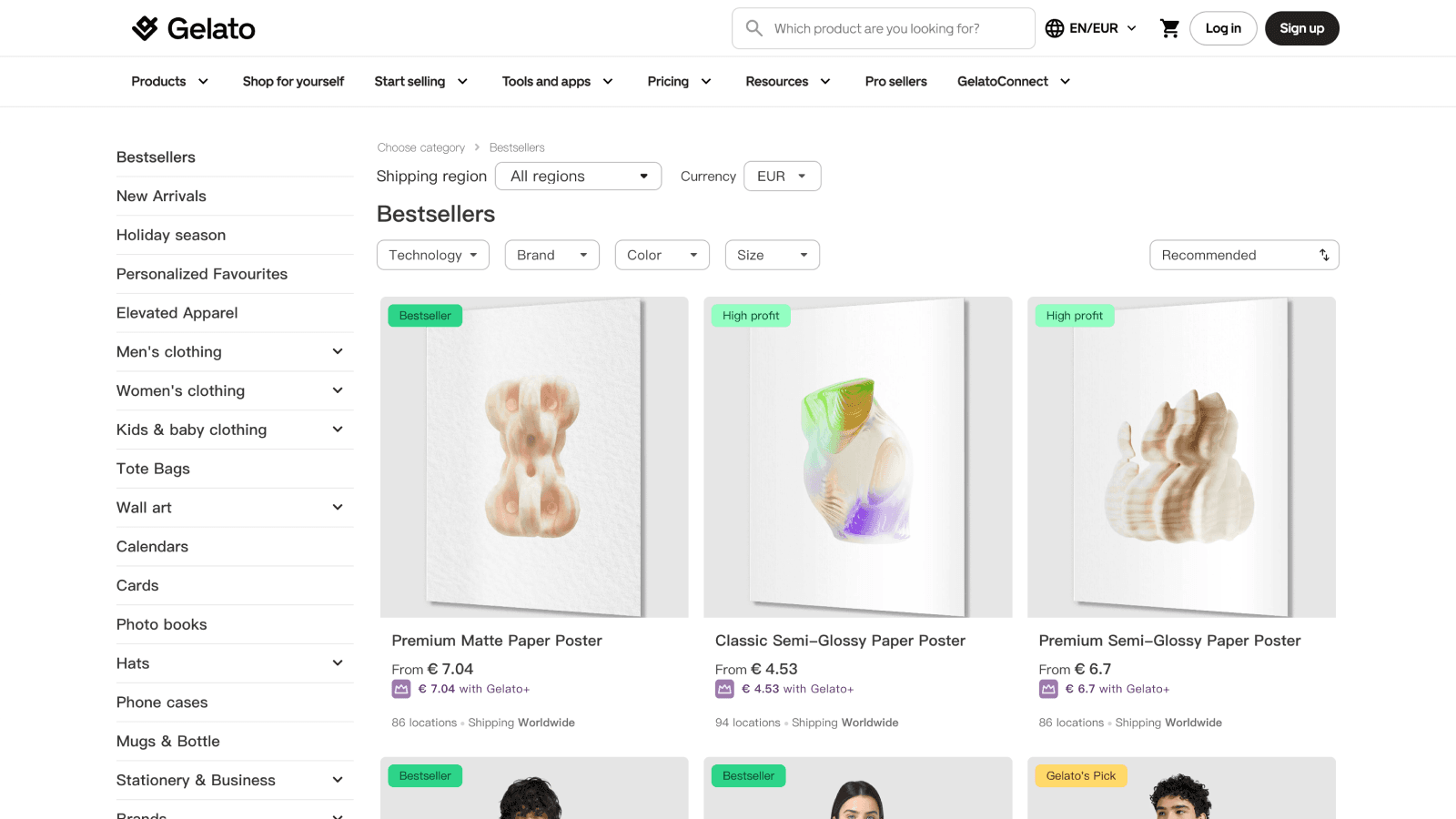
Gelato started as a platform for wall art and photo books. They are excellent at this. However, treating apparel like paper leads to "Flat" products.
The "Paper Mindset" (Gelato):
On Gelato, apparel is often treated as a commodity canvas.
- Limited Print Area: Most providers are locked to standard 12" x 16" print areas.
- Simple Techniques: They primarily support standard DTG and embroidery. Complex techniques like the combination of embroidery and printing are difficult to standardize across a global network.
- Standard Blanks: They rely on distributors. You get the same Bella+Canvas or Gildan tees that everyone else has.
The "Fashion Mindset" (PODpartner):
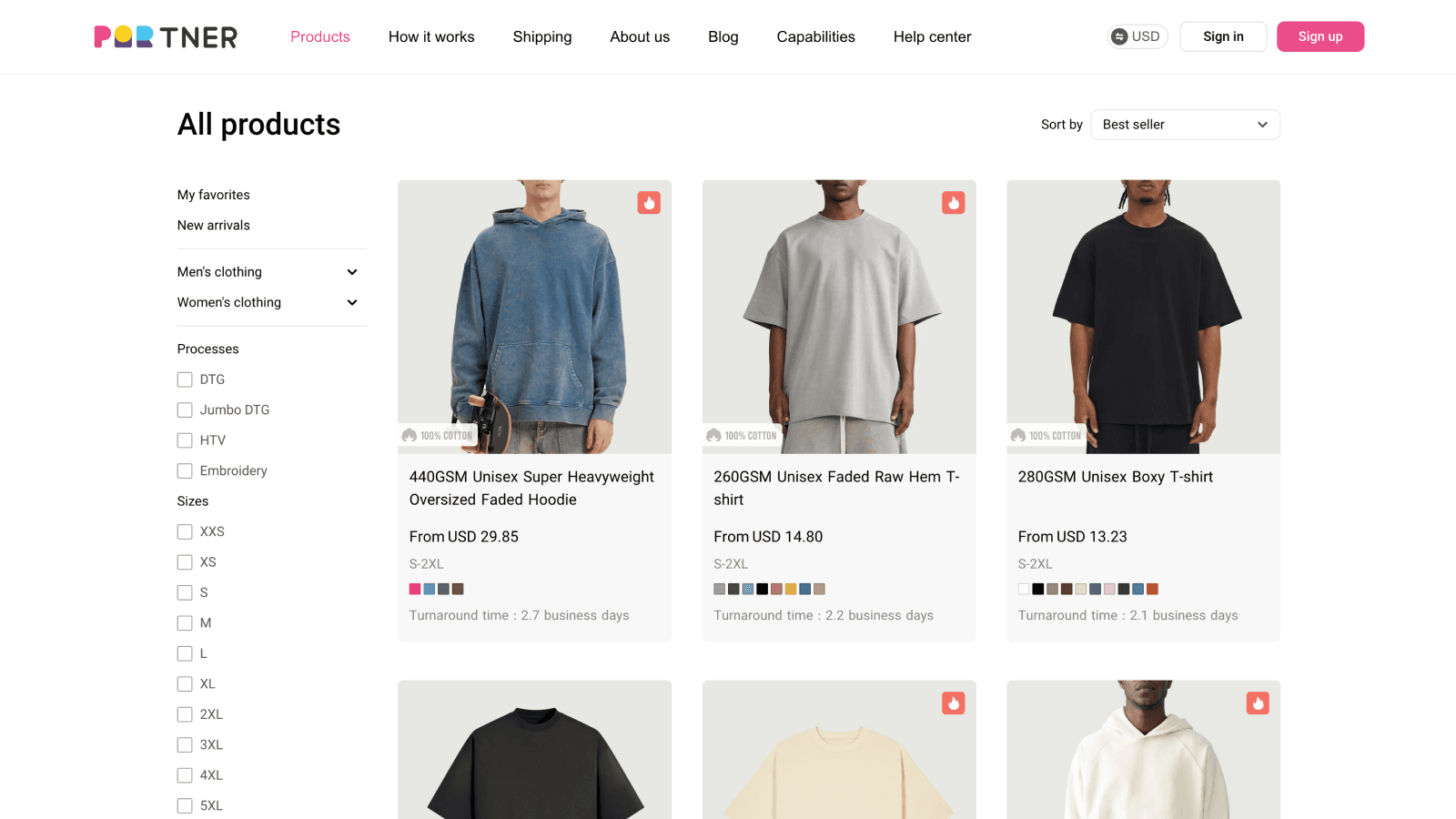
We live and breathe fabric. Our technology is built to handle the texture, stretch, and weight of premium garments.
- Proprietary Fabrics:
We don't buy blanks; we knit them. Our 440gsm Heavyweight French Terry is designed specifically for the "Streetwear Fit"—drop shoulders, boxy cuts, and substantial hand-feel. - Jumbo DTG
We invest in the Brother GTX600 series—the industrial standard for high-fidelity, mass-production DTG. This hardware supports extra-large 24" x 24" platens, enabling Jumbo prints that cover the entire back of a hoodie.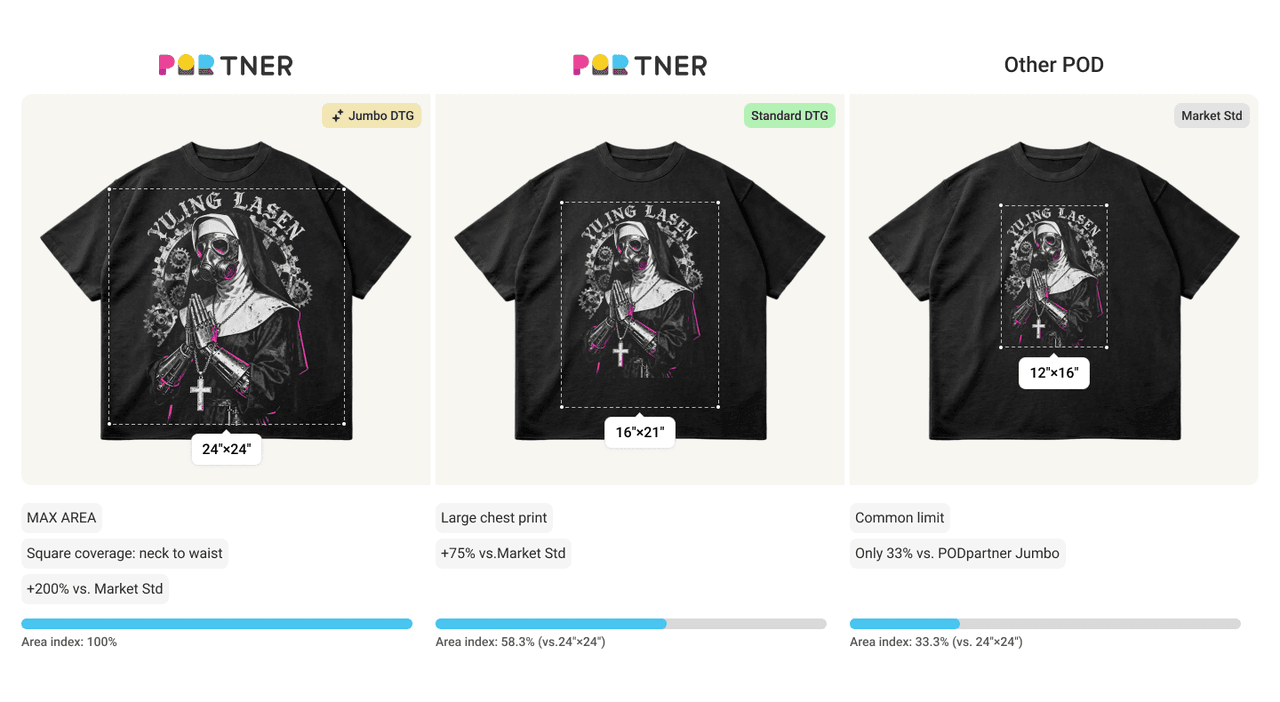
- Expert Embroidery
Achieve a classic, high-end aesthetic with our industrial-grade embroidery. Unlike competitors limited to just 6 colors, we support up to 15 thread colors per design for vibrant detail. We also accept professional .DST files, giving you total control over stitch patterns and density.

- Unmatched Placement Versatility
Break free from the "center chest" limitation. We support 21 unique print placements across the garment—including sleeves, hoodie pockets, and hems—giving you the freedom to place your art exactly where it belongs. - Premium HTV
Elevate your brand with special finishes. Our Premium HTV capabilities support diverse materials—including Glitter, Glow, and Metallic vinyl—adding tactile depth and visual impact that standard digital ink simply cannot achieve.

- Hybrid Process Innovation
Why settle for flat prints? We offer advanced Hybrid Processes that combine DTG + Embroidery + HTV on a single product. This allows you to mix textures and techniques for a premium, retail-quality look that standard POD providers cannot replicate.
Dimension C: The Economics of "High Ticket" (Profit)
There is a misconception that "Local Shipping is Cheaper." While the shipping fee itself might be lower on Gelato, the Total Cost of Goods Sold (COGS) and the Value Ceiling tell a different story.
The Gelato Economy:
- Base Cost: To get a "decent" quality hoodie (e.g., Stanley/Stella) on Gelato, the base price is high because you are paying multiple middlemen (The Blank Brand + The Distributor + The Local Print Shop + Gelato).
- Retail Ceiling: Because it is a standard blank with a standard print, it is hard to sell it for more than $60.
- Outcome: Lower margins.
The PODpartner Economy:
- Base Cost: Because we are the factory, you pay Factory Direct prices. Even with higher international shipping fees, the total landed cost for a premium item is often competitive.
- Retail Ceiling: Because the product is Heavyweight (440gsm) with Jumbo Prints and Expert Embroidery, it is perceived as a "Luxury Item." You can easily retail this for $100+.
- Outcome: Significantly higher profit per unit.
The Math:
- Gelato: Sell for $60 - Cost $35 = $25 Profit.
- PODpartner: Sell for $100 - Cost $45 (inc. shipping) = $55 Profit.
How to Decide: A Strategic Framework
We are not saying Gelato is bad. We are saying it is a specific tool for a specific job.
Stick with Gelato If:
- You Sell Paper Products: If your store focuses on Art Prints, Calendars, or Cards, Gelato is the undisputed king. Their paper quality and global reach are unbeatable.
- Speed is Your #1 Priority: If you are selling "Birthday Gifts" or "Event Merch" where delivery simply must happen in 3 days, local production is the only way.
- You Market "Carbon Neutrality": If your brand's main selling point is "Printed 5 miles from your house" to reduce carbon footprint, Gelato's model fits your narrative perfectly.
Switch to PODpartner If:
- You Sell "Unique" Apparel: You need Heavyweight fabrics, Snow Wash effects, or Distressed items that cannot be found in a local generalist print shop.
- You Need Complex Customization: Local production limits you to simple DTG. We offer Jumbo DTG, 15-Color Embroidery, and premium HTV—techniques that require specialized factory lines.
- You Want Consistent Branding: You want every customer to receive a package with your custom neck label and branded dust bag. Gelato's distributed network makes this level of custom packaging difficult and expensive.
FAQ: Common Questions for Brand Owners
Q: Gelato delivers in 3-4 days. Can you match that?
A: We focus on Quality over Speed. Our Express shipping typically takes 5-8 days to the US and Europe.
The Reality Check: Ask yourself—would your customer rather wait 3 extra days for a hoodie they will wear for years, or get a mediocre one instantly? In the fashion world, anticipation often builds value.
Q: Is Gelato more sustainable?
A: Local production reduces shipping emissions, which is good. However, Durability is the ultimate sustainability.
Fast fashion that loses shape after 3 washes (common with standard blanks) ends up in landfills quickly. Our heavyweight garments are built to last a lifetime. A hoodie worn for 5 years is more sustainable than a hoodie thrown away after 5 months.
Q: Can I sell globally with PODpartner?
A: Absolutely. We ship worldwide with tracked express carriers (FedEx, YunExpress, USPS). And unlike Gelato, your brand experience (packaging, tags, quality) remains consistent no matter which country your customer is in. You don't have to worry about the "Australian Factory" having a bad day.
The Verdict
Gelato is a Software & Logistics Company. It is perfect for selling art on paper.
PODpartner is a fashion company. It is perfect for selling art on garments.
If your business model relies on speed and standard commodities, Gelato is a fantastic partner.
But if your business model relies on Brand Equity, Product Quality, and High Ticket Sales, you cannot rely on a decentralized network.
Don't use a paper printer to build a clothing brand. Upgrade to a manufacturing partner that cares as much about the stitch as you do about the design.