
 USD
USD
Tank Tops vs Sleeveless Shirts: What’s the Difference?

Why This Question Matters More Than It Seems
If tank tops and sleeveless shirts were truly interchangeable, they wouldn’t be one of the most common sources of confusion in apparel ecommerce. Yet they are, and not because shoppers are careless. The problem is that the industry itself has been lazy with language for years.
In online stores, “tank top” is often used as a catch-all term for anything without sleeves. That shortcut works right up until customers open the package. Then expectation collides with reality.
Return behavior makes this painfully clear. Sleeveless items with vague or misleading naming routinely see higher return rates than standard tees, often by a wide margin. And when customers explain why they’re returning them, the reason is rarely quality. It’s expectation failure. “Not what I thought it would be” is the polite version. What they really mean is that the product page created the wrong mental image.
Clothing isn’t abstract. People buy it already picturing where, when, and how they’ll wear it. When the garment doesn’t match that picture, trust erodes fast. For brands, POD sellers, and marketplaces, understanding the difference between tank tops and sleeveless shirts isn’t about semantics. It’s about preventing avoidable damage.
What a Tank Top Is and What It’s Built For

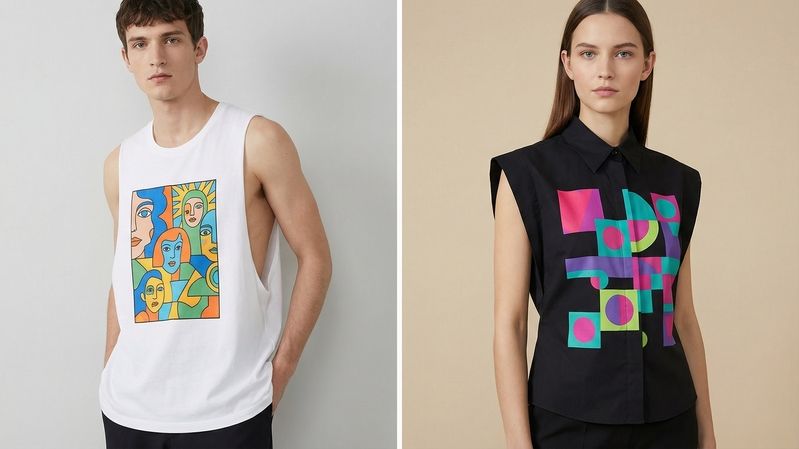
A tank top is made in terms of exposure, movement and airflow. When a garment has small shoulders, deep armholes, and an opening in the neckline that causes the chest to open more than a usual tee, then you are most definitely dealing with a tank.
These are not the details of style. Tight straps and lower armhole eliminates fabric where it gets in the way or causes a buildup of heat. And that is why gymnasiums, beach, and summer sportswear are dominated by tank tops. They are designed to operate in places where comfort and ventilation are of more importance than the structure.
This construction captures the shoulders and arms and draws the eye to the upper, as well. That is why tank tops are more likely to be taken as sportive or casual. The cut alone predetermines heat, activity or leisure even before we talk of fabric or fit. Tank tops do not claim to be versatile and that is precisely the reason why they are so relevant in the tasks they are to be used.
What a Sleeveless Shirt Is and Why It Feels Different

A sleeveless shirt begins with another philosophy. It is not structured in terms of exposure as it is structured in terms of structure.
Majority of the sleeveless shirts start as normal shirts. The sleeves are taken off, although the proportions are still original. Shoulder panels remain broader, armholes are elevated and are also nearer to the body and necklines are in the traditional crews or collars of shirts. Due to this fact, the garment still acts as a shirt, but without sleeves.
That is a preserved structure and that makes everything different. Sleeveless shirts are less revealing, put better on the body, and distribute the weight of the image better. They do not focus on movement or muscle and make the lines straight through the chest and the torso. This outcome is less frenzied, more deliberate and more stylish.
That is why sleeveless shirts are more frequently represented in street style, travel wear and everyday casual models. They are not screaming g-y-m or he-a-t-s-v-i-v-e. They just blend in with wardrobes where flexibility is paramount.
How Construction, Fit, and Fabric Change Wearability
The point where the two garments part ways is the interaction between construction and fit and fabric.
Tank tops are more biased towards tight fits particularly in performance or athletic styles. Much of the relaxed tanks tend to follow the torso and not floating freely. That aids in movement and breathing, however, it makes tanks intolerant. They reveal the posture, proportions and the comfort levels instantly.
Shirts that are sleeveless are more flexible. Since the clothing still has the qualities of a shirt, brands have a chance to experiment with fit and not lose the point. Frequent, exaggerated, square, cut up. Sleeveless shirts can be loose and not appear casual and this is the reason why it works well in lifestyle segmentation.
Clothing decisions enhance this division. Lighter-weight cottons, cotton-poly blends and performance knits are some of the most common tank tops, within the 140180 GSM range. Drape is not as important as breathability and stretch. Midweight or heavier fabrics, typically in the 180220 GSM range, are more likely to be used in sleeveless shirts, and in this case, the issues of the opacity, structure and durability are important.
The natural consequence of this is seasonality. Tank tops are high when it is hot and decline when it is not. Sleeveless shirts also sell better due to the fact that they can be worn easily beneath the overshirts, flannels and light jackets. One is a seasonal demand, in sales point of view. The second one is wardrobe infrastructure.
Styling, Use Cases, and Buyer Expectations
Here the expectations make the difference between a customer retaining and returning a product. There is a social message in tank tops. When the person is wearing a tank, the majority of the people will think of three factors; they are exercising, the weather is very hot or they are not interested in appearing to be dressed. That’s not criticism. It is a common cultural short-cut. Customers select tanks with that knowledge.
Sleeveless shirts are not burdened with baggage. They are read in a light, yet not thoughtless, manner. They may be dressed in denim, cargos, overshirts or worn under open button-down. This is why the shoppers who visit sleeveless shirt stores want to see some coverage, structure and versatility and not a gym attire.
This difference is enhanced by gender and unisex expectations. The tank tops which are worn by men, women, and unisex differ drastically since the difference in the strap width or depth in the armholes changes the appearance by a large margin. Sleeveless shirts are easier to make in unisex collections since they share the standard proportions of tees.
In cases where the sellers mix up these expectations by sloppy naming, customers do not feel educated. They feel misled.
What This Difference Means for POD and Apparel Brands
This difference has a direct impact on margin as far as brands and POD sellers are concerned.
The first filter that customers use is Product naming. Perceived use is reduced instantly by tank top. “Sleeveless shirt” widens it. Label him/her improperly and you get the wrong buyer or lose the right one. Both outcomes cost money.
Placement of design and print is also important. The print areas of tank tops are erratic. Deep armholes may cut into expansive chest graphics, and skinny straps will render centered designs physically unbalanced. The sleeveless shirts are more like normal tees and therefore the place where the print is located is easier to normalize and scale.
It is not a bad idea to offer both of the styles, yet only when their distinctions are considered. It is just laziness to copy-paste the same piece of art and claim that it is the same product and the customers will realize. POD sites such as PODpartner are simpler to test, but the test only works when the products are placed truthfully and accurately described.
Conclusion: Choosing the Right Sleeveless Style
Sleeveless shirts and tank tops are not competitors. They are the ones who solve various problems.
Tank tops are hot, mobile and minimal. Sleeveless shirts are regarding structure, flexibility, and wearing in every-day. Embracing diversity makes good purchases and addresses selling approaches cleaner.
It is merely a rule that is workable in the real world; the sleeveless style has to correspond to the need, not to the fashion. Trends fade. Returns don’t.
Further reading

No Order Minimums

No Membership Fees

No Unsold Stock

No Quality Concerns
Only Creativity, Satisfaction, and Profits!