
 USD
USD
Does Cotton Shrink? How to Test Any Blank Before You Order

Every cotton garment shrinks. That isn't news, and it isn't the useful question.
The useful questions are the ones nobody writes about: how much will the blank you're sourcing actually shrink, whether the word "pre-shrunk" on a spec sheet means anything, and how much shrinkage is normal versus how much means you should be going back to your supplier. Search "does cotton shrink" and you get a wall of advice aimed at consumers — how to rescue a shirt you already shrank, how to wash gently so it doesn't happen again. Almost none of it is written for the person placing the order.
This guide is. It explains why cotton shrinks, why "pre-shrunk" is close to meaningless as a label, and then it hands you a wash test you can run yourself — a repeatable two-minute protocol you can point at any supplier's blank to see what it actually does, before you commit a bulk run to it.
One thing to hold onto before we start: "pre-shrunk" is a barely regulated word. The same two syllables can describe a fabric that moves less than 1% and a fabric that still loses 7%. By the end of this you'll know how to tell which one you're holding.
1. Why cotton shrinks in the first place
Shrinkage isn't the fabric failing. It's the fiber going back to where it wanted to be.
To spin cotton into yarn and knit or weave that yarn into fabric, the fibers are put under tension — stretched longer than their natural relaxed length and held there through construction. That tension is baked into the finished cloth. The moment water gets deep into the fiber, the tension releases and the yarn contracts toward its true length. The garment gets shorter. Textile people call this relaxation shrinkage, and it's the main event: the fabric was holding its breath, and water is what lets it exhale.
Heat and agitation matter, but not the way most people assume. They don't cause the shrinkage — water does, by penetrating the fiber and breaking the temporary hydrogen bonds holding the stretched shape. Heat and tumbling just accelerate that process and drive it further. This is why the common phrasing "hot water relaxes the fibers" gets the cause backwards: the water does the work, the heat speeds it up. It's a small distinction, but it's the one that explains why a hot tumble dry shrinks a shirt far more aggressively than a warm soak — the dryer combines heat and mechanical action at the exact moment the fiber is wet and mobile.
There's one more thing worth understanding, because it clears up a common argument. The big, permanent shrink happens once — the first time the fabric goes through a full wet-heat-dry cycle. After that, most of what people notice is reversible: the garment stretches out as you wear it, then draws back toward that shrunk baseline when you wash it again. So a customer who says a shirt "keeps shrinking every wash" is usually describing that stretch-and-recover cycle, not fresh permanent loss. There's one exception worth knowing: if the wash conditions change — someone who always washed cold suddenly runs a hot cycle and a high-heat dryer — the fabric can give up a fresh round of permanent shrinkage it hadn't reached before. But under consistent care, the permanent damage was done on wash one. Which is exactly why wash one is what you need to test.
2. "Pre-shrunk" is a diluted word
Here's the part that costs brands money, and it's the same trap as fabric weight: the same word pointing at two completely different realities.
The instinct is to treat "pre-shrunk" as a yes/no fact — the fabric either is or it isn't. But pre-shrinking isn't one thing. It's a family of processes that range from rigorous to nearly cosmetic, and the label flattens all of them into two identical syllables. What actually separates a pre-shrink claim worth trusting from one that isn't comes down to two questions the label never answers: what conditions was it tested against, and if it fails, does anyone stand behind it.
Take the first question. The most established pre-shrink process, Sanforization, has been around since 1930 — a controlled compressive pre-shrink, mechanical, no chemicals, and the reason your raw denim behaves differently from your everyday jeans. It's rigorous enough that it proves the important point: near-zero residual shrinkage is a real, achievable, decades-old standard, not a marketing fantasy. But here's the catch that matters for you — the classic benchmark for processes like it is measured against air-drying. And your customer does not air-dry. That gap between the condition a fabric was tested under and the condition it actually meets in a customer's home is the whole game, and we'll take it apart in the next section.
So the number a pre-shrink claim is benchmarked to is only as good as the wash it was benchmarked against. "Pre-shrunk," printed on a hangtag with no stated test condition, typically means the fabric went through a shrink step once, measured to air-dry — which is why a garment labeled "pre-shrunk" can still lose 2–7% the first time it meets a hot home dryer. The label is describing that a process happened. It is not telling you what conditions it survived, and it is not promising a result.
Line the finishes up and the spread is not subtle. Same "100% cotton" on every tag:
- Untreated, loose knit: 8–15% first-wash shrinkage
- Generic "pre-shrunk," benchmarked to air-dry: still 2–7% in a hot dryer
- Mercerized: roughly 2–4%
- Garment-dyed (shrinks during the dye process): around 1–3%
- Rigorously pre-shrunk and verified against tumble-dry: 1% or less
That's an order of magnitude of difference hiding behind three identical words on a label. Which is the real takeaway of this section: "100% cotton" tells you almost nothing about how a garment will behave after a wash. It names the fiber. It says nothing about the tension locked into the yarn, the tightness of the knit, what wash the pre-shrink was tested against, or whether anyone will stand behind the result. Heavier fabrics compound this — the more cotton in the cloth, the more there is to move, which is why heavyweight blanks need pre-shrinking taken more seriously, not less. (We get into how weight itself gets measured and misrepresented in what GSM actually measures.)
The second question — whether anyone stands behind the claim if it fails — almost no supplier answers at all. Hold onto it. It's the one that separates a label from a commitment, and we come back to it at the end.
3. Why the industry's shrinkage test misleads you
Now let's take apart that gap from the last section, because it's the most valuable idea in this whole piece.
The industry-standard shrinkage tests — the methods behind AATCC 135 (Dimensional Change of Fabrics After Home Laundering) and ISO 6330 (Domestic Washing and Drying Procedures) — are run under controlled conditions: a specified water temperature, a specified cycle, and, in many benchmarks, measured to a flat air-dry. That's correct for a lab, because you need a repeatable, comparable baseline. The problem isn't the test. It's the gap between that baseline and what your customer actually does.
Your customer isn't in a lab. They wash warm or hot, and then they throw the garment in a high-heat tumble dryer. And as the last section covered, the dryer — heat plus mechanical action on a still-wet fiber — is the main driver of shrinkage, not the water temperature on its own. So a fabric that tests at "3%, passing" under a controlled benchmark can lose 8–10% in your customer's dryer. The test didn't lie. It just measured a scenario your customer will never reproduce.
And you can't bet on your customer air-drying. The numbers are clear: 81% of households in the United States, 80% in Canada, and 58% in the United Kingdom own a tumble dryer (Persistence Market Research, North America Washer & Dryer Market Report 2025; Statista, Major Appliance Ownership 2024; Cotton Inc. lifestyle data). Most of your market takes the garment home and treats it in exactly the way the fabric was never tested for.
One reviewer who does teardown wash tests put it as bluntly as it can be put: you can write all the care instructions you want on a hangtag, and customers won't follow them. They machine wash and machine dry. Which is why "teach the customer to launder gently" is a losing strategy — it asks you to change the habits of thousands of strangers, not one of whom you control. What you can control is the state the fabric is in before it ever reaches them.
Here's what that difference looks like measured on a table. Same cotton, same starting size, only the finishing differs:
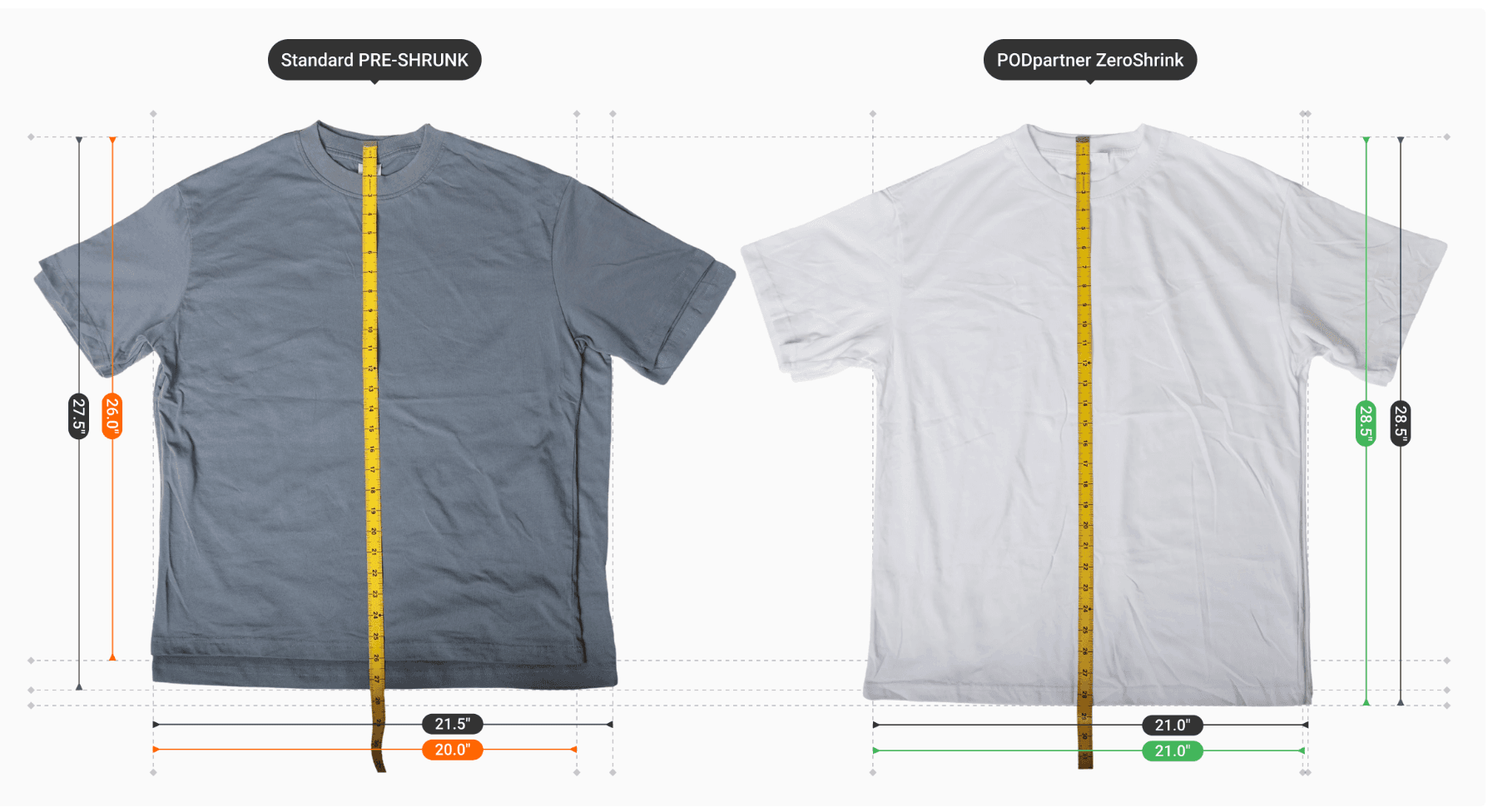
The pre-shrunk shirt on the left lost an inch and a half in both length and width after washing — enough to drop a size. The ZeroShrink shirt on the right held both dimensions inside the ±1″ production tolerance. Same fiber, same starting measurements. The only variable is whether the shrink was driven out before the shirt was cut, or left for the customer's dryer to find.
We ran the same thing across five hot wash-and-dry cycles on video, if you'd rather watch it happen than take our word for the table:
4. Run the wash test yourself: a protocol
The last three sections told you where shrinkage comes from, why the label can't be trusted, and why the standard test misleads you. This section hands you the tool — a standardized protocol, runnable by anyone, about two minutes of hands-on work. Point it at any supplier's blank and it turns a vague "pre-shrunk" on a spec sheet into a number you measured yourself.
The core principle is the same as everything above: test the way your customer actually launders, not the gentlest thing the care label allows. You're checking the worst realistic case, not the best.
Step 1: Measure and record. Lay the garment flat on a hard, level surface, smooth it out naturally, and do not stretch it. Measure two dimensions: body length (from the highest point of the shoulder to the hem) and chest width (across, 1 inch below the armhole). Write them down and take a photo. This is your baseline.
Step 2: Wash it the way your customer will. Not the gentlest setting on the care label — the way your actual market does laundry. If your customers largely run warm or hot water and high-heat tumble drying, then wash it warm or hot and tumble it on high. You're reproducing your customer's laundry room, not a lab.
Step 3: Repeat for 3 to 5 cycles. This is the step most people skip. Around 70–90% of total shrinkage happens in the first 1 to 3 washes, and it stabilizes around the fifth. A single wash underestimates the shrinkage. Run 3 to 5 full wash-and-dry cycles to see where the fabric actually settles.
Step 4: Measure again and calculate the percentage. Lay it flat and measure the same way as Step 1. Shrinkage = (original − washed) ÷ original × 100%. Calculate length and width separately — cotton often shrinks in length while width barely moves, because the yarn was stretched mainly along the length. Averaging the two together hides what's actually happening.
Step 5: Compare across suppliers. Run the identical protocol on blanks from different suppliers and put the numbers side by side. Suddenly "our blanks are pre-shrunk" stops being a claim you either believe or don't, and becomes a column you can compare. That's the real use of this protocol — it doesn't just test one fabric, it lets you measure everyone with the same ruler.
One tell worth knowing: if a swatch comes back from a hot wash and dry having shrunk nothing at all, and the supplier can't tell you what wash condition that was verified against — be suspicious, not reassured. Untreated cotton shrinks 3–5%; that's physics. A genuine near-zero result is the product of a specific, verifiable finishing process, and a supplier who has actually done it can tell you exactly how it was tested. A bare "it won't shrink" with nothing behind it is a claim, not a measurement.
On what to measure and how to measure it precisely, this is the same discipline as verifying fabric weight — we covered it in what GSM actually measures: a spec claim is only a claim until you've measured it yourself.
5. Reading the results: what's normal, and what's your supplier's problem
You've run the test and you've got a set of percentages. Now, how do you tell which number is "normal" and which one means something's wrong?
Start with a baseline: ±1 inch (about 2.5 cm) is the production tolerance the industry generally accepts, and it does not count as shrinkage. Garments are made by real people from a natural fiber, and some dimensional variation between runs — even between pieces in the same run — is physically unavoidable. No supplier and no process escapes it. So if your washed measurement lands within an inch of the size chart, that's normal production variance, not a fault in the fabric.
Past that, it's shrinkage, and it's a problem.
Here's a concrete line. A size M t-shirt with a chart body length of 28.3″ measures 26.8″ after washing. That's a 1.5″ difference, past the 1″ threshold — not tolerance, shrinkage, and grounds to go back to your supplier. The whole point is drawing that line clearly: tolerance is a physical reality, shrinkage is an avoidable failure, and one inch is the boundary between them.
Once you know where the line is, you can use it to protect yourself before a bulk run — not after. Three moves:
Put it in the production agreement, not just the tech pack. The most useful line you can add is that bulk production must use the same fabric as the approved sample, and that shrinkage may not exceed an agreed figure. With that sentence in writing, a shrinking bulk run stops being your problem to eat and becomes the supplier's breach to fix.
This isn't hypothetical — brands negotiate exactly this. In one public thread, a founder sourcing tees had a sample that fit perfectly to his measurements. Before ordering, he asked one more question — how much would it shrink — and the factory told him the 100% cotton would move 6–8%, the blend 4–5%. His reaction was the right one: I hate it when a shirt that fits perfectly shrinks after washing, and I'm sure my customers won't appreciate it either. He walked, on the grounds that a supplier who couldn't offer a properly pre-shrunk blank wasn't the right one. Another maker in the same thread put the number in context: a tee moving 6–8% points to fabric that wasn't tested and a loosely spun knit — a 100% cotton tee should move only 1–2% total after washing — and the takeaway was blunt: wash them yourself before the bulk order, or you may end up with a large quantity of clothing you can't sell.
Weigh — and wash — a sample from the bulk run, not just the pre-production sample. Pre-production samples are often made in small batches, sometimes half by hand; bulk is machine-run at volume, and swapping in a cheaper fabric lot or skipping a finishing step is a real thing that happens at that stage. The gap between those two is exactly where the problem hides.
And don't treat the testing as overhead worth skipping to save time. One private-label manufacturer described a brand that asked to skip the wash test to make a launch date. The factory pushed back and ran it anyway — and found the fleece shrank more than expected and twisted at the side seam. Shipped on the original plan, the whole run would have shrunk half a size in the customer's first wash. Their math: fixing a flaw on one sample costs one sample; fixing it after bulk means rework, replacement, or scrap across the entire order, plus a blown delivery date and a customer already waiting. The few days a wash test "costs" are almost always cheaper than the alternative.
6. The fix: shrinkage should happen on the production line, not in your customer's washer
The last five sections were about the problem and how to test for it yourself. This one is about the fix — and it's already sitting in the logic of everything above.
You can't control how your customer does laundry. What you can control is the state the fabric is in before it becomes a garment. So the real fix isn't more care instructions on a hangtag, and it isn't hoping the customer treats it gently. It's driving the shrinkage out at the source: washing and drying the fabric before it's cut, so it shrinks while it's still fabric — and by the time it reaches the cutting table, it's stable, with nothing left to give.
This is also why a print-only POD platform can't do it: they never touch the fabric upstream. The blank is bought in from a third party and they print on the finished garment. Whether shrinkage was handled, and how, was decided before the blank ever reached them — a layer they can't see and can't control. It isn't a matter of effort. Structurally, they can't reach it.
This is exactly what PODpartner's ZeroShrink does. We run our own production line, and the fabric is pre-washed and tumble-dried before it's cut — so the shrinkage happens on our line, not in your customer's washer. And it answers the two questions we left open back in section 2 — what was it tested against, and does anyone stand behind it — directly: it's verified against tumble-drying (not air-drying), and it's backed by a written guarantee.
We state the guarantee plainly, no hedging: if a ZeroShrink product, after a wash that follows the care label, measures more than 1 inch (2.5 cm) shorter than the size chart, you can file within 30 days of delivery with your order number and a flat-lay photo with a tape measure, and we remake and reship it free, or refund it — reviewed within 5 business days. (Full terms on the ZeroShrink Guarantee page.)
Notice the wording. We don't say "zero shrinkage." Shrinkage is physics; tolerance is a reality. What we say is that we keep shrinkage inside the production tolerance, and if it ever falls outside, that's on us — which is the same line you learned to measure against a few sections ago.
7. Frequently asked questions
Does cotton shrink?
Yes. All cotton shrinks, because the fibers are stretched under tension during spinning and construction and contract back toward their natural length when water gets into them. The real question isn't whether it shrinks, but how much, and whether that shrinkage was driven out before it became your problem.
Does pre-shrunk cotton still shrink?
It can, depending on how it was pre-shrunk and what it was tested against. A blank labeled "pre-shrunk" and benchmarked to air-drying can still lose 2–7% in a hot home dryer. Pre-shrinking once doesn't mean it will survive the way your customer actually launders.
How much shrinkage is normal?
Within about ±1 inch (2.5 cm) is the production tolerance the industry generally accepts, and it isn't counted as shrinkage. Beyond that range, it's a problem you have grounds to raise with your supplier.
How do I test whether a blank shrinks?
Lay it flat and measure body length and chest width, then wash it the way your customer actually will (usually warm or hot water and a high-heat tumble dry), repeat for 3 to 5 cycles, and measure again — calculating length and width separately. Run the identical process on blanks from different suppliers to compare them directly.
What's the difference between sanforized and pre-shrunk?
Sanforization is a decades-old, verifiable, controlled compressive pre-shrink process that proves near-zero shrinkage is achievable. "Pre-shrunk" on a hangtag, with no stated test condition, only means a shrink step happened — it doesn't guarantee a result. The difference isn't the name; it's what the process was tested against and whether anyone stands behind the result.
Should I wash in hot or cold water to prevent shrinking?
Cold water reduces shrinkage, but the bigger driver is the high-heat tumble dryer, not water temperature. And you can't control how your customer launders — so rather than trying to teach customers to change their habits, start from a blank that already had the shrinkage handled.
Why does the same brand shrink differently between batches?
Because a blank's shrinkage depends on the specific lot's treatment and finishing, and that can vary between runs — even between colors of the same style, since the dye process affects shrinkage. This is exactly why the brand and the "pre-shrunk" label aren't enough on their own: you have to test the specific style and lot you're actually going to use.
Is the dryer the main cause of shrinkage?
Yes. The dryer applies high heat and mechanical tumbling at the moment the fiber is wet and mobile, which shrinks it more aggressively than hot water alone. And most of your market tumble-dries — which is why a shrinkage figure "measured to air-dry" misleads you.
Every question worth asking about shrinkage comes down to the same thing: whether the fabric had its shrinkage driven out before it reached your customer. And that isn't something a word on a hangtag, or your customer's laundry habits, can guarantee.
Most of PODpartner's blanks are pre-shrunk on our own line — the washing and drying happen before the fabric is cut, so the shrinkage happens here, not in your customer's home. We keep it inside the production tolerance, and if it ever falls outside, we stand behind it in writing: shrink past 1 inch, and it's a free remake or refund. Standard on cotton and cotton-rich styles (tees, long sleeves, hoodies, crewnecks, sweatshirts, sweatpants), from a single unit, no minimums.
Before you bet a whole run on a "pre-shrunk" label, test one yourself first.
Explore ZeroShrink →