
 USD
USD
Church Merch That People Actually Wear

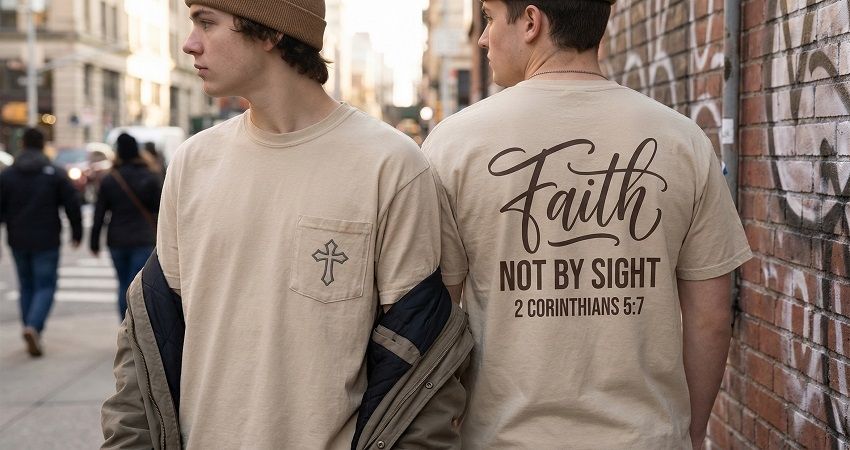
Most church merch doesn't get worn because it's made as a promotional item instead of a piece of clothing. It gets one wear at the event, then it sits in a drawer. Merch people actually wear starts as a genuinely good shirt or hoodie first. The faith message rides along instead of leading the design.
1. Why Most Church Merch Doesn't Get Worn
Someone needs shirts for an event by a certain date, and the budget is tight. That's usually how the brief starts, and it explains a lot about how the shirt turns out. The easiest path is a big church logo on the front, the event name and year on the back, printed on whatever blank shirt costs the least per unit. That shirt does its job at the event. It gets a name tag, a wristband, a photo. Then the event ends, and the shirt goes in a drawer. Merch people actually wear starts from a different goal: a genuinely good piece of clothing a person would pick out on their own, with the faith message riding along inside that design instead of leading it.
Once that shirt is home, it competes with everything else in the closet. A boxy cotton tee with a stiff full-front print and an event date from three years ago rarely wins that competition. It isn't that the person doesn't care about their faith. The shirt was made to promote the church at one event, and it never had a second job to do. Most church merchandise only solves that first problem and stops there.
That's the pattern behind a lot of the frustration you find when church staff and volunteers compare notes online: closets full of shirts nobody reaches for, a leftover box of XLs sitting in a supply room, a fresh order every year because last year's batch never really got used. The shirt did its promotional job once. It was never designed to survive contact with someone's actual wardrobe, and nobody planned for it to.
2. Church Merch Ideas That People Actually Wear
The best church merch ideas all start the same way: flip the brief. Treat the shirt or hoodie as a garment first, something a person picks out of their closet because it looks good and fits well, and let the faith message ride along instead of leading.
Design. The layout stays simple: one idea, real typography or a small symbol, sized the way a clothing brand would size a logo. When a church runs more than one design at once, matching the type and layout choices across pieces makes them read as a single collection instead of a handful of shirts designed in isolation.
Fabric. The garment feels like something worth keeping. A tee benefits from a softer, tri-blend or ring-spun cotton that feels good against skin day to day, while a hoodie needs the weight and structure to hold its shape. A print that survives a wash cycle instead of cracking after a few matters as much as the fabric underneath it, and a muted color, navy, olive, heather gray, tends to get worn more often than a bright primary.
Faith expression. The message is present but restrained: a verse on the back, a symbol on the chest, a phrase that reads like a personal statement rather than an announcement.
Those three things working together are what separate a shirt someone wears to volunteer on a Saturday from one that never leaves the drawer.
3. The Design Direction for Christian Apparel and Faith Expression
Christian apparel that's held up over time tends to be design-forward rather than promotional. Brands like God Is Dope built a following on a few words in clean type on a plain fabric, no illustration, no clutter around it. NOTW took a different route and folded a symbol into its own logo instead of laying a cross over the front of every shirt. Neither brand is trying to look like a flyer. Both read closer to a streetwear label that happens to carry a faith message.
That's a useful reference point even outside faith apparel. Look at how Fear of God's Essentials line or Aimé Leon Dore handle a logo: small, placed with intention, often just type. Nike does something similar with the Swoosh, a mark small enough that it doesn't have to shout to be recognized. None of those brands are making a statement about faith. They're making a point about restraint, and it's the same point a well-designed church shirt has to make. A cross doesn't need to cover the whole chest to mean something. A verse doesn't need sixty-point type to be read.
A useful rule of thumb here: aim for something a step more considered than what a congregation would pick for itself, enough of a stretch to feel intentional without going so far that nobody actually wears it. The same restraint logic applies to finish as much as it does to layout. A metallic or glitter accent on a logo is often the exact detail that tips a design from restrained into overdone. It applies to how specific a symbol gets, too. A phrase or image that only makes sense to someone deep inside a particular tradition can read as closed off to everyone outside it, while a simpler, more recognizable message doesn't carry that risk.
This is also why the pieces that hold up tend to work outside of Sunday too. A shirt built with real garment sensibility gets worn to run errands or meet friends as easily as it gets worn to a church event, because it doesn't announce where it came from before anyone even reads it. That kind of everyday range comes straight out of the design choices made early on. Good design earns wear beyond the people it was made for, too. A well-executed faith apparel piece regularly gets worn by people outside the faith it represents, purely because the design holds up on its own, which is about the clearest sign a shirt has crossed over from a promotional item into a genuine piece of clothing.
None of this is about copying a brand's playbook to become the next one. It's a reference point for what a restrained design looks like when it's doing less and saying more. A church's own colors, its own language, its own visual identity still has to lead the design. The takeaway is the level of restraint itself. The specific look of any single brand matters far less than the habit of holding back.
4. Church T-Shirts and Hoodies: What Fabric and Print Method Decide
Church t-shirts and hoodies only get worn again if they feel good the second time too. That's a fabric question before it's a design question. A heavyweight fabric, something in the 440GSM range, holds its shape wash after wash instead of going thin and shapeless by the third laundry cycle. That weight is part of why a hoodie built on it reads as real outerwear instead of a giveaway. Anything worn to a baptism needs that same weight for a more specific reason: a thin fabric goes see-through the moment it's wet, which a heavier blank simply avoids.
Print method matters just as much. A flat, all-over print on cheap cotton looks and feels like an ad the moment it starts to crack. Embroidery, DTG, and heat transfer vinyl can all live on the same garment, and each one changes how a faith message reads. Embroidery gives a small symbol texture and weight instead of a flat block of ink, closer to a logo on a jacket than a slogan on a poster. DTG holds fine detail for a verse or an illustration. HTV works well for a clean type treatment on a sleeve or hem. Combining them on one piece lets a design layer the way a considered garment does, instead of flattening everything into one loud graphic. If prints are cracking or fading faster than they should, this breakdown of why prints crack after washing covers what causes it and how to avoid it.
One merchant selling apparel through PODpartner put it simply in a review on the Shopify App Store: the cloth quality is there, and it's something a customer notices the moment they put the piece on. That's the whole test for church merch too. Someone puts it on, and either it feels like something worth reaching for again or it doesn't.
A heavyweight hoodie is a common starting point for churches because it works across seasons and holds a design well, whether that's an embroidered mark on the chest or a printed graphic on the back. PODpartner's 440GSM oversized hoodie is built on that heavier fabric, with a 24x24 inch print area and more than 21 print positions to place a mark where it actually belongs on the garment instead of wherever a template allows.
5. How to Start Ordering Church Merch
Whoever ends up in charge of merch, often a volunteer taking it on alongside everything else, usually has two real worries: finding a vendor that won't blow a tight budget, and finding one that communicates clearly enough to get sizing and placement right the first time. Starting smaller solves both problems better than starting big does. One well-designed hoodie will get worn far more than three mediocre options ordered because a big batch felt efficient, and a shirt for volunteers and a shirt for an outreach event are two different design problems that one generic design usually leaves half-solved.
Start with one or two styles: a hoodie for cooler months and a simple tee for the rest of the year, rather than trying to cover every ministry on one shirt. Test in a small batch before committing to a run for the whole congregation. A single design ordered in bulk before anyone has actually worn it is exactly how a supply closet fills up with extras nobody claims. Order a sample first and check the fabric weight and the print quality on an actual piece, including how a back design looks from the front. A heavy print on the back can show through faintly on a front-facing photo, or even in person, and that alone can make a well-made garment look cheaper than it is. Minimum orders can start at a single unit, so testing a design doesn't require a bulk commitment up front.
6. Design Church Merch Your Community Will Actually Wear
Church merch works the same way any other apparel does. People wear what looks good and feels good, and they leave the rest folded at the bottom of a drawer. A design that earns a place in someone's regular rotation does more for how a faith community shows up in the world than a stack of shirts everyone forgot about by the following spring.
If a hoodie feels like the right starting point, PODpartner's heavyweight hoodie is built for that kind of everyday wear. Or browse the full product catalog to see what fits a congregation's style and budget, and start with a small order to see how it actually wears before committing to more.
7. Frequently asked questions
How do I make church merch people will actually wear?
Design it like a real piece of clothing first. Keep the graphic small and restrained, use a heavier fabric that holds up in the wash, and let the faith message read as part of the design instead of an announcement printed across the chest.
What should church merch be made of?
Look for a heavier weight fabric, something in the 440GSM range, since it holds its shape and print quality over repeated washes better than a thin, cheap blank. A print method that resists cracking matters as much as the fabric itself.
How many pieces should we order to start?
Start small. Orders can begin at a single piece, so a church can test a design's fit, fabric, and print quality with a small batch before committing to a larger run for the congregation.
Can we do embroidery on church hoodies?
Yes. Embroidery works well for a small symbol or mark on a hoodie chest or sleeve, and it can be combined with DTG or heat transfer vinyl on the same garment for different parts of a design.
How do we design church merch that isn't cheesy?
Keep it simple. One idea per shirt, restrained typography or a small symbol instead of an oversized graphic, and no more than two or three colors. A verse or symbol works better as a detail than as the whole design.
What's the difference between church merch and church merchandise?
Nothing beyond wording. Both describe the same category, apparel and items branded for a church or ministry, and the same design and fabric principles apply to either term.
Most church merch is made as a promotional item and worn once. The pieces that stick around start as a genuinely good shirt or hoodie first, with the faith message riding along instead of leading the design.
PODpartner builds on heavier, wash-durable fabric with embroidery, DTG, and HTV available on the same garment, and orders can start at a single piece so a design gets tested before a congregation-wide run.
Design merch your community will actually wear.
See what PODpartner makes →