
 USD
USD
PODpartner vs Printful vs Printify (2026): Production, Print Size, Embroidery and Pricing Compared

Updated October 2026
PODpartner vs Printful vs Printify: which is best for an apparel brand?
They run three different models. PODpartner manufactures its own garments and prints in-house — heavyweight 100% cotton blanks up to 440 GSM, 24″×24″ Jumbo DTG, 21 print placements, 15-colour embroidery and mixed decoration on one garment — but sells apparel only and ships from China. Printful owns print facilities in the US, Europe and beyond, with the widest integrations and faster local delivery. Printify connects you to 90+ independent print providers, with the broadest catalog and lowest entry costs, but quality and speed vary by provider. Choose PODpartner for premium, heavyweight apparel; Printful for convenience and local speed; Printify for low-cost testing across many product types.
If you're weighing a specific switch, see our dedicated guides: Printful alternatives and Printify alternatives.
According to Future Market Insights, the print-on-demand market — valued at $11 billion in 2025 — is entering a high-growth phase and is projected to reach $89.4 billion by 2035. Three forces drive it: the rise of e-commerce, the shift toward asset-light, fast-iteration business models, and the growth of social media and the creator economy.
For merchants, print on demand means selling custom apparel and products without holding inventory, cutting upfront costs and waste. Integrations with Shopify and Etsy have made it accessible to independent creators and small brands.
This guide compares PODpartner, Printful and Printify on features, catalog, printing technology, pricing and shipping, so you can match each platform's strategy to your brand.
1. Key Features and Services
The three companies illustrate three distinct ways a POD business can manage production, integrations and the seller experience.
Production models
PODpartner runs its own garment manufacturing factory as well as its own print facility. That gives it control from fabric to finished print, so samples match bulk orders and every item is checked before packing and shipping.
Printful is one of the most established POD providers, operating its own print facilities across the U.S., Europe and other regions, which keeps print quality consistent and delivery local in those markets.
Printify is an open platform connecting merchants with 90+ independent print providers and a large catalog. Merchants compare providers by product, price, production time, location and reviews — flexible, but quality depends on which provider fulfils the order.
Platform integrations
PODpartner connects with Shopify, Etsy, WooCommerce, Wix and Squarespace.
Printful connects with Shopify, Etsy, WooCommerce, Wix, Squarespace, BigCommerce, Ecwid, Amazon, TikTok Shop and more, automating product syncing, orders and fulfilment.
Printify integrates with Shopify, WooCommerce, BigCommerce, PrestaShop, Wix, Etsy and eBay, plus Shutterstock for design resources and API options such as TikTok Shop.
Seller experience
PODpartner: a clean dashboard for product setup and order management, with transparent production updates, real-time order tracking and pre-shipment photo verification. Production time is published on every product page — currently 1.7 to 2.8 business days — and orders under $800 carry a promised turnaround of about 3 business days, backed by a written delay compensation policy. Support runs via WhatsApp, Messenger, online chat and email, with a Help Center for self-service answers.
Printful: a stable fulfilment network and polished experience, with a mockup generator, order tracking and analytics. Printful reports a 99.76% order success rate. Users get 20% off Fiverr design services, and support is available 24/7 via live chat and email.
Printify: a beginner-friendly dashboard with a drag-and-drop Product Creator and a supplier rating system to balance cost, quality and delivery time. It also connects with Fiverr and Shutterstock. Production and shipping are handled by individual providers rather than in-house.
Core features compared
| Company | Production model | Integrations | Seller experience |
|---|---|---|---|
| PODpartner | Own garment factory and print facility; production 1.7–2.8 business days, published per product | Shopify, Etsy, WooCommerce, Wix, Squarespace | Production updates, pre-shipment photos, real-time tracking; written delay compensation; WhatsApp, Messenger, chat and email support |
| Printful | Own print facilities across the U.S., Europe and other regions; reports a 99.76% order success rate | Shopify, Etsy, WooCommerce, Wix, Squarespace, BigCommerce, Ecwid, Amazon, TikTok Shop | Mockup generator and analytics; 24/7 live chat and email |
| Printify | Network of 90+ independent print providers | Shopify, WooCommerce, BigCommerce, PrestaShop, Wix, Etsy, eBay, plus Shutterstock and TikTok Shop | Drag-and-drop Product Creator; supplier ratings to balance cost, quality and speed |
2. Catalog and Printing Technology
PODpartner
PODpartner specialises in apparel — unisex streetwear and everyday essentials, curated around garment quality rather than catalog breadth: t-shirts, long sleeves, hoodies, sweatshirts, tank tops, shorts and pants for men and women, about 150 products in total.
Printing and embroidery are done in-house: DTG on Brother GTX Pro-B printers, and embroidery on Tajima TMEZ-S1501C machines with Coats Sylko 120D thread. The standard DTG print area is up to 16″×21″, and Jumbo DTG goes up to 24″×24″. Across print and embroidery there are up to 21 placements, including shoulders, pocket, hem and inner neck.
Embroidery supports up to 15 thread colours per design — more than the 6-colour cap on Printful's and Printify's standard embroidery — and a maximum area of 12″×12″. You can upload professional DST files, which preserve exact stitch paths and thread order, or upload an image for digitising. 3D puff embroidery runs on garments as well as hats.
Because PODpartner makes its own blanks, it can offer heavyweight 100% cotton garments — tees from 240 to 425 GSM and hoodies up to 440 GSM — and its Hybrid Process combines DTG, embroidery and Heat Transfer Vinyl on the same garment for a flat $2.99. That makes it a strong fit for streetwear and premium brands that need deep customisation.

Printful
Printful offers 370+ customisable products across apparel, accessories and home décor — from t-shirts, hoodies and dresses to shoes, tote bags, mugs, posters and blankets.
It supports DTG, all-over sublimation (AOP), DTF and embroidery. AOP prints full-coverage designs on polyester fabric before the garment is sewn, with production times of 2–7 business days. Standard embroidery uses a 15-colour palette with up to 6 colours per design; an unlimited-colour option, which dyes a single thread with CMYK inks during stitching, costs an additional $3.95 per item on selected products. Standard DTG print area is 15″×18″ on select products, and 3D puff embroidery is available on hats only.
Printify
Printify offers one of the largest catalogs in print on demand — apparel, accessories, home décor and more — through 90+ print providers in multiple countries, with curated "Printify Choice" suppliers for faster shipping and reliable stock.
Capabilities depend on the provider: DTG on cotton (up to around 14″×18″ on some products), sublimation for all-over prints on polyester, embroidery, laser engraving, and UV printing for drinkware. Embroidery colour limits and print sizes vary by provider, so sample before committing.
3. Pricing and Shipping
PODpartner
No subscription is required. The listed product price already includes one DTG print area (up to 16″×21″), so if a design needs only one print, you pay the product price and shipping — no separate print fee.
Base prices start at $6.61 for a 180 GSM Classic Fit tee, with heavyweight 440 GSM hoodies from about $29.31. Additional DTG placements are priced by area, and embroidery fees start at $1.99. Low base costs on heavyweight garments, plus on-demand hangtags and packaging, give brands room to price at premium retail levels.
Orders ship from China. At the time of writing, sending one t-shirt to the U.S. costs $4.96 for the first item and $2.44 for each additional item by standard shipping (7–12 business days), or $27.88 and $4.26 by express (3–5 business days). See the shipping page for current rates. If an order arrives later than the promised duration, PODpartner's delay compensation policy pays 1% of the order amount per delayed business day, capped at 20%, and offers a free reshipment or full refund plus 10% if a package is more than 20 business days late.
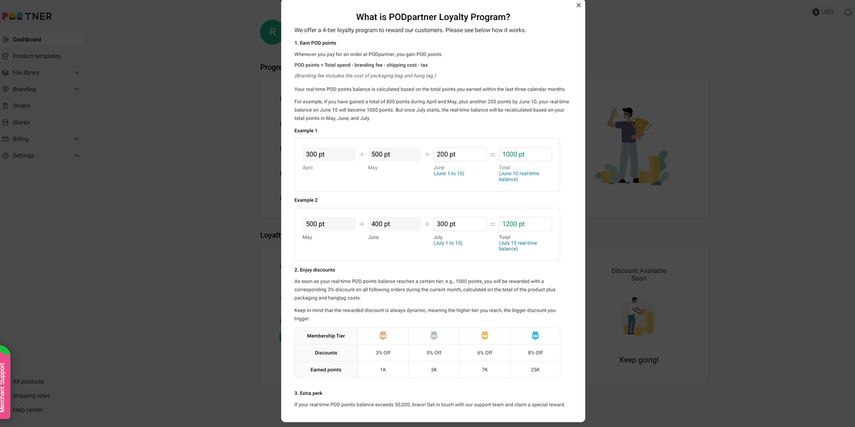
A four-tier loyalty program awards POD points for each order (total spend minus branding, shipping and tax), calculated on the last three months of activity: 1K points unlock 3% off, 3K points 5%, 7K points 6%, and 25K points 8% on products and packaging/hangtag costs. Sellers with more than 50K points can contact support for a special reward.
Printful
No mandatory subscription: you pay for products, fulfilment, shipping and taxes per order. Base prices include a blank and a standard print and vary by product and region — for example, a Gildan t-shirt in the US/EU at $6.95, and Bella+Canvas from $9.25 to $11.50. Extra prints and branding such as custom labels ($0.99–$2.49) cost more. The optional Growth plan ($24.99/month, free after $12K in annual sales) gives up to 33% off products and 9% off branding. Flat-rate shipping: the first U.S. t-shirt is $4.75 (+$2.20 per additional item), Europe $4.79 (+$1.45), with handling times of 2–5 business days.
Printify
The free plan gives access to all products. The Premium plan ($29/month, or $24.99/month annually) gives 20% off all products and supports multiple stores; Enterprise offers custom pricing for high-volume sellers. Costs vary by provider — t-shirts typically $8–$12 (Bella+Canvas $8.50–$11). Shipping also depends on the provider: U.S. domestic t-shirts $3.99–$8 (2–5 business days), Europe and international $7–$15+ (5–15 business days), with seasonal surcharges at peak times.
| Item | PODpartner | Printful | Printify |
|---|---|---|---|
| Subscription | None | Optional Growth plan $24.99/month (free after $12K annual sales) | Free plan; Premium $29/month ($24.99 annually); Enterprise custom |
| Base apparel price | Tees from $6.61 (180 GSM); 440 GSM hoodies from about $29.31 | Gildan tee $6.95; Bella+Canvas $9.25–$11.50 | Tees $8–$12 (Bella+Canvas $8.50–$11) |
| Heaviest hoodie | 440 GSM, 100% cotton, made in-house | Varies by blank brand | Varies by provider |
| Max print size | 24″×24″ Jumbo DTG; 16″×21″ standard | 15″×18″ on select products | Varies by provider |
| Printing / embroidery fees | First DTG area included; extra areas by size; embroidery from $1.99 | Standard print included; labels $0.99–$2.49 | Varies by provider |
| Shipping to the U.S. | From China: standard 7–12 days, $4.96 first tee + $2.44 each; express 3–5 days, $27.88 + $4.26 each | Flat rate $4.75 first tee + $2.20 each; handling 2–5 business days | $3.99–$8 domestic (2–5 days), varies by provider |
| Best for | Premium and streetwear brands needing heavyweight garments, large prints and mixed decoration | Sellers wanting ease of use, wide integrations and local delivery | Sellers testing many products at low cost |
4. How to Choose
PODpartner suits independent apparel brands that want to stand out: heavyweight in-house garments, 24″×24″ Jumbo DTG, 21 placements, 15-colour embroidery, mixed decoration and made-to-order branding for a premium unboxing. The trade-offs are an apparel-only catalog and shipping from China.
Printful stands out for its own facilities in multiple regions, a broad catalog including accessories and home goods, all-over print, and the widest set of integrations — though higher base prices can squeeze margins.
Printify offers flexible pricing and a large provider network, ideal for sellers testing products or markets — though quality and shipping speed vary between providers.
For brands with diverse catalogs, running more than one POD platform — for example, PODpartner for hero apparel and Printify or Printful for non-apparel — balances quality, flexibility and profitability.
5. FAQs
Which is better for apparel brands: PODpartner, Printful or Printify?
For premium or streetwear apparel, PODpartner: it makes its own heavyweight garments (up to 440 GSM) and offers 24″×24″ Jumbo DTG, 21 placements, 15-colour embroidery and mixed decoration. For ease of use and fast local delivery, Printful. For the lowest entry cost across many product types, Printify.
How fast is PODpartner compared with Printful and Printify?
PODpartner's production takes 1.7 to 2.8 business days depending on the product, then ships from China in 7–12 business days standard or 3–5 express. Printful's handling time is 2–5 business days with local shipping in the U.S. and Europe. Printify's speed depends on the provider.
Do I need a subscription for any of them?
No. PODpartner has no subscription. Printful and Printify both have free tiers, with optional paid plans (Printful Growth at $24.99/month, Printify Premium at $29/month) that lower product costs.
Which has the best embroidery?
PODpartner supports up to 15 thread colours per design, DST file uploads, a 12″×12″ maximum area and 3D puff on garments. Printful's standard embroidery is capped at 6 colours per design, with an unlimited-colour option at $3.95 on selected items. Printify's embroidery varies by provider.
Related Reading