
 USD
USD
Best Tapstitch Alternatives in 2026: An Honest Look at Where Each One Fits

Updated October 2026
What are the best Tapstitch alternatives in 2026?
It depends on which Tapstitch limit you've hit. If you need more decoration than DTG and DTF, PODpartner is the closest fit: 24″×24″ Jumbo DTG vs Tapstitch's ~12″×16″, 21+ print placements vs 4, five decoration methods including 15-colour embroidery and six Heat Transfer Vinyl finishes, and DTG + embroidery + Heat Transfer Vinyl on one garment in a single production pass. If you need fast US delivery across a broad catalog, Printful's US facilities cover far more than Tapstitch's 34 LA-fulfilled products. Stay with Tapstitch if your priority is catalog breadth (799 styles), a 500 GSM blend hoodie or insert cards. PODpartner ships from China in 7–12 days, or 3–5 days express — the same standard window as 96% of Tapstitch's catalog.
1. You're reading Tapstitch reviews. Here's what reviewers usually skip.
You're already on this page because you've seen Tapstitch's product. The reviews you've found so far probably told you the GSM (Tapstitch's RW0035 hoodie ships at 500 GSM, which is genuinely heavyweight), the catalog size (799 product styles across streetwear, activewear, and matching sets), and the comparison points against Printful on US fulfillment speed.
Here's what they usually skip:
Tapstitch's US LA fulfillment is available on 34 products. Their broader catalog is 799 product styles — meaning 96% of what they sell can only ship from China in 7-12 days, the same logistics window as PODpartner. The "Tapstitch is fast" headline applies to about 4% of their catalog.
That doesn't make Tapstitch slow. It means the comparison most reviews run — speed vs. craft scope — only holds on a curated sliver of what Tapstitch actually sells. For the other 96%, the comparison shifts entirely to which vendor offers more decoration scope, more print zones, and a branding workflow that fits how your team actually ships.
Here's the thesis this article carries: different products need different tools. Most established brand-builders don't pick one vendor — they run 3-5, and assign each product to whichever one fits that product's requirements. If you want the side-by-side on how the two operations differ at the production level, that's covered in the detailed PODpartner vs Tapstitch comparison.
If you've been searching for "Tapstitch alternative" expecting to find one platform that beats Tapstitch at everything — that's the wrong question. The right question is: which slot in your stack does Tapstitch fill, and which slot does it leave empty?
This article is the answer.
2. Why most Tapstitch reviews miss the brand-builder lens
Open any of the top-ranking Tapstitch reviews from 2026 and you'll see the same structure: a feature list, a pricing table, a UI walkthrough, a "pros and cons" summary, and a verdict tilted toward whoever's affiliate-linked. These reviews exist because they answer a specific question — "should I sign up?" — for a specific audience: someone evaluating their first POD platform.
That's not a wrong question. It's just the wrong question for you.
If you're already at $20K+/month, running a 3-5 vendor stack, and your catalog has both spread products and hero products, you don't ask "should I sign up for Tapstitch?" You ask: at which point in my catalog does Tapstitch stop fitting, and what fills that gap?
That's a different question. It can't be answered by a feature list. It has to be answered by mapping Tapstitch's structural choices — and the trade-offs that come with them — against what your brand actually ships.
So that's what this does.
3. What Tapstitch actually does well (and we mean it)
This section is the trust foundation for everything that follows. If we can't accurately name where Tapstitch wins, you shouldn't trust us when we name where it doesn't.
Tapstitch wins on four things that brand-builders genuinely care about.
1. US LA fulfillment speed — on the products that qualify. Their facility at 4730 Littlejohn St in Baldwin Park, California, ships standard orders to US customers in approximately 5 business days. That's a real advantage for the 34 products currently fulfilled from LA. The remaining 96% of their 799-product catalog ships from China in the same 7-12 day window as PODpartner. If your hero products land in the LA-fulfilled 34, this is a structural advantage Tapstitch holds and PODpartner doesn't. If they don't, the US-speed lens stops applying.
2. Catalog spread. 799 product styles across categories — t-shirts, hoodies, sweatpants, matching sets, activewear, accessories — with size and color variants on top of each. PODpartner runs a tighter catalog of approximately 150 products. If your brand drops across many silhouettes and you want one vendor to cover most of them, Tapstitch's spread is real.
3. Heavyweight GSM at 500. Tapstitch's RW0035 fleece-lined hoodie catalog spec is 500 GSM (cotton-polyester blend, 53.75% / 46.25%). On the absolute GSM number, this exceeds PODpartner's 440 GSM heavyweight. Fabric composition is a different trade-off — high cotton optimizes hand-feel and brand-tier perception; high-blend optimizes weight, durability, and cost — and that's a separate decision for each brand. But on GSM alone, Tapstitch wins.
(Side note on industry honesty: ISO 3801 standard measures GSM on finished fabric pre-wash. Customers feel the post-wash number, which is typically 8-15% lower depending on shrinkage control and fiber composition. Neither vendor surfaces this distinction — and that's an industry-wide gap, not a PODpartner-specific dodge. What matters in practice is hand-feel after wash 1, wash 5, wash 50. So wash-test before you commit.)
4. Insert Cards in the branding suite. Both Tapstitch and PODpartner offer custom branding — labels and hangtags. (We'll cover where each wins in the next section.) On one specific spec category, Tapstitch carries a service PODpartner doesn't: custom insert cards (13×9 cm or 13×19 cm, 350gsm cardstock, double-sided print). If unboxing inserts (thank-you notes, promo codes, brand story cards) are part of how your brand earns repeat orders, Tapstitch has the dedicated workflow PODpartner currently doesn't.
These aren't minor concessions. They're real wins. If your business is built on US speed for the handful of products Tapstitch fulfills from LA (just 34 — about 4% of their catalog), catalog spread, branded insert cards, or 500 GSM availability — Tapstitch is the right tool, and the rest of this article isn't trying to talk you out of it.
The rest of this article is about the products and the moments where Tapstitch isn't the right tool. Those exist too.
4. Where Tapstitch hits its ceiling (and PODpartner picks up)
Here's where the lane splits.
Tapstitch supports two decoration methods: Direct-to-Garment (DTG) and Direct-to-Film (DTF). That's confirmed on their own help center FAQ and cross-checked against third-party reviews. The design tool surfaces no other process — no embroidery, no Heat Transfer Vinyl, no sublimation. The platform makes the production choice for you behind the scenes, and the two methods cover the majority of streetwear graphic-print use cases.
PODpartner supports five: DTG, Jumbo DTG, Heat Transfer Vinyl (6 finishes), 15-color Embroidery, and Hybrid Process (multiple decoration methods on the same garment in a single production cycle).
That's not a "PODpartner is better" claim. It's a scope claim. When your design calls for metallic Heat Transfer Vinyl on a sleeve plus 15-color embroidery on the chest plus a full-back DTG graphic — all on the same hoodie — Tapstitch's two-method scope can't reach that combination. PODpartner's five-method scope can. Different scope, different product types served.
The print zone difference is the second structural split. Tapstitch's design tool surfaces a max print zone consistent with the industry-standard 12×16 inch — appropriate for most chest, back, and centered placements. PODpartner's Jumbo DTG supports up to 24×24 inch print zones — roughly 4× the design area, allowing edge-to-edge and full-front graphic compositions that 12×16 physically can't accommodate. If your design language depends on oversized graphics, the zone limit isn't a workaround problem. It's a wall.
The placement count is the third. Tapstitch's product design tool offers four print placements per hoodie: Front, Back, Left Sleeve, Right Sleeve. PODpartner offers 21+ print placements — well beyond the standard front/back/sleeve set. Four vs twenty-one-plus isn't a marginal difference — it's a different idea of what "branded placement" means.
The fourth is multi-process per garment. Tapstitch produces single-method per garment by design. That's not a flaw — it's an operational choice that keeps their LA facility fast. PODpartner's production cycle supports stacking DTG + Embroidery + Heat Transfer Vinyl on a single garment in one production pass. If your hero product's design language requires more than one decoration method co-existing on one piece, this is the structural difference that decides the choice.
The fifth is SLA in writing. Tapstitch's delayed shipment compensation policy reads: "Small-volume orders aim to complete production within 3-7 business days... customers may be eligible for compensation of up to 10% of original product value." Up to 10%. May be eligible. PODpartner's production is typically 1.7–2.8 business days, with a 3-business-day SLA, with compensation of 1% per business day of delay, capped at 20%, and 20+ business day delays triggering free reship or full refund + 10% additional credit. One is intent. The other is contract. Brand-builders managing customer expectations across a launch should read both side-by-side and decide which language reflects how they want delay risk distributed.
The sixth is batch consistency framing. Tapstitch's own product pages openly disclaim: "Minor batch differences can occur during blank garment production due to variations in fabric, dye and processing. This is common in apparel manufacturing." That's honest — and it's also the structural cost of any model that doesn't own yarn → fabric → dye → cut under one roof. PODpartner's batch consistency isn't a marketing flourish. It's what happens when the same hands handle yarn intake through final QC. Where each operation actually sits in the supply chain is the question underneath this one.
The seventh is branding scope. Both vendors offer custom branding — but the scope differs.
Tapstitch branding inventory: custom clothing labels (2 sizes: 2×6 cm and 4×4 cm, black or white only), custom hangtags (single size: 13×5 cm, 350gsm cardstock, white only), custom insert cards (2 sizes: 13×9 or 13×19 cm). All three are immutable once approved and are only available with China international fulfillment — not with the US LA speed they market on the homepage. Their own FAQ documents that the 4×4 label spec has stitching limitations on pants and overlapping wash tags.
PODpartner branding inventory: custom packaging bags (9 color options ranging from coral pink, charcoal, muted lime, turquoise, vivid sky blue, neon orange, translucent, half-translucent half-clear, clear — at $1.49 each), custom hangtags (rounded rectangle, 350gsm paperboard, black or white, 4×7 cm at $0.99 each), and custom neck labels (supports dark and light garment variants, print-based, applied directly inside the collar — no separate sewn-in label).
That's not a "PODpartner branding is better" claim. On branding, it's split — not a sweep either way. Tapstitch wins the insert-card category (PODpartner doesn't offer them). PODpartner wins packaging-bag color options (9 colors — Tapstitch has no custom packaging bag at all). Neck branding is a tie in form, not a win: Tapstitch sews in a printable woven label, PODpartner prints directly inside the neck. And both offer custom hangtags. Different scope, different operational shape.
None of this means Tapstitch makes worse products. It means Tapstitch makes a different kind of product, optimized for different product types and different brand-builder priorities. The question for you is which kind of product your hero pieces are.
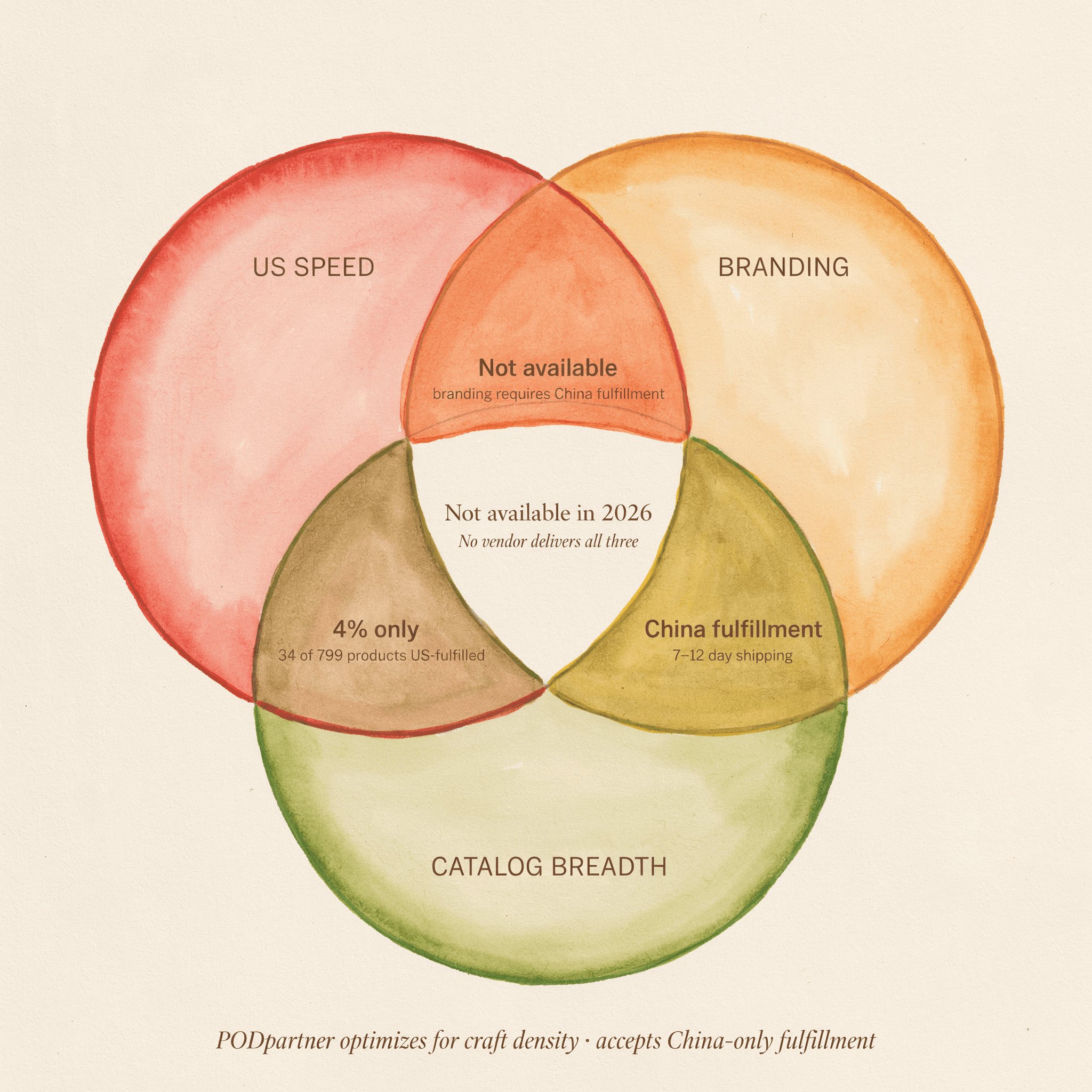
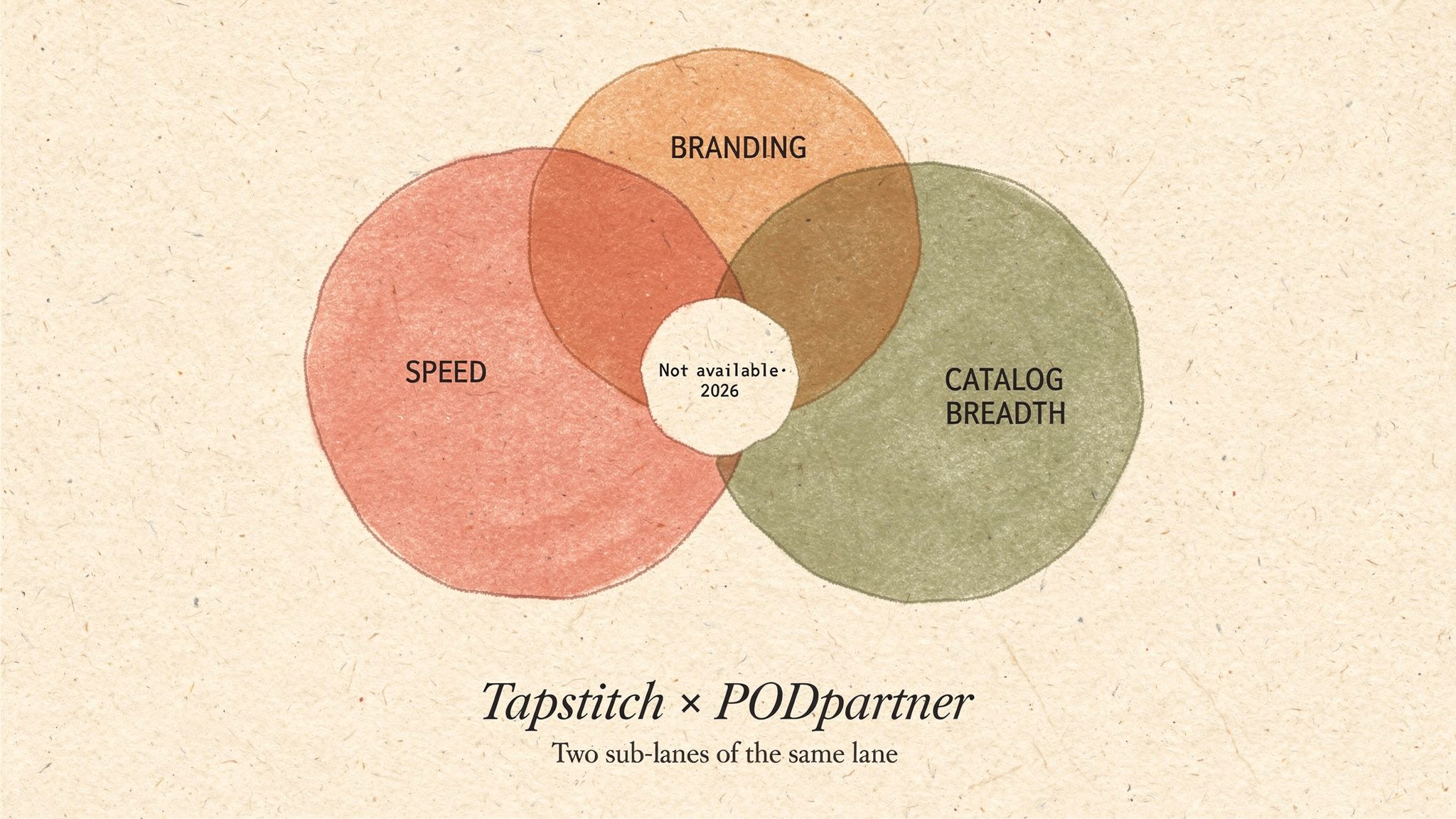
5. The three-axis trade-off: Speed × Branding × Catalog Breadth
Here's a fact-based observation that most Tapstitch reviews don't surface.
Tapstitch positions on the homepage as "Build a real clothing brand with print-on-demand." To deliver on that positioning, they offer three branding categories (labels, hangtags, insert cards) and LA fulfillment for speed.
But each of those services is constrained to a specific axis, and the axes don't overlap cleanly.
Axis 1 — US Speed. LA fulfillment, ~5 day delivery to US customers. Available on 34 products (about 4% of their 799-product catalog).
Axis 2 — Custom Branding. Labels, hangtags, insert cards. Tapstitch's three FAQ pages all confirm the same restriction: "Custom labels are only available with international fulfillment." / "Hangtags are not available for orders fulfilled through US fulfillment." / "Insert cards are not available for orders fulfilled through US fulfillment." Branding requires China fulfillment, which means 7-12 day shipping — same as PODpartner.
Axis 3 — Catalog Breadth. 799 product styles total. 96% of them rely on China fulfillment. The US-LA Speed advantage applies only to the curated 34.
What this means in practice:
- Want speed + 799 catalog breadth? You can pick from 4% of catalog and ship from LA in ~5 days.
- Want speed + custom branding? Not available. Branding requires international fulfillment.
- Want catalog breadth + custom branding? Available — but at 7-12 day shipping from China. The same window as PODpartner.
- Want speed + catalog breadth + custom branding? Not available at any vendor in 2026. That combination doesn't exist yet.
The honest reading: Tapstitch's US LA speed advantage is real but narrow (4% of catalog). For 96% of their products and for any product requiring custom branding, the comparison to PODpartner shifts entirely away from speed — both vendors ship China-fulfilled in 7-12 day window — and lands fully on craft scope, decoration methods, print zones, multi-process capability, and branding scope.
That's not a critique of Tapstitch. It's how the operational economics of POD work in 2026. PODpartner optimized for craft density and multi-process decoration at the cost of US-domestic fulfillment speed. Tapstitch optimized for US-domestic speed on a curated product set at the cost of decoration scope and the speed-branding combination. Neither vendor delivers all three axes simultaneously, because nobody currently does.
6. How PODpartner compares as a Tapstitch alternative: 11 dimensions
For the record. Bookmark this if you ever need to reference it.
| Dimension | Tapstitch | PODpartner | Winner |
|---|---|---|---|
| Catalog spread | 799 products 34 US-LA · 96% China-only | ~150 products all China-fulfilled | Tapstitch |
| US fulfillment speed | ~5 day from LA only 34 products (~4%) — these ship bare, no branding | 7–12 day from China 3–5 day express · branding on full catalog | TS · narrow |
| Max GSM (catalog spec) | 500 GSM RW0035 cotton-poly | 440 GSM | Tapstitch |
| Decoration methods | DTG + DTF 2 methods | DTG · Jumbo DTG · 6 Heat Transfer Vinyl finishes · 15-color Embroidery · Hybrid Process 5 methods | PODpartner |
| Max print zone | ~12×16 inch industry standard | 24×24 inch Jumbo DTG | PODpartner |
| Print placement count | 4 positions | 21+ positions | PODpartner |
| Hybrid decoration on one garment | No | Yes DTG + Embroidery + Heat Transfer Vinyl, one production pass | PODpartner |
| Delay compensation SLA | Up to 10% cap "may be eligible" — discretionary · multiple exclusions | 1%/day, cap 20% reship or refund + 10% at 20+ business days | PODpartner |
| Branding · Packaging bag | No custom option | 9 colors · $1.49 | PODpartner |
| Branding · Insert cards | Yes 13×9 or 13×19 cm · China-fulfilled only | Not offered | Tapstitch |
| Branding · Neck branding | Woven label, sewn-in printable, 2×6 or 4×4 cm · China-fulfilled only | Inner-neck print direct-to-garment · no separate label | Tie |
Six wins for PODpartner, four for Tapstitch, one tie, plus one shared baseline. Both vendors offer custom hangtags (Tapstitch 13×5 cm white / PODpartner 4×7 cm black or white). One note worth flagging: every Tapstitch branding option — hangtag, label, insert card — is China-fulfilled only. The 34 products on its US LA lane ship with no branding at all.
This isn't "one's better." It's a portfolio decision: which set of wins maps to which products in your catalog.
For the full pricing, shipping and manufacturing breakdown, read our complete PODpartner vs Tapstitch comparison.
+ Traditional apparel manufacturer for high-MOQ custom production
Most $20K+/month brand-builders don't pick a single POD vendor. They run a 3-5 vendor stack. Tapstitch and PODpartner aren't an either/or choice — they're different slots in that stack.
A practical example: A streetwear brand running 100 products in their portfolio might assign 60-70 spread products to Tapstitch (mix of US-LA fulfilled for the products that qualify and China-fulfilled for the rest), 5-10 products specifically requiring insert cards to Tapstitch International, and 20-30 hero products to PODpartner (oversized graphic prints, multi-process garments, embroidery-heavy designs, packaging-color-driven drops). Three slots. One brand. No either/or.
PODpartner doesn't ask to be your only POD vendor. The right framing — and this comes directly from the brand's positioning — is: PODpartner asks to be the slot for the products where craft density and multi-process decoration matter. Tapstitch fills the other slots. The remaining slot in your stack might be local screen printing for solid-color 200+ unit drops, or a traditional apparel manufacturer for high-MOQ custom production.
That's how mature brand operations actually run in 2026.
7. Where neither serves you (and that's not a failure — it's an industry gap)
There's one category of brand-builder need that neither Tapstitch nor PODpartner addresses fully in 2026, and being honest about it matters.
If you want fully bespoke woven labels — any custom size you specify (not constrained to 2×6 / 4×4 / 4×7 cm standards), custom thread colors beyond black or white, multiple stitching methods, custom material weave — that's still the territory of traditional apparel manufacturing with 500+ unit minimums. Both vendors offer custom branding within their fixed spec catalogs (Tapstitch 2 label sizes B/W, PODpartner 4×7 hangtag B/W, etc.) — and within those specs both can deliver — but the fully-custom-no-spec-limit version of woven labeling exists at neither vendor.
If you need that level of label customization, you're looking at traditional manufacturing, with the MOQ and lead time that comes with it. That's the industry-wide gap. It's not Tapstitch's failure. It's not PODpartner's failure. It's how POD economics constrain customization scope in 2026.
The same applies to fully custom garment patterns at a 1-piece minimum — neither vendor offers this today.
Naming the gap honestly is part of how PODpartner shows up. If we recommended PODpartner for a product it can't deliver, we'd lose your trust the moment you placed the order. Pointing to where neither vendor — including us — is the right answer is how we earn your decision when we are.
8. When to choose Tapstitch over PODpartner — and vice versa
Three clean decision rules. No hedging.
Choose Tapstitch (US LA fulfillment) when:
- Your hero product lives in their 34-product US-fulfilled subset
- 90%+ of your orders ship to US customers and 5-day delivery is non-negotiable
- Your design language fits within standard 12×16 inch DTG on front/back/sleeves
- You don't need custom labels, hangtags, insert cards, or packaging bags day-one (US fulfillment doesn't offer them)
- You don't need decoration combinations beyond DTG/DTF
- You accept that this advantage is narrow (about 4% of Tapstitch's catalog)
Choose Tapstitch (International fulfillment) when:
- Your launch specifically requires insert cards (the one branding category PODpartner doesn't offer)
- Your catalog requirements span 50+ silhouettes that benefit from one-vendor consolidation
- 7-12 day shipping is acceptable (same as PODpartner anyway)
- Your decoration needs fit DTG/DTF single-method scope
Choose PODpartner when:
- Your hero product requires multiple decoration methods on one garment (DTG + Embroidery + Heat Transfer Vinyl combinations)
- Your design uses Jumbo prints (over 12×16, up to 24×24 inch)
- You need 15-color embroidery with DST file workflow
- You need print placement beyond Front/Back/Sleeves (21+ positions)
- Batch consistency verifiable via yarn-to-QC operational chain matters for your hero products
- Post-wash sizing consistency matters for your returns rate (ZeroShrink fabric on most hero styles is pre-washed, not pre-shrunk)
9. Honest take, honest verdict
If you've read this far and your hero products fit Tapstitch's scope cleanly — keep going with them. The platform delivers on what it positions for.
If you've recognized that 2 or more of these specific patterns describe your situation — Jumbo DTG designs cut down to 12×16, multi-decoration designs split across vendors and stitched together in post, embroidery limitations forcing you into print-only workflows, hero products where batch inconsistency in reviews is starting to affect repurchase rate, "ran small after washing" complaints driving size-swap returns, designs simple enough that competitors knock them off within a season, or you need custom packaging bags a decorate-only vendor can't supply — then PODpartner fills the slot Tapstitch can't. The deeper reason is structural: source-level control over yarn-to-QC is what makes batch consistency repeatable, multi-process decoration deep enough to be genuinely hard to copy, and ZeroShrink fabric that holds size after washing — the moat that print-only vendors can't build from the decoration step alone.
See how PODpartner's 5 decoration methods stack against the product types Tapstitch limits.
Reinventing print-on-demand for brand-builders.
10. Frequently Asked Questions
What are the best Tapstitch alternatives in 2026?
It depends on which limit you've hit. For more decoration scope — embroidery, Heat Transfer Vinyl, 24×24 inch Jumbo DTG, 21+ print placements, or several methods on one garment — PODpartner is the closest alternative. For fast US delivery across a broad catalog, Printful's US facilities cover far more products than Tapstitch's 34 LA-fulfilled styles. For the lowest base cost and widest non-apparel range, Printify. Tapstitch remains a strong pick for apparel catalog breadth, 500 GSM blend hoodies and insert cards.
Is Tapstitch a good POD platform in 2026?
Yes — for brand-builders whose hero product lands in Tapstitch's 34-product US-LA-fulfilled subset, who need catalog spread, who can express designs within 12×16 inch using DTG/DTF, or who specifically need insert cards in their branding suite. It serves specific product types well — but the US speed advantage only applies to about 4% of their catalog, and custom branding is China-fulfilled only.
Can I use both Tapstitch and PODpartner at the same time?
Yes. Most $20K+/month brand-builders run 3-5 vendor stacks. Tapstitch typically fills US-speed (for qualifying products), catalog-spread, and insert-card-branding slots; PODpartner typically fills the craft-density slot for hero products requiring multi-process, Jumbo printing, or packaging-color-driven drops. They don't conflict — they complement.
Which has heavier hoodies — Tapstitch or PODpartner?
Tapstitch's RW0035 catalogues at 500 GSM (cotton-polyester blend, 53.75 / 46.25). PODpartner's heavyweight is 440 GSM. On absolute GSM number, Tapstitch is 60 GSM higher. Fabric composition is a different decision — cotton optimizes hand-feel and brand-tier perception; cotton-poly blend optimizes weight and durability. Both numbers are catalog-spec pre-wash; post-wash hand-feel runs 8-15% lower depending on shrinkage and fiber composition. Wash-test before committing to either. More detail in our heavyweight oversized hoodie supplier guide.
What decoration methods does Tapstitch support?
DTG (Direct-to-Garment) and DTF (Direct-to-Film) — two methods. No embroidery, no Heat Transfer Vinyl, no sublimation, no multi-process per garment. This is confirmed on tapstitch.com FAQ and cross-checked with third-party reviews. The design tool surfaces no other process options to the user.
How does Tapstitch's print area compare to PODpartner's?
Tapstitch follows the industry-standard maximum print zone consistent with 12×16 inch on hoodies (per their design size guide). PODpartner's Jumbo DTG supports up to 24×24 inch — roughly 4× the design area, enabling edge-to-edge and full-front graphic compositions that 12×16 physically can't accommodate. Print placement count also differs: Tapstitch offers 4 positions on hoodies; PODpartner offers 21+ placements.
Compare Other Platforms