
 USD
USD
The Retail-Grade Print-on-Demand Stack: What It Means and Who It's For

Your storefront looks like a brand. The photography is clean, the logo is right, the product page reads like something you would buy yourself. Then the hoodie arrives, and the illusion ends at the doorstep: a thin blank with a print on it, the same blank ten thousand other stores ship, at a price your margin barely survives.
Most print-on-demand brands do not fail at design or marketing. They fail in the gap between what the storefront promises and what the supply chain behind it can actually produce. Print-on-demand gave brand-builders flexibility: no inventory, no minimums, no risk. What it never gave them was a product that could stand next to retail apparel and justify a retail price.
Print-on-demand flexibility, real-brand results. Both, finally. That is the promise behind a term you will be seeing more often: retail-grade POD. This article defines it, breaks down the five elements behind it, and helps you decide whether your brand actually needs it. Some brands do not, and we will be honest about who should stay exactly where they are.
Quick Answer
Retail-grade POD (also called brand-grade POD) is print-on-demand production built to the standard of retail apparel: batch-consistent quality, heavyweight fabrics, retail-level print areas, decoration depth beyond basic DTG, and unit economics that support retail pricing, all delivered with 1-piece MOQ flexibility. It is defined by five elements: Quality, Fabric, Design, Craft, and Retail economics. It does not replace your existing vendors. It fills the slot in your stack reserved for the products that carry your brand's name.
Why "Stack" Is the Right Word
Talk to founders who run apparel brands on print-on-demand and a pattern emerges fast: almost nobody uses a single supplier. A typical brand runs three to five vendors at once. One for speed on basic tees. One for breadth when a customer wants a product outside the core line. One for regional fulfillment. One for experiments that may never reorder.
That is not a failure of loyalty. It is how a smart supply chain works. Each vendor fills a slot defined by what it does best, because no single vendor does everything best. Anyone who promises otherwise is selling you something.
But walk through those stacks and one slot is almost always empty, or badly filled: the slot for retail-grade apparel. The products that anchor the brand. The hoodie that has to feel heavier than anything at the mall. The piece a customer photographs, posts, and reorders. Most founders fill that slot with the same print-on-demand platform that handles their five-dollar experiments, then wonder why their flagship product feels interchangeable with everyone else's.
This article is about that one slot: what filling it properly requires, why aggregator POD structurally cannot fill it, and how to tell whether your brand has reached the point where it matters.
What Is Retail-Grade POD? The Five Elements
Retail-grade POD is not a marketing label for slightly better blanks. It is a production standard defined by five elements. Miss any one of them and what you have is ordinary POD with a higher price tag.
1. Quality: the 500th piece matches the 50th
Retail apparel lives or dies on consistency. A customer who loved their first order expects the reorder to feel identical, and a wholesale buyer expects every unit in a batch to match the sample. Retail-grade production means every order runs inside one facility, under one QC system, on the same machines, so the piece a customer reorders in month six matches the piece that made them follow your brand in month one.
2. Fabric: weight a generic catalog cannot fake
Fabric is the first thing a customer's hands notice and the last thing a blanks catalog can fix. Retail-grade means access to genuinely heavyweight fabrics, like 440 GSM fleece, produced for the purpose rather than picked from a generic list built for the broadest possible market. Weight, hand feel, and structure are where "looks like a brand" becomes "feels like a brand."
3. Design: print area that matches the garment
Standard DTG print areas top out around 12 by 16 inches, which is why so many POD products look like a small rectangle floating on a large garment. Retail-grade production supports jumbo DTG up to 24 by 24 inches, and that changes what a designer can do: full-front statements, oversized placements, compositions that read as designed rather than stamped on. We have broken down how jumbo DTG compares with other premium decoration methods in a separate guide.
4. Craft: decoration depth that resists copying
A design printed in basic DTG can be replicated by anyone with the same file and any POD account. Retail-grade means decoration depth: Heat Transfer Vinyl in six distinct finishes, 15-color embroidery, and hybrid processes that combine printing, vinyl, and embroidery on a single garment. Depth of craft is what makes a product difficult to clone, and difficulty of cloning is what protects a brand's pricing.
5. Retail: unit economics that allow retail pricing
A retail-grade product has to leave room for a retail price. That requires a factory-direct cost structure rather than a chain of intermediaries each taking a margin before you take yours. If the economics only work at commodity prices, the product is not retail-grade, whatever the mockup looks like.
The 5 Ceilings of Aggregator POD
Aggregator POD platforms, the mainstream print-on-demand services most stores start on, route your orders to a network of third-party print shops working from catalogs of generic blanks. The model is excellent at what it was built for: breadth, zero upfront risk, instant start. But each of the five elements above has a mirror image inside the aggregator model: a structural ceiling that no amount of switching between vendors inside the network can escape.
The Quality Ceiling
Your orders are produced by different shops, in different facilities, on different machines, depending on routing you do not control. The result is batch drift: the 500th piece does not quite match the 50th, and your customers notice before you do.
The Fabric Ceiling
Aggregator catalogs are built on generic blanks designed for the broadest possible market, and fleece in those catalogs rarely exceeds roughly 240 GSM. Heavier fabric exists in the world. It just does not exist in the catalog, because the catalog was never built for brands that compete on hand feel.
The Design Ceiling
Standard print areas cap near 12 by 16 inches across the network, because the network can only promise what its weakest print shop can deliver. Your design ambitions are capped by equipment you have never seen.
The Copycat Ceiling
When decoration is limited to basic DTG, every product you launch can be replicated by anyone within an afternoon. The platform that makes it easy for you makes it exactly as easy for the person copying you.
The Retail Ceiling
Every aggregator order carries the platform's margin plus the print shop's margin before your margin begins. That cost stack quietly caps your retail price: raise it and you lose conversion, hold it and you cannot afford growth. The ceiling is invisible until you push against it.
None of this means aggregators are bad. It means the ceilings are structural. They come from the business model itself, not from any single platform's execution, which is why switching between the big platforms changes so little. For a closer look, we have compared how Printful and Printify serve established brands.
Founders consistently describe the same arc. From zero to roughly $5K MRR, aggregator POD is the right choice: it validates designs and audiences with no risk, and nothing else does that better. From $5K to $20K, volume rises and batch drift starts reaching customers, eroding margin through returns and quiet churn. Past $20K, growth demands retail pricing, but a generic blank with a basic print gives a price increase nothing to stand on: raise prices and conversion drops, hold prices and ad costs eat the margin. The wall is not a marketing problem. It is a supply chain structure problem, and it cannot be optimized away from inside the structure that creates it.
The Two Axes: Why Only the Intersection Works
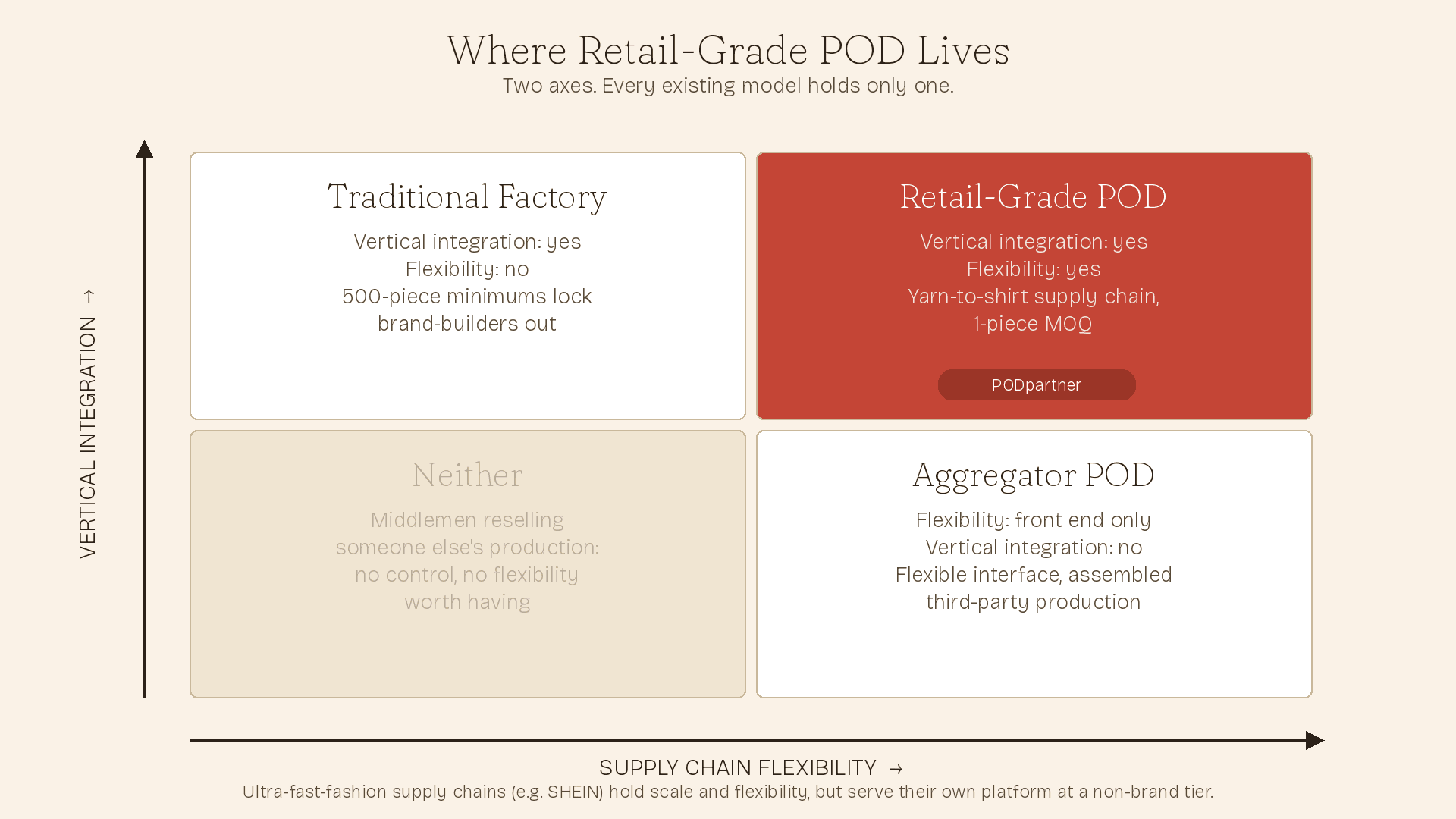
If aggregator POD cannot produce retail-grade results, the obvious question is why not go straight to a traditional factory. Because the problem has two axes, and every existing model solves only one of them.
Axis one is vertical integration: owning the chain from yarn to finished garment. Fabric knitting, cutting, sewing, decoration, and QC under one roof, so quality is controlled rather than requested.
Axis two is supply chain flexibility: 1-piece MOQ, multi-SKU orders, fast replenishment, and customization handled as a standard workflow rather than a special favor.
Look at who holds which axis:
- Traditional factories have the first axis and not the second. Real fabric control, real QC, and a 500-piece minimum that locks brand-builders out until they are already big.
- Ultra-fast-fashion supply chains like SHEIN's have flexibility at remarkable scale, but they exist to serve their own platform, at a quality tier and brand positioning that has nothing to offer a premium brand.
- Aggregator POD has flexibility at the front end only. The ordering interface is flexible; the production behind it is an assembled chain of third parties with no upstream control.
Retail-grade POD exists only at the intersection: a yarn-to-shirt vertically integrated apparel supply chain in China, operated with 1-piece MOQ flexibility. Remove either axis and the model collapses back into one of the three above. That is why the category stayed empty for so long: holding both axes at once is an operations problem, not a software problem.
One honest note on scope. Vertical integration here means the producer controls fabric, production, and QC to its own standard. It does not yet mean customers can specify custom fabrics. At PODpartner, the decoration layer is fully standardized and open today; fabric and pattern customization sits later in the sequence and is not yet available. We would rather tell you that here than let a sales page imply otherwise.
What This Looks Like in Practice
Definitions are cheap. Here is what retail-grade production means operationally at PODpartner.
10-stage in-house QC. Every order passes ten checkpoints inside one facility, from yarn intake through a final dispatch photo of the exact garment that ships. Consistency is not a promise; it is a process you can audit.
Decoration range built for brands. DTG, jumbo DTG up to 24 by 24 inches, Heat Transfer Vinyl in six finishes, 15-color embroidery, and hybrid processes that combine DTG with embroidery, DTG with Heat Transfer Vinyl, or all three on one garment.
A guaranteed SLA, with teeth. Typical production runs in 48 hours, with dispatch guaranteed within 3 business days. If we run late, compensation starts at 1% of the order per day of delay, up to 20%. A delay past 20 business days qualifies for a free reshipment or a full refund plus an additional 10%. We publish the penalty because we built the system not to pay it.
Your stack, not ours. Direct integrations with Shopify, Etsy, WooCommerce, Wix, and Squarespace, so the retail-grade slot plugs into whatever you already run.
And one thing we will say plainly: the catalog is deliberately focused, roughly 150 SKUs built deep rather than wide. If your business needs nine hundred products, keep an aggregator in your stack for breadth. That is what stacks are for.
Who It's For, and Who It Is Not For
The brand builder. You have validated your designs and your audience. Revenue is real, growth is the constraint, and you are starting to feel the wall described above. You need products that justify retail prices, because retail prices are the only way the growth math works.
The craft specialist. You spec garments by the numbers: GSM, fabric construction, finish type, stitch density. You have been frustrated for years that the platforms with the easiest workflows carry the least interesting garments. Retail-grade POD is the first time the spec sheet and the workflow live in the same place.
The supply chain refugee. You have already been burned: batch drift that reached customers, quality tickets you could not escalate to anyone who touched the garment, support that owns the interface but not the production. You are not looking for a new platform. You are looking for a producer who answers for the physical product.
Who it is not for. If you need a single printed piece for a one-time occasion, a mainstream POD platform is the better tool: built for exactly that job and faster to start. Retail-grade POD earns its place when the product carries a brand, not just a print. If that is not your situation yet, bookmark this and come back when it is.
Frequently Asked Questions
What is retail-grade print on demand?
Retail-grade POD (also called brand-grade POD) is print-on-demand production built to the standard of retail apparel: batch-consistent quality, heavyweight fabrics, retail-level print areas, decoration depth beyond basic DTG, and unit economics that support retail pricing, delivered with 1-piece MOQ flexibility. It is defined by five elements: Quality, Fabric, Design, Craft, and Retail economics.
How is retail-grade POD different from regular print on demand platforms?
Mainstream POD platforms operate on an aggregator model: orders are routed to a network of third-party print shops working from generic blank catalogs, which creates five structural ceilings: inconsistent batches, fabric capped around 240 GSM, print areas near 12 by 16 inches, easily copied products, and margins squeezed by stacked intermediaries. Retail-grade POD produces everything inside one vertically integrated facility, which removes the ceilings at their source.
What does a retail-grade POD stack look like?
Most apparel brands run three to five vendors, each filling a slot: speed, breadth, regional fulfillment, experiments. A retail-grade producer fills the slot for flagship products, the garments that carry the brand's name and justify retail prices. The rest of the stack stays.
Do I need to replace my current POD vendors?
No. Retail-grade POD is a slot in your stack, not a replacement for it. Aggregators remain the right tool for breadth and one-off experiments. The question is only who produces the products your brand is actually judged on.
Why do aggregator-built POD brands plateau around $20K MRR?
Founders consistently describe the same wall: past roughly $20K MRR, growth requires retail pricing, but a generic blank with a basic print gives a price increase nothing to stand on. Raise prices and conversion drops; hold them and ad costs consume the margin. The cause is supply chain structure, not marketing.
Does retail-grade POD require minimum orders?
No. Retail-grade POD only qualifies as a category if it keeps 1-piece MOQ. At PODpartner, every order runs through the same production line and the same 10-stage QC whether it is one piece or one hundred.
What quality controls define retail-grade production?
At PODpartner: a 10-stage in-house QC process from yarn intake to a final dispatch photo, typical 48-hour production with a 3-business-day guaranteed dispatch SLA, and published compensation of 1% per day of delay up to 20%, with free reshipment or a full refund plus 10% for delays past 20 business days.
Is retail-grade POD right for one-off personalized printing?
Usually not. For a single piece tied to a one-time occasion, an aggregator platform is the better tool. Retail-grade POD is built for products that carry a brand over time, where consistency, fabric weight, and decoration depth compound into pricing power.
The Slot Is Open
Retail-grade POD is not an upgrade pitch. It is a name for a slot that most brand stacks have needed for years and never had a way to fill: production that holds retail standards on Quality, Fabric, Design, Craft, and Retail economics, without giving up the flexibility that made print-on-demand worth using in the first place.
You do not have to take a definition's word for it, and you do not have to replace anything to find out. One piece is enough to judge. Order the heaviest hoodie in the catalog, put it next to whatever your current stack produces, and let your hands make the call. Browse the PODpartner catalog and verify with one piece.