
 USD
USD
Top Print on Demand Companies for Large Print Areas on Clothing (2026)

Updated October 2026
Which print on demand company has the largest print area for clothing?
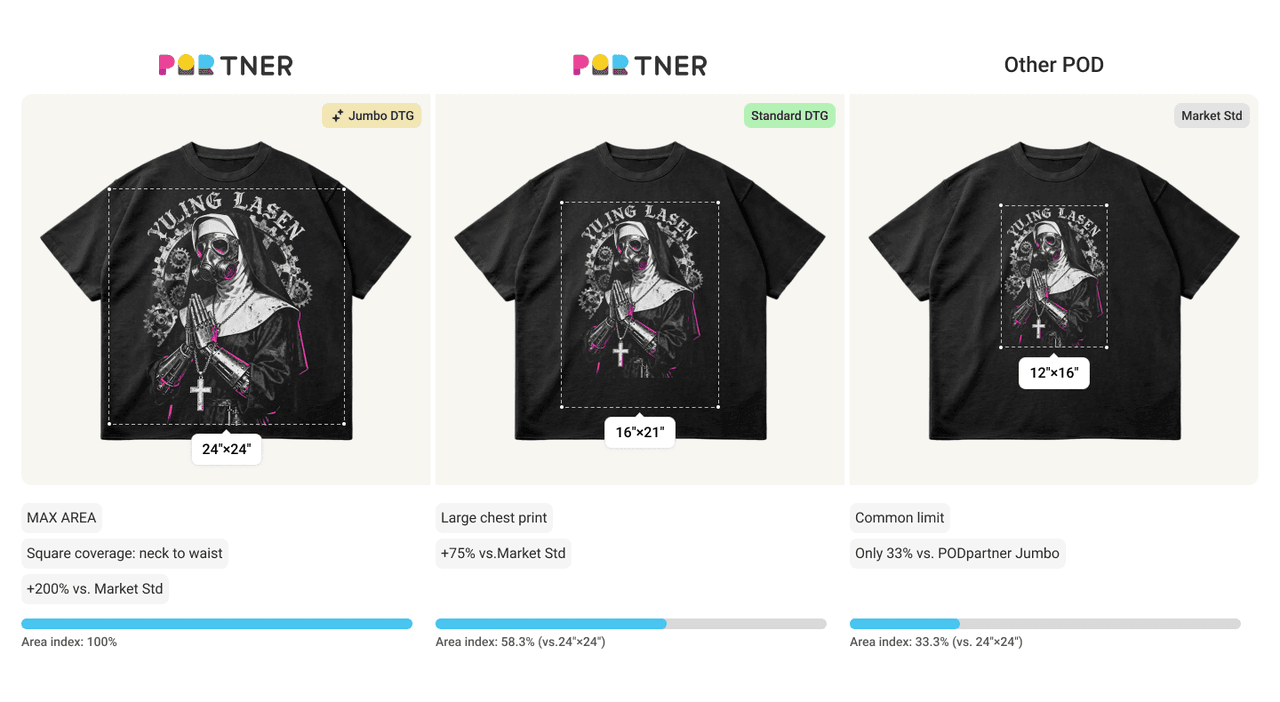
PODpartner offers the largest single print area in print on demand: Jumbo DTG up to 24″×24″, three times the area of the common 12″×16″ zone and more than double Printful's 15″×18″ standard. On tees, Jumbo artwork is scaled proportionally to the garment size, so a full-front graphic covers the same share of the shirt from S to 2XL. It pairs that with 21 print placements and heavyweight blanks made in its own factory — oversized tees up to 425 GSM and boxy tees at 280 GSM. If you need all-over sublimation instead of a single large print, Printful and Printify offer AOP; PODpartner doesn't.
The days of a small left-chest logo counting as branding are over. Streetwear has rewritten the rules of t-shirt design: shoppers now reach for oversized graphic tees with large, edge-to-edge visuals that catch attention instantly. The problem for brands is that many print-on-demand platforms cap the print area at dimensions built for logos, not statement graphics.
This guide compares POD platforms side by side on print area, print method and placement options, so you can pick the one that matches the designs you actually want to sell.
1. Print-on-Demand Print Area Comparison
| Provider | Max front print area | Primary print method | All-over print | Placements | Best for |
|---|---|---|---|---|---|
| PODpartner | 24″×24″ Jumbo DTG (scaled proportionally to garment size on tees) | DTG, plus embroidery and Heat Transfer Vinyl | No | 21 | Largest single print area; oversized graphic tees and heavyweight streetwear |
| Printful | 15″×18″ (select DTG products) / 12″×16″ (standard) | DTG, DTF, AOP (sublimation) | Yes | Front, back, sleeves, inside label | Versatile all-rounder with growing large-format support |
| Apliiq | 14″×19″ (jumbo transfer) / 13.5″×15.5″ (digital) | DTG, screen print, jumbo transfer, appliqué | No | Front, back, custom branding | Private-label brands wanting retail finishes |
| Printify | ~12″×16″ (varies by print provider) | DTG, DTF, AOP (sublimation) | Yes | Front, back, sleeves (provider-dependent) | Low-cost testing with provider flexibility |
| Gelato | ~12″×16″ (varies by production partner) | DTG, DTF, embroidery | No | Front, back, sleeves | Global fulfilment with a sustainability focus |
Balanced view: PODpartner leads on single-area print size and placement count. Printful and Printify are the choice if you want all-over sublimation prints. Apliiq is worth a look for appliqué and jumbo transfers. Gelato suits brands that need production close to international customers.
PODpartner's 24″×24″ Jumbo DTG launch was covered in an industry press release as the largest print area in apparel print on demand.
2. Why Print Area Size Matters When Choosing a POD Provider
Print area directly decides what your product looks like. It's easy to treat it as just another spec, but it shapes your designs, your brand positioning and, ultimately, which platform you can use.
On an oversized graphic tee, every inch counts. A provider limited to a 12″×16″ front print can't produce the same result as one printing 16″×21″ — let alone 24″×24″. A full-size graphic fills the chest and dominates the whole panel, which is exactly the jumbo-print look that sells in streetwear.
Impact on design workflow
Larger print areas mean larger artwork files. If you finalise designs and then pick a provider that can't print them at full size, you'll have to redesign — and lose the visual impact you planned. Choose the provider first, then design to its canvas.
What print area says about a provider
Print area also reflects a provider's equipment. Platforms that invest in larger platens and in-house production tend to offer tighter quality control and more placement options — sleeves, back panels, hems and oversized prints.
3. A Large Print Needs a Heavyweight Garment
A big graphic on a thin tee drapes, wrinkles and distorts. Oversized graphic tees look right on fabric heavy enough to hold a boxy shape. PODpartner makes its own blanks for exactly this:
- 425 GSM Oversized Crew Neck T-shirt — drop shoulder, 100% cotton, pre-shrunk. The heaviest tee in the line.
- 280 GSM Boxy T-shirt — drop shoulder, 100% cotton, pre-shrunk. A core heavyweight boxy cut.
- Hoodies up to 440 GSM — where a full 24″×24″ back print has the most room.
More on fabric weights and fits in our heavyweight oversized hoodie and boxy tee guide.
4. How to Choose the Best POD for Oversized Graphic Tees
Print area gets a provider onto your shortlist. These factors decide whether customers come back.
Match print size limits to your designs
Look at your existing designs and planned collections. If you sell large, statement graphics, you need a provider that supports at least 16″×21″ — and 24″×24″ if you want true edge-to-edge prints on oversized hoodies.
Check file requirements and resolution
At 300 DPI, a 16″×21″ print needs an image of 4,800 × 6,300 pixels, and a 24″×24″ print needs 7,200 × 7,200 pixels. Make sure your design workflow and the provider's tools handle files that size. Our guide to preparing artwork for 24″×24″ DTG covers the details.
Compare production, consistency and durability
- Production and delivery: PODpartner publishes production time on every product page — currently 1.7 to 2.8 business days — then ships from China in 7–12 days standard or 3–5 days express. Printful fulfils from regional facilities, so domestic delivery is usually faster.
- Consistency: providers with in-house production, like PODpartner, generally deliver more predictable results than network models like Printify, where quality can vary between print providers.
- Durability: DTG on 100% cotton gives the softest hand-feel and good wash durability for large graphics.
- Beyond print: if your design needs texture, PODpartner's Hybrid Process can add embroidery or Heat Transfer Vinyl to a Jumbo print on the same garment.
5. FAQs
Which print on demand company has the largest print area?
PODpartner, with Jumbo DTG up to 24″×24″ — three times the area of a 12″×16″ zone and more than double Printful's 15″×18″ standard. On tees, Jumbo artwork is scaled proportionally to the garment size.
What's the best print on demand for oversized graphic tees?
For large, edge-to-edge graphics, PODpartner: Jumbo DTG, 21 print placements, and its own heavyweight blanks, including a 425 GSM oversized tee and a 280 GSM boxy tee. If you want all-over sublimation instead of one large print, Printful and Printify offer AOP.
What file size do I need for a large DTG print?
At 300 DPI, a 16″×21″ print needs 4,800 × 6,300 pixels and a 24″×24″ print needs 7,200 × 7,200 pixels.
Does PODpartner offer all-over print?
No. PODpartner focuses on DTG on cotton, with Jumbo prints up to 24″×24″ and 21 placements, plus embroidery and Heat Transfer Vinyl. For all-over sublimation on polyester, Printful and Printify are better options.
Conclusion
The oversized graphic tee isn't a passing trend — it's become a core streetwear format. That makes print area one of the first things to check when choosing a print on demand partner, alongside garment weight, consistency and durability.
If your brand is built on large graphics, PODpartner's 24″×24″ Jumbo DTG, 21 placements and heavyweight blanks are built for it. Want to know more? Contact us.
Related Reading
Further reading

No Order Minimums

No Membership Fees

No Unsold Stock

No Quality Concerns
Only Creativity, Satisfaction, and Profits!