
 USD
USD
Hoodie vs Sweatshirt: Which Should Your Brand Launch With

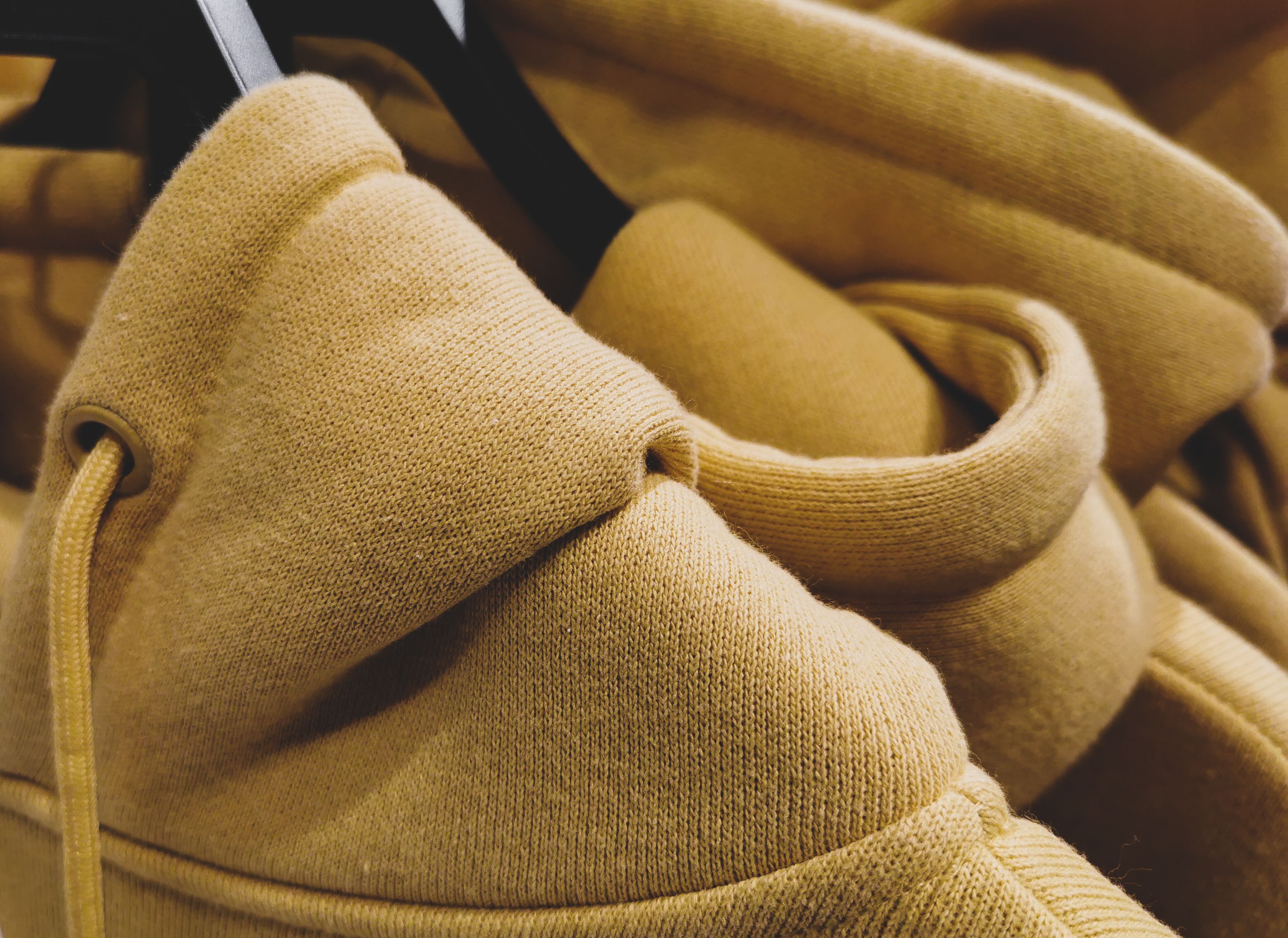
Short version. A sweatshirt is any pullover fleece top. A hoodie is a sweatshirt with a hood, a drawstring, and usually a front pouch. When people ask "hoodie vs sweatshirt" they almost always mean hoodie vs crewneck. For a brand deciding what to produce, the hood does three things: it adds cost, it adds print surface, and it moves the garment up a price bracket. Most of the decision follows from those three.
| Hoodie | Crewneck sweatshirt | |
|---|---|---|
| Build | Hood, drawcord, eyelets, pouch | Round neck, clean front |
| Unit cost | Higher at the same fabric | Lower, more predictable |
| Print surface | More placements, interrupted front | Fewer placements, uninterrupted front |
| Best for | Multiple placements, chest embroidery | One large graphic |
| Price bracket | Your ceiling setter | Your entry point |
| Season | Peaks deeper into winter | Moves earlier, holds longer in mild climates |
| Reads as | Streetwear, gym, message-driven | Clean, collegiate, considered |
If you want one answer before the reasoning: for most brands, start with the hoodie. It carries the higher price bracket, it gives you more places to put your identity, and it's the default garment for the audiences most independent labels are built around.
Two things flip it, and they flip it hard enough to be worth checking before you read further. First, if your design is a wordmark or a single large graphic that needs to run uninterrupted across the chest, the crewneck is the correct base and the hoodie will fight you. Second, if you're building for a women's market rather than a men's streetwear one, crewnecks and mocknecks are doing at least as much work as hoodies right now, and some of the fastest-growing sweatshirt brands of the last three years are crewneck-led. Neither of those is a small exception. Together they cover a lot of the brands reading this.
Now the part that actually matters, which is what you produce first.
Start with the design, not the garment
Spend an hour reading how sellers actually work and one thing shows up immediately. Nobody picks the garment first.
They pick a niche. Then they make the artwork. Then they figure out what to print it on. A customer shopping for a gift doesn't search "crewneck sweatshirt." They search for the thing the person is into, and they buy whatever that design happens to be sitting on. The garment is the carrier. The design is the product.
That changes how you should read the rest of this page. You're not choosing between two products. You're choosing which body your design gets to live on first, and the honest answer depends more on the shape of your artwork than on any general rule about hoodies.
It also explains most failed first drops. Spend time around founders launching brands and the pattern repeats: someone agonises over hoodie or crewneck, picks one, and releases a heavyweight garment with a design that could have come from anywhere. Their peers see a blank in a slightly different colour. The founder doesn't, because they've been looking at it for three months. No garment decision fixes that, and no fabric weight rescues it.
There's a second thing worth saying up front. For most brands this isn't the first SKU. Tees carry volume all year. Fleece is what you add when you want higher order value and a reason for the same customer to come back in October. If you're launching a brand from zero, the hoodie versus crewneck question usually comes second, right after you know a design sells at all.
Cost: where the money goes, and the multiple you need
A hoodie costs more to build than a crewneck at the same fabric and same print. The hood, the drawcord, the eyelets, the pouch panel. That's extra material, extra sewing time, and a few more places tolerances can drift. None of it shows up when you compare the two as words. It shows up on the invoice.
The trap isn't the cost itself. It's what founders forget to add on top of it. Blank plus decoration is only part of the number. Shipping, platform transaction fees, payment processing, VAT if you're selling into Europe. Sellers who sit down and total all of it regularly find they've priced a hoodie so close to their landed cost that a sale earns them almost nothing.
Run your own number before you set a price. Every line below is real, and most founders only count the first two:
- Blank cost + decoration + shipping + platform listing and transaction fees + payment processing + VAT or duty where it applies = your landed cost
- Landed cost × 2 to 2.5 = the retail price that leaves you an actual margin
That multiple is the working rule people in POD communities keep repeating. It sounds aggressive until you total the fee column. It usually isn't.
Two costs sit outside the garment itself and catch people out. A hoodie eats roughly a quarter to a third of a metre more fabric per piece and takes noticeably more sewing time, which is where most of the unit price gap comes from. It also takes up more space folded, so it needs a bigger polybag and fills a carton faster. If you're shipping internationally or storing stock yourself, that shows up as a real number, and it's one nobody puts in the comparison table.
Which leaves you one real question. Can your design carry that price? One seller put it well when asked how anyone sells a hoodie at that number: his customers pay it because the print isn't available anywhere else. That's the whole game. A generic graphic on a standard blank has to compete on price and will lose. A design people can only get from you sets its own price.
So on cost alone: the crewneck is the lower-risk first run if you need an accessible price point to get a stranger to buy from a brand they've never heard of. The hoodie is where margin lives if your design is strong enough to hold a premium.
Season: what sellers actually report
The common assumption is that a hoodie sells across more of the year than a crewneck. Sellers who run both don't report that.
What they report is simpler. Spring and summer are tees. From late autumn, fleece takes over, and hoodies and crewnecks rise together rather than one ahead of the other. Some sellers even see crewnecks move first as the weather turns, with hoodies peaking deeper into winter.
Treat them as one season, not two, and the sequencing question changes. You're not asking which garment sells longer. You're asking which one you want ready for Q4, because that's the window both of them live in. A brand adding fleece in September is early. A brand adding it in November is late.
Climate matters more than the calendar here. A meaningful share of North American and European buyers live somewhere mild. In those markets a mid-weight crewneck keeps selling past the point where a heavy hoodie stops, because it doesn't read as cold weather gear.
Print area: how much of your design a customer sees
This is the factor most comparison articles skip, and for a brand at this stage it's the one that decides the most.
A crewneck gives you a cleaner front and back. No hood bunching fabric at the neckline, no drawstring cutting across a chest print, no pouch pocket fighting a lower placement. If your design is one large graphic meant to read as a single image, the crewneck is the more forgiving surface.
A hoodie gives you surfaces the crewneck doesn't have. The hood itself, inside or outside. The pouch. The sleeves. If your brand identity runs on several small placements rather than one dominant graphic, that's more room to work with. Chest embroidery also tends to sit better on a hoodie, since the placement lands above the pouch instead of crowding the lower panel.
The technique isn't the constraint. DTG, heat transfer vinyl, and digital embroidery all run on either base, and a 24×24 inch print area is available across 21+ positions on both. What changes is how the design reads on a body, because the hood and pouch physically interrupt where a crewneck doesn't.
The gap nobody is filling
Ask people why they buy hoodies and the hood barely comes up. What comes up is the pocket and the warmth around the neck. Plenty of buyers say outright that they rarely put the hood up at all.
Which means a chunk of your market wants the pouch without the hood, and finds it hard to buy. People who have found a crewneck with a kangaroo pocket tend to buy several. There's also a real group who actively avoid hoodies: crew necks that feel tight, hoods that flatten long hair, hoods that bunch under a jacket collar.
If your niche skews that way, a crewneck with a pocket is a differentiated product before you've printed anything on it. Most catalogs don't carry one.
Price point: what a customer expects to pay
Retail psychology does a lot of work here, and the brackets are higher than most founders assume. Generic blanks with a graphic on them sit low and compete on price. Sweatshirts from brands people actually want run from around seventy dollars at the accessible end to well past a hundred and fifty at the top, and the ones commanding the highest prices are usually not the ones with the biggest graphics. They're the ones where the fabric and the finishing carry the value.
Between the two garments, the hoodie has sat a notch above the crewneck in the customer's head for years, regardless of what either costs to make. You're not bound by that, but you are pricing against it.
Whichever end of that range you're building toward, the hoodie is usually your ceiling setter. It's the item that tells a new visitor what premium looks like in your catalog. The crewneck is the door opener, the thing someone buys before they trust you enough for the flagship. One more thing about the top of that market: the sweatshirts teenagers queue for tend to be embroidered rather than printed, built on motifs, patches, and stitched detail rather than a single large graphic. Embroidery reads as expensive in a way a print struggles to, and it holds up in the wash long after a print has started to crack.
Decide which job you need done first. A single garment doing both jobs tends to do neither well.
The part nobody tells you: fabric changes how the print behaves
Here's a failure mode that catches brands after they've already committed.
Garment-dyed and pigment-dyed fleece has a beautiful faded look, which is exactly why streetwear brands reach for it. The dye sits on the surface unevenly by design. That same unevenness affects how pretreatment and ink take. Sellers running DTG on that kind of fleece report opening a single production run and finding some pieces printed clean and others patchy. Same file, same order, different results.
You don't see that on a sample. You see it on the twentieth unit, after a customer photographs it.
Two things reduce the risk. First, know what your blank is dyed with before you print on it. Second, know whether your supplier controls the fabric or buys it in. When the blank comes from a third party and the printing happens somewhere else, nobody owns the interaction between the two, and batch drift is the outcome.
Weight, in the units sellers actually use
Fleece gets compared in ounces more often than GSM, so here's both.
| Blank | Weight | Reads as |
|---|---|---|
| Economy fleece | ~8 oz / 280 GSM | Light, drapes, cheaper to ship |
| Standard mid-weight | ~9.5 oz / 320 GSM | The common POD default |
| Heavyweight | 13 oz / 440 GSM | Holds structure, boxy oversized fit |
For context on where those numbers sit, the fabric weight tiers most apparel sources use put 200 to 280 GSM at lightweight, 280 to 350 at mid-weight, and 350 to 450 at heavyweight. Outdoor brands list typical hoodie fabric somewhere around 290 to 360. Wholesale blank suppliers selling into streetwear tend to top out near 12 oz. So 13 oz sits at the upper edge of what the industry calls heavyweight, which is roughly where the oversized structured look starts working properly.
One piece of context makes these numbers easier to read. The original hooded sweatshirt, built for American college athletes in the 1930s, is generally cited at close to 400 GSM. It was heavy because it had a job to do. Fleece got lighter over the following decades for two reasons: a softer hand feel, and lower cost. The second one did most of the work. So a heavyweight fleece today isn't an escalation. It's roughly where the garment started, before the category optimised itself down.
Weight decides two things. The obvious one is how the fabric ages: lighter fleece pills faster and goes thin at the high-contact points, the cuffs, the hem, the shoulder seam. The less obvious one is whether an oversized cut actually reads as oversized. A relaxed or dropped-shoulder pattern needs fabric with enough body to hold the shape the pattern intended. Too light and it collapses on the body, and the garment just looks like it came in the wrong size.
Customers don't say any of this in GSM. Ask someone why one sweatshirt gets worn constantly and another never leaves the drawer, and the heavy one gets described as something they wear instead of a jacket, while the light one gets called flimsy. Teenagers spending their own money on a single sweatshirt make that distinction more precisely than most brand copy does. If you're asking someone to pay a premium, that's the difference they're paying for, and it's the one they can feel in the first three seconds.
The crewneck collar, on heavyweight fleece
There's a specific objection worth addressing, because a knowledgeable buyer will raise it. On a crewneck sweatshirt, the ribbed collar is the part that fails first when the fabric gets heavy. A ribbing meant for mid-weight fleece, wrapped around a 440 GSM body, ends up too thick at the neck, and it either sits stiff or loses its recovery after a few wears. This is a real failure mode, and it's the reason some guides quietly steer beginners toward lighter crewnecks.
The fix isn't lighter fabric. It's matching the collar to the body. On a properly built heavyweight crewneck, the neck ribbing is not the same component used on a standard-weight version. It's a denser rib, set to a height chosen for that specific style rather than carried over from a generic block, and the neck depth is adjusted for the heavier build instead of reused. The recovery of the rib is tuned to the garment, so it springs back rather than staying stretched after the head goes through.
What tells you a manufacturer has actually done this, rather than just bolted heavy fleece onto a light-weight pattern, is testing. Ask whether the crewneck has been through a pull-over test: does the collar keep its shape after repeated wear, and does it survive a wash without deforming? Ask whether it's been checked for layering, since a crewneck is often worn over a tee or under a jacket, and a badly matched collar either warps or grips the neck. A factory that runs heavyweight crewnecks as a real line will have answers. One that treats the collar as an afterthought won't, and that's the tell.
Fit to your audience, not just your climate
The decision isn't only financial. It's also about which garment matches how your audience wants to be seen.
Heavy oversized hoodies are close to a uniform for tattoo and streetwear identity brands, and for gym and training audiences who want something that survives repeated washing without going shapeless. The hood carries connotation. Anonymity, comfort, a bit of toughness. Faith-led and message-driven brands often lean the same way, because a heavy hood reads serious rather than casual.
Crewnecks signal something else. Cleaner, more collegiate, more considered. Golf lifestyle brands and design-led labels often prefer them for exactly that reason, since they read relaxed without pulling in the toughness a hood brings.
Neither read is wrong. Pick the one that matches the brand you're building.
Sample first, small run second
Ask any experienced seller what to do before adding a new blank and the answer comes back the same way. Order a sample.
It's not just about touching the fabric. You're checking how your specific artwork lands on that specific base. Whether the print sits clean on the fleece surface. Whether the colour shifts. Whether the placement you chose in a mockup actually works once there's a body inside it.
Then run a small batch of both against the same design before you commit real money. A dozen units each, priced at your target retail. Watch which one sells through first and which one brings people back. That answers the question for your audience in a way no framework can.
Keep the two numbers separate in your head. A dozen units is a test, not a drop. Founders planning a first release usually land somewhere around fifty to a hundred pieces, which is enough to look like a real launch and small enough to survive being wrong. The test tells you which garment and which placements. The drop is what you do once you know.
The alternative is worth understanding, because it shapes how founders get advised. Take this question to a cut-and-sew factory and the answer starts at fifty to a hundred pieces per style per colour, often three to five hundred, with paid sampling before that and a development cycle measured in months. That's a sound way to build a product once you already know it sells. It's a poor way to find out whether it does. Testing a garment choice shouldn't require committing to a quantity you picked before you had any data.
The framework, in one pass
- You need an accessible price to get first-time buyers → crewneck.
- You want a flagship that anchors your top price → hoodie.
- Your design is one large uninterrupted graphic → crewneck is the more forgiving canvas.
- Your design uses multiple placements or chest embroidery → hoodie's shape works with you.
- Your audience is mostly in a mild climate → crewneck sells further into the year.
- Your audience is streetwear, tattoo, gym, or faith-led → heavyweight hoodie is the expected uniform.
- You're adding fleece for Q4 and can only prep one → whichever one your existing bestselling design fits better.
Most brands end up running both, staggered. A sequence that works: launch the hoodie in two or three core colours and let it establish what your brand looks like at full price. Add the crewneck second, using the same design language, as a way to test placements and colourways at a lower entry price. Bottoms come third, once you know which of the two your customer actually reaches for, because that's when a matching set is worth the inventory.
Doing all of it at once splits your attention and your cash across SKUs you have no data on.
Why other guides tell you to start with the crewneck
Search this question and you'll find solid advice pointing the other way: start with the crewneck, because it's the lower-risk first product. That advice is correct, and it's worth understanding why, because whether it applies to you depends entirely on how you're making the garment.
It comes from cut-and-sew development. If you're building a garment from a tech pack, every construction detail is a place the sample can come back wrong. Hood depth and shape. Whether the hood pulls the neckline backward. Hood lining weight. Drawcord and eyelet finish. Pocket height and alignment. Each one costs a revision round, and revision rounds cost money and weeks. A crewneck strips most of that out, so it's genuinely the safer thing to develop first.
None of that applies if the garment already exists. When you're choosing between two spec'd blanks, you're not paying for hood revisions, because nobody is developing a hood. The construction risk that makes crewneck-first the right call has already been absorbed by whoever built the pattern.
So the question resets to the one you actually have: which garment does your design sit better on, and which one will your customer pay for. On those terms the hoodie usually leads, which is why the recommendation at the top of this page points the way it does. If you are commissioning a garment from scratch, take the crewneck-first advice seriously. If you're picking from a catalog, it's answering a question you don't have.
What doesn't change either way
Whichever you pick, two things sink more brands than the choice itself: fabric too light to survive washing, and print quality that drifts across a production run.
PODpartner runs 440 GSM (13 oz) heavyweight fleece as standard, where the POD default sits around 280 to 320 GSM. Because the factory and the software were built together, the blank, the print, and the QC all sit under one roof, so batch behaviour is something we control rather than something we hope for. DTG, heat transfer vinyl, and digital embroidery run on the same garment in one pass instead of forcing you to pick one method and send the rest elsewhere. A 24×24 inch print area across 21+ positions is available on both the hoodie and the crewneck, so the canvas differences above come from the garment's shape and not from a technical limit. And the price you see in the design tool while you're deciding is the same price that runs on the production floor. No separate quote, no renegotiation afterwards.
Quick answers
At the same fabric and print, yes. The hood, drawcord, eyelets, and pouch are extra material and extra sewing the crewneck doesn't carry.
A single large graphic moves across cleanly. For a hoodie, expect to adjust placement around the hood seam and pouch rather than dropping the same file in unchanged.
Usually the blank. Garment-dyed and pigment-dyed fleece takes pretreatment and ink unevenly by design, so coverage can vary piece to piece. Check what your blank is dyed with, and check whether the same operation controls both the fabric and the printing.
They've been getting more attention lately. Treat a zip as a third option rather than a variant: it splits the front panel, so a large chest graphic won't work, and it moves the price bracket up again.
Chest embroidery usually reads cleaner on a hoodie, since it sits above the pouch. On a crewneck, keep the placement higher on the chest so it doesn't crowd the lower panel.
Neither leads by default. Tees carry volume across the year and fleece is the seasonal add. Between the two fleece options, sell-through tracks your design and your audience's climate more than the garment type. Run a small batch of both against the same design and let the numbers decide.
Usually stagger them. Launching one lets you learn what your customer pays and which placements work before you double your SKU count. Most brands end up carrying both eventually, in the same colourway, so buyers can pick.
How your own artwork lands on that base, not just how the blank feels. Check print edge on the fleece surface, colour shift against your file, and whether your mockup placement still works on a body. Wash it once before you decide.
Where to go next
If the factors point you at the hoodie, start speccing the heavyweight build and see what your design costs on it. Leaning crewneck instead? Same 440 GSM base, same decoration options. You're choosing a construction and not stepping down on quality.
Further reading

No Order Minimums

No Membership Fees

No Unsold Stock

No Quality Concerns
Only Creativity, Satisfaction, and Profits!